A fairly short chunk of the path; I was intending to go a bit further, but the sun went in and I wasn’t really enjoying it much so I hopped on the tube at Westminster. Still, if you use one of the traditional definitions of a city—a town with a cathedral—this section includes the three medieval cities at the centre of London; it starts by Southwark Cathedral, goes past St Paul’s and ends at Westminster Abbey.
Just to explain that, because I guess not everyone knows the history of London: the royal court and the government was based at Westminster, separated by about a kilometere of fields from London, the mercantile and legal centre where all the law courts and guilds were based. The dynamic between the two is quite interesting, I think: London had a lot of legal autonomy (and indeed money) so even in the days of apparently absolute monarchs the balance of power was less clear cut than you might think. To this day when the Queen goes to St Paul’s for some kind of ceremonial function, her coach stops at the boundaries of the City of London and she asks permission to enter. As a South Londoner it pains me to say it, but Southwark wasn’t really much more than the overflow from London over London Bridge, although because of some kind of legal quirk that meant it wasn’t under the jurisdiction of London it became the centre for bear pits, whorehouses, theatres and similarly disreputable trades. Which is why The Globe was there.
That distinction between the mercantile City of London and Westminster as the seat of government has persisted, of course: we even still refer to ‘The City’ as shorthand for the banking and financial services sector and ‘Westminster’ as shorthand for parliament and government. I find these echoes of the longer history of London interesting because so little physically remains. The Great Fire of 1666 really did burn down nearly the entirety of medieval London. Much of it would no doubt have been knocked down anyway, whether by the Luftwaffe, town planners or commercial developers; but even things like the churches, which might normally offer that kind of continuity, were lost. And most of the Palace of Westminster burnt down in the C19th as well, so that was another major medieval building lost. There are still a few left: Westminster Abbey, Southwark Cathedral, the Tower of London, the Guildhall. But there’s no part of London you can visit and feel you’re in contact with what the city was like. The oldest part of the city is a business district, so it’s all office buildings. All that’s left is the street names: Old Jewry, Cripplegate, Milk Street, London Wall, Blackfriars, Hosier Lane, Carmelite Street.
What’s amazing is that London and Westminster remained separate up until about the mid C18th. So it took about 700 years for London to spread the one kilometre westwards to reach Westminster; but in the next 150 years it spread something like 10 km in all directions.
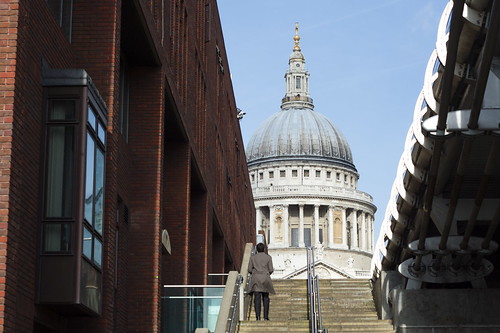
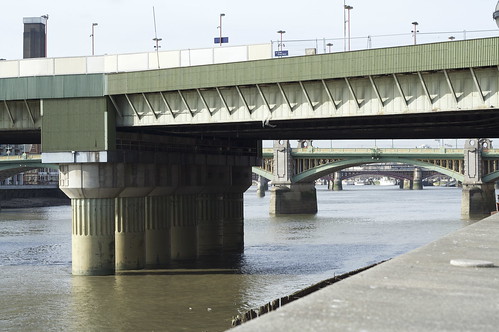
Anyway, you may be wondering why I’m wittering on about the history of London instead of talking about the actual walk. It’s because I didn’t find it very interesting. I decided to walk the north bank because I more often go along the southern side, because of Tate Modern, the South Bank Centre and so on. There quite a few theoretically interesting things to look at: war memorials, the Millennium Bridge, Cleopatra’s Needle, a glimpse of St Paul’s and a couple of the Christopher Wren city churches, as well as views of Tate Modern, Shakespeare’s Globe, the South Bank Centre, the London Eye, the Oxo tower. And just at the end, Big Ben and Portcullis House. But it’s all very familiar; and the path goes past the City and the West End without actually having much contact with them.
It doesn’t help that if you’re walking the north bank in winter, the light is coming from over the river all the time. So everything on the other side of the river was backlit and dificult to photograph; and I really need a wider-angle lens to take pictures of buildings near me.
» Once again I’ve added the pictures to my Thames Path set on Flickr; these ones are tagged with thamespath3.