Categories
Nature

Harry’s advent calendar of birds, day 24: Robin

No surprise in the final bird on the advent calendar. Or at least, no surprise for my British readers; robins probably appear on more Christmas cards here than Jesus.
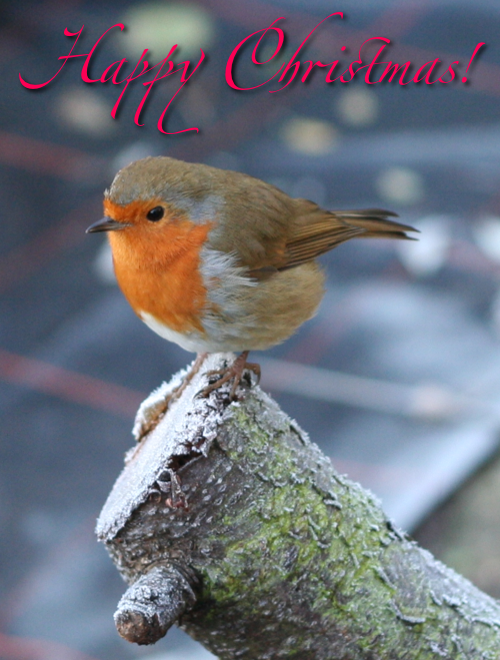
In fact, the robin is so deeply linked to Christmas that it’s slightly surprising to remember other countries don’t have the same association. Some of them have the excuse that they don’t actually have any robins — and no, Americans, your so called ‘robins’ don’t count — but the same applies to other European countries.

It’s not completely clear where the connection came from. It’s relatively recent, as folklore goes; at most back to the eighteenth century, and it became really well established in the nineteenth, as Christmas cards became popular. One suggestion, according to Birds Britannica, is that Robin was a nickname for Victorian postmen, who had red uniforms; so the birds often appeared on Christmas cards carrying envelopes in their beaks. Or perhaps it’s because they sing through the winter.

Christmas aside, they are very popular birds; they are famously tame around people, hanging around gardeners looking for worms. Apparently they actually evolved this behaviour in association with wild boar, which they would follow through the forest in much the same manner. I guess there are worse things to be than a substitute boar.

Happy Christmas, one and all.
Categories
Nature

Harry’s advent calendar of birds, day 23: Partridge

I’ve been baking a ham, wrapping presents, and listening to cheesy Christmas music today, so let’s plough on with the Christmas clichés.

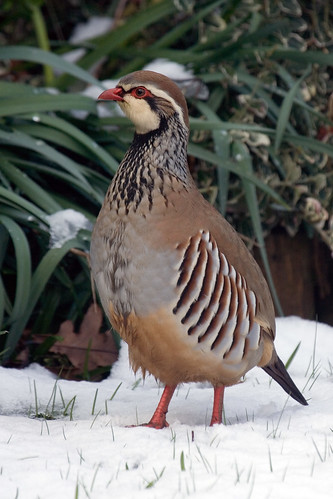
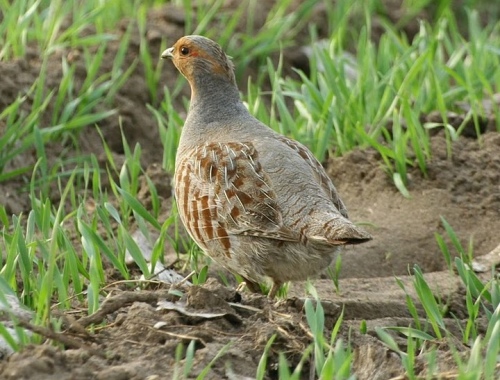
I’ll skip the seven swans a-swimming, the six geese a-laying, four colly-birds, three french hens and two turtle doves; but here’s a partridge:

It’s not in a pear tree because, apart from anything else, it would be very unusual to see a partridge in any kind of tree.

The partridge above is the Grey Partridge, Perdix perdix, which is native to the UK, as well as much of the rest of Europe. So that’s probably the partridge in the song, although according to Wikipedia the song came from France, so perhaps it was about the Red-legged Partridge — which also came from France. The song dates to 1780 in English, and the first breeding record of RLP is 1770, so they could even have been introduced together… though probably not.

People have all sorts of reasons for introducing birds to countries where they aren’t native, but not surprisingly, species which are good for hunting and eating are one popular choice.

The Red-legged Partridge is still known to hunters in the UK as the ‘French Partridge’, and even after 200 years we still think of it as an introduced species. But it’s not the only introduced game animal; the pheasant, the rabbit and the fallow deer are all so well established as to seem like native species, but the (originally Asian) pheasant was brought by the Romans, and the Normans brought us fallow deer and rabbits.

Here’s some good stuff from Wikipedia about variant versions of the song:

France

In the west of France the piece is known as a song, “La foi de la loi,” and is sung “avec solennite,” the sequence being: a good stuffing without bones, two breasts of veal, three joints of beef, four pigs’ trotters, five legs of mutton, six partridges with cabbage, seven spitted rabbits, eight plates of salad, nine dishes for a chapter of canons, ten full casks, eleven beautiful full-breasted maidens, and twelve musketeers with their swords.

Scotland

In Scotland, early in the 19th century, the recitation began: “The king sent his lady on the first Yule day, | A popingo-aye [parrot]; | Wha learns my carol and carries it away?” The succeeding gifts were three partridges, three plovers, a goose that was grey, three starlings, three goldspinks, a bull that was brown, three ducks a-merry laying, three swans a-merry swimming, an Arabian baboon, three hinds a-merry hunting, three maids a-merry dancing, three stalks o’ merry corn.

That French version sounds like a recipe for one hell of a Christmas party.

» Photo Credits: Grey Partridge (Perdix perdix) is © Tomasz Kulakowski and used under the CC by-nd licence. Partridge in Snow 2 is © Keith Marshall and used under the CC by-nc-sa licence.

Categories
Nature

Harry’s advent calendar of birds, day 22: Spotted Nightjar

I’m going out on the razz this evening and I have things to do; presents to wrap, cats to give pills to, ummm… that might be it. But anyway, here’s a quick one, a lovely picture of a Spotted Nightjar and chick which I found on Flickr:

Cryptic camouflage designed to help birds hide can be just as beautiful as flamboyant plumage used to attract mates.

» Photo Credit: There are two nightjars is © Brent Barrett, and used under the CC by-nc-nd licence.

Categories
Nature

Harry’s advent calendar of birds, day 21: Raven

My computer shows signs of being on its last legs, so here’s an avian omen of death. In Anglo-Saxon poetry, in the build-up to a battle, three animals — the eagle, the raven and the wolf — turn up in an ominous foreshadowing of the bloodshed to come.

I’m pretty sure this literary trope didn’t arise from symbolism or metaphor, but from simple observation. Animals don’t need to be that clever to work out that following an army is a way to find meat.*

And ravens are actually pretty smart. Crows and parrots are the cleverest of birds, capable of problem-solving, playful and inquisitive.

Perhaps that’s why Odin had two ravens, Huginn and Muninn (‘thought’ and ‘mind’), which flew around the world each day, gathering information for him.

And North American folktales raise the raven even further, into the spirit who created the human world; but also a trickster, capricious and dangerous.

That’s my kind of creator: a raven creating the world out of boredom and mischief. That’s the trouble with Christianity; I guess I can live with a a god who is all-knowing and all-powerful, but does he have to be so damn pious?

* Even when there wasn’t human flesh available, there would be scraps of rubbish to pick at. It has been suggested that dogs were not intentionally domesticated by people; wolves domesticated themselves by switching to a diet of scavenged rubbish and becoming associated with human settlements.

» Photo Credits, from top to bottom: Common Raven (Corvus corax), © Derek Bakken, used under the CC attribution licence; Raven, © Atli Harðarson, used under the by-nd licence; Common Raven, © Paruula, used under the by-nc-sa licence.

Categories
Nature

Harry’s advent calendar of birds, day 20: Hawfinch

I sometimes dream about birds. Particularly, I dream about rare birds turning up suddenly in my garden.

And my subconscious aims high; I dream about mixed flocks of parrots and hornbills which, in dream-logic, have been caught up in some extraordinary freak weather system and blown from all corners of the world to turn up together in suburban London.

These are nice dreams, I suppose, but they also carry a whiff of anxiety. The panicky feeling of trying to find and positively identify an exciting new bird, which, being a bird, is liable to fly away.

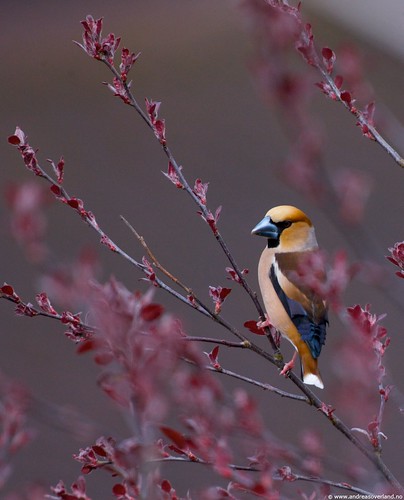
I remember three birds from last night. There was some kind of pipit with a yellow flush along each side of a strongly streaked breast. There was a large, black and white booby which was flying against a window with the mechanical aimlessness of a badly-programmed computer game character that reaches a wall and just keeps walking on the spot. And there was one identifiable species; a hawfinch:

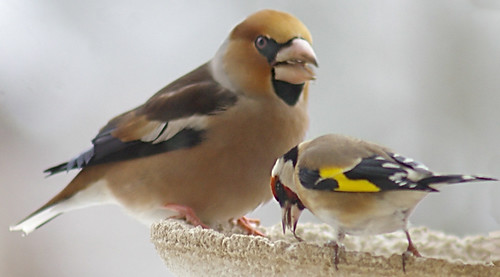
A booby turning up in my garden would be preposterous. A hawfinch would just be staggeringly unlikely; they do breed in Britain, and they clearly come to birdtables in some places:

Look at that beak, big enough to crack open cherry stones. What a bird.

» Hawfinch is © Andreas Øverland and used under the CC Attribution licence. Hawfinch 3 is © Max Westby and used under the CC by-nc-sa licence.

Categories
Nature

Harry’s advent calendar of birds, day 19: Magpie Shrike

Just a quickie, since I’m catching up with myself; the Magpie Shrike:

» The 3 watchers, © Marc Dezemery, is used under the CC by-nc-nd licence.