Categories
Other

Criced!

That’s ‘cricket’ in Welsh, since the first Ashes test is being held in Cardiff. Assuming the rain holds off long enough for them to play, that is: it’s certainly not very promising in London, but of course it hardly ever rains in Wales.

Come on, England.

Categories
Other

Yay for Twenty20 cricket.

I’ve really been enjoying the Twenty20 World Cup, and the more I see of twenty-over cricket and the more it matures as a game, the the more I think it’s a brilliant invention.

Someone has finally invented a form of the game where every ball is interesting. Before it started, the assumption was that T20 would be all about sixes; but it’s equally true that it’s all about dot balls. I mean really, a form of cricket where a dot ball is an exciting event: it’s a fucking miracle.

And I love the fact that it legitimises six-hitting. Even Test-cricket purists love to see big sixes. But really, in Test cricket, it’s a self-indulgent shot; the shot of a show-off. You can argue, perhaps, that it’s a valuable weapon in the psychological battle between bowler and batsman; and there are a few situations, like hastening a declaration or when a batsman is running out of partners, where it makes more sense; but the honest truth is that usually the extra two runs are just not worth the risk.*

In 20 over cricket, though, where run rates are so important, it is an entirely reasonable calculated risk. Even in Twenty20 there’s a risk of overvaluing sixes; it’s noticeable that the most successful batsman of the tournament, Tillekeratne Dilshan, is not a big six-hitter, and has racked up most of his runs as fours. But it is certainly a legitimate shot, and as a supporter you can just enjoy the spectacle, without that queasy sense that it’s all about to go pear-shaped.

Don’t get me wrong, I love the different pleasures of Test cricket. Admittedly, it can be the most tedious game in the world. But at its best, the slowness of Test cricket is its great strength. It’s the gradual ratcheting up of tension, the shifting balance of bat and ball, the psychological endurance needed for a long innings. At its best it doesn’t just produce exciting moments, it produces engrossing passages of play that develop over an hour or an afternoon — which is why it never works that well as highlights. It’s seeing the batsman playing and missing over and over, the ball whistling past off stump, that creates the atmosphere for the release of tension when the batsmen hits a beautiful straight drive for four — or the bowler sends the off stump cartwheeling.

But if we are going to have a short form of the game, then let’s get rid of the fifty over game, which is neither one thing or the other, and so often drifts towards a result which is entirely predictable with twenty overs to go.

And incidentally, if there were ever two countries who were in need of a bit of light relief to distract them from the more dismal realities of their domestic politics, it would be Pakistan and Sri Lanka. So let’s hope for a great final.

* Kevin Pietersen has played the same number of tests, 52, as Don Bradman; Bradman scored six sixes, KP has scored 48. Bradman converted 70% of his 50s into centuries and 29% into double or triple centuries. KP has converted 53% of his 50s into 100s, which is actually pretty good, but only scored one double hundred. Admittedly, comparing anyone to Bradman is a bit harsh. But still.

» The photo, Brooding sky @ the cricket, is © Mark Elkins and used under a CC by-nc licence. I suppose it’s a bit odd to illustrate the post with a shot of the groundstaff preparing the pitch instead of the actual play, but I liked the shot.

Categories
Other

Financial pandemic

During the most dramatic paroxysms of the banking sector last autumn, they kept saying, in the media, that this was the worst financial crisis since the Great Depression. But I think a lot of people (like me, initially) heard that as: the worst economic crisis since the Great Depression.

And the thing is, they were using the terminology correctly. It was a very serious crisis of the financial system — that is, a banking crisis. And it was the worst one since the Depression. But it was not then and is still not (yet) the worst economic crisis since the Depression. So, assuming I was not the only one who misunderstood, there was a disconnect between what they were saying and what their audience were hearing.

swine-flu

I think the same thing is going on with the swine flu. The WHO have just raised the alert level to five on their scaring-the-shit-out-of-everyone scale, meaning that they fear a pandemic is ‘imminent’. The trouble is that when I hear the word ‘pandemic’ I think ‘Spanish Flu!’ or indeed ‘Black Death!!’. Death and devastation on a vast scale. Tens of millions dead.

Whereas what the WHO means by pandemic is something like ‘international outbreak of serious infectious disease’. A major public health event, but not necessarily with quite the overtones of The End Of Days. For example, I was surprised to learn that there have been two serious flu pandemics since 1918 — the Asian flu in 1957-8 and the Hong Kong flu in 1968-9. They both killed about a million people, so I don’t want to downplay them too much, but it’s not exactly the Black Death. Apparently something like 34,000 die from flu in the US in a normal year, and the Hong Kong flu killed about 34,000, so it was effectively an extra flu season.

Categories
Other

Let them eat farls

More gloomy news from Northern Ireland. I can’t tell you how depressing it was a few weeks ago to be woken by Radio 4 reporting on the terrorist attack that killed two soldiers in Northern Ireland.

Because really, if you’d asked me to pick one unambiguously good news story from my time on earth, I’d have said the ending of violence in Northern Ireland. I grew up with bombs going off regularly in London; it wasn’t an unusual experience to go up to Oxford Street to do your Christmas shopping, and find a whole chunk of it roped off because of a bomb scare. And there seemed to be no end in sight: the conflict had been going on in its modern form for decades and in one way or another for centuries. It was a poisonous mixture of politics, identity and religion, weighed down by centuries of historical baggage, and there seemed to be no common ground to serve as a starting point for compromise.

For all the frustrations and messiness of the ‘peace process’, it still seemed miraculous that we had reached a point where the British Army was no longer on active duty in Northern Ireland, no-one was blowing anyone up, and the conflicts were being resolved via something like normal politics.

And so, on top of all the other bad news, to wake up to the news of that particular wound being re-opened… bleargh. I wouldn’t want to overstate the importance of what has happened so far; by historical standards the murders of two soldiers and a policeman are fairly minor incidents. And it’s a sign of how far we’ve come that Martin McGuinness of Sinn Féin condemned the attacks standing next to the head of Northern Ireland’s police force and someone from the DUP. But it’s a depressing reminder that the underlying causes of the conflict are still there, and that we’re a long way from being able to say that it’s all over.

It may not be a coincidence that the peace process coincided with Ireland’s period as the Celtic Tiger, the great economic success story of Europe, and that the re-emergence of violence comes with the bursting of the Irish housing bubble and the collapse of their economy. That happened in the Republic of Ireland, not Northern Ireland, but their politics are intertwined. And Northern Ireland has been particularly badly hit by the recession, apparently, because of its ‘large exposure to the construction sector’.

One more reason to hope, against all the evidence, that the G20 can somehow get the world economy started again.

Categories
Other

Sad cat news

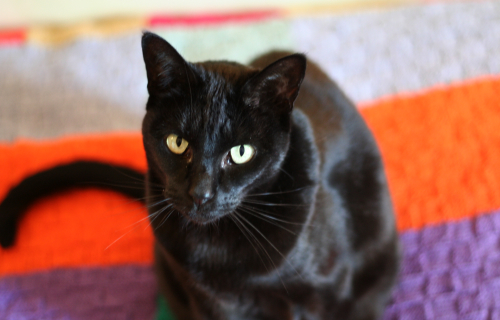
The vet came round to put down one of the cats yesterday.

img_2121

Posy big green eyes and the softest fur of any cat I’ve ever met, and huge scary claws that she only ever stuck into human flesh accidentally.

She had a tiny voice, not so much a meow as a mi.

She didn’t show any interest in meat or fish, but she did like blue cheese and prawns.

She didn’t like being picked up, and had limited tolerance for being stroked, but if she was curled up on the bed and you rested your head on her like a pillow, she would purr and purr. And then, once you lifted your head again, she’d methodically wash off any trace of contact.

She led a largely sedentary lifestyle, but when the mood took her she had a truly extraordinary turn of speed.

She brought in less prey than the other cats, but she did hold the house record for rarest catch: a big fat Convolvulus Hawkmoth, which is a rare vagrant in Britain.

She was a lovely cat.

Categories
Other

How to reform the FA Cup

My solution to the periodic handwringing about how to make the FA Cup more popular again, and as a bonus, to reform the UEFA Cup as well.

It’s simple: make the UEFA Cup an extension of the FA Cup. The genius of the FA Cup is that the format maximises the chance of shock results. No group stage, no seeding, no ties played over two legs with the away goals rule: just straight knockout competition, winner takes all. It has a similar conceptual purity to the league; in the league, every team plays every other team home and away and you tally up the points. In the FA Cup, you just put all the names into a hat to decide who plays who, and the winner gets to stay in the competition. And whereas the league is set up to decide which is the best team in the country in the fairest, most objective way possible, the FA Cup is just the opposite: it maximises the impact of luck. And that’s a good thing. It provides a counterpoint to the league.

Now there are practical reasons why we can’t have a proper European league running in parallel to the domestic leagues, but the Champion’s League does its best to provide something similar: with a seeded group stage and ties played over two games, it maximises the chances that the big names get through to the later stages. Cynically, you might say that’s because the big names pull the big TV audiences; but it does also mean that whoever wins the competition has a good claim to being the best team in Europe.

What Europe needs to complement this ‘league’ is a proper cup competition: the four semifinalists from every national cup competition in Europe being entered into an unseeded cup which is straightforward knockout football from beginning to end. And if Barcelona gets drawn against Manchester United in the first round, well, that’s the luck of the draw. And if Juventus get knocked out in the first round after a flukey goal and a lung-busting defensive performance by a team in the Polish second division: that’s part of the fun.

Of course for this to work, you would need all the top teams to take part. They’d have to play both in the Champion’s League and the new-format UEFA Cup. And that gives you scheduling problems. But if you could find a way to do it — you could exempt teams in the UEFA Cup from having to play in the League Cup, for a start — it would be such a fab competition. Are you listening, Michel Platini?