Categories
Other

More thinking about Wikileaks

One interesting thing I’ve noticed since Wikileaks exploded out of its relative obscurity: I keep finding myself of things which I wish someone would leak to them.

So, after FIFA awarded the World Cup to Russia and Qatar in what is widely asumed to be a more-or-less bent bidding process, I thought ‘there must be someone who has some dirt on Sepp Blatter and the FIFA organising committee, someone who knows where the bodies are buried… be nice if they leaked that to Wikileaks’. And today, when we learn that no charges will be brought following a probe into phone hacking at the News of the World, I thought ‘those nasty fucks have got away with it again… there must be someone who has the evidence that Andy Coulson knew what his reporters were doing and could send it to Wikileaks’.

Because the powerful have so many ways of suppressing information, the simple idea of an avenue for people to anonymously release information is rather intoxicating. And the higher-profile Wikileaks becomes, the more likely it will be that individuals within organisations like FIFA, or the News of the World, or the Metropolitan Police, will feel able to get that information out.

Interesting times.

Categories
Culture

Harry’s advent calendar of paintings, day 9: Saville

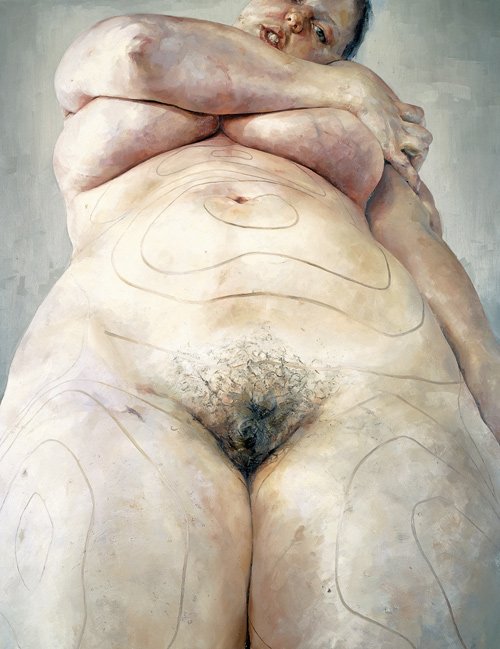
Whoops, nearly forgot to post one for today. So here’s Plan, by Jenny Saville:

It’s another one where the size is relevant — it’s actually 9 feet tall and 7 wide. So it’s a big painting; it changes it from an intimate perspective into something more monumental.

I’ve always found the subject of size in art kind of fascinating, incidentally: not just big paintings versus small ones but the difference between reading a 900 page novel and a 200 page one, or a poem of 14 lines versus one of 400.

Although the comparison between literature and the visual arts doesn’t quite hold up, because you can’t just keep a novel the same but make it twice as long; whereas you could scale a painting or a sculpture. How different would Vermeer’s paintings seem if they were three times the size? Or if Michelangelo had made David life size instead of 17 feet tall?

Indeed we frequently do see works of art in the wrong size, because we often see them in photographs, and it’s not an unusual reaction, I find, to see the real things for the first time and be surprised by their size — like Gauguin, whose paintings were surprisingly small.

Categories
Culture

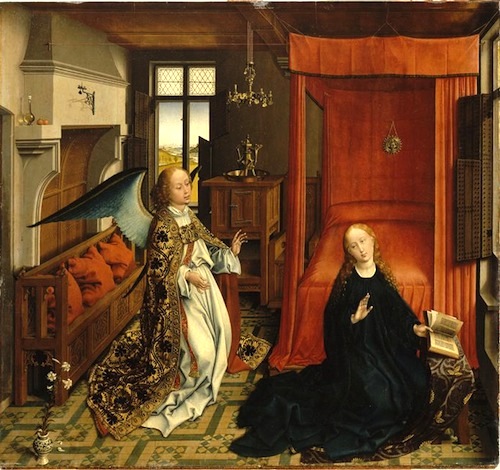
Harry’s advent calendar of paintings, day 8: van der Weyden

Today’s painter is Rogier van der Weyden. This is, perhaps self-evidently, The Annunciation:

I have a real thing for the painters of the Northern Renaissance: Jan Van Eyck, Memling, Dürer, Holbein, Bruegel, Bosch, Cranach. In fact, I love medieval and renaissance art generally, and that certainly includes the Italians, but for some reason I have special soft spot for the northerners.

It’s appealing to think that there’s some kind of specifically northern European aesthetic, some kind of cultural continuity that stretches over five centuries to form a link between me and them… but that’s the kind of explanation that would annoy me if someone else came up with it. Apart from the fact that it’s too hand-wavy to actually explain anything, it doesn’t match the facts; there’s plenty of art and literature from southern Europe that I love, and plenty of northern stuff that bores me silly.

I guess it has something to do with the fact that the medieval influence lingered longer in the north; the paintings are gloriously well-painted and lavish, but they are still in a more constrained, stylised world. Something about that stiff intricacy appeals to me.

Here’s a detail from the same painting:

Categories
Other

Thinking out loud about Wikileaks

I’ve been feeling a bit ambivalent about the latest Wikileaks kerfuffle — not an unusual reaction, I suspect.

Because I don’t think there’s anything inherently sinister or unreasonable about the fact that diplomats want to be able to say things in private that they wouldn’t say in public. And quite apart from the Swedish sexual assault allegations, Julian Assange comes across as a bit of a dick: arrogant and egomaniacal.

And I’m a bit creeped out by the self-righteous certainty of internet evangelists for the idea that information wants to be free: whether it’s the anti-copyright campaigners, or Mark Zuckerberg with his high-handed attitude to other people’s privacy, or Julian Assange. Although of the two, a wish to abolish government secrecy is easier to defend than a wish to abolish personal privacy.

So for those reasons I’m a bit sceptical. And yet…

Someone once jokingly defended fox hunting to me on the basis that ‘it keeps the foxes on their toes’. And I feel that way about governments. Sure, there are good reasons why they want secrecy… but I don’t want them to get too complacent about it. I don’t want them to assume they can do things that no-one will ever know about.

Some of my feelings about it were crystallised by this excellent blog post — essay, really —  by Aaron Bady, which concentrates on the role of diplomacy in East Timor, and how the State Department’s eventual backing for UN peacekeepers in East Timor only came after spending decades providing military support to the murderous and oppressive Indonesian regime.

Because despite politicians’ high-minded rhetoric, when it comes to foreign policy human rights is always the bottom priority. Our governments will prop up almost any regime, however brutally oppressive and violent, for almost any reason. They — we — do it to ensure access to resources, whether it’s oil or something else; or because the enemy of our enemy is our friend; or because they may be a bastard, but at least they’re OUR bastard; or because we want to stay on the right side of the Americans; or for reasons of ‘stability’; or because they are valuable trade partners; or because we want somewhere to put our air bases.

And the thing is, none of those are stupid reasons. Take oil. If we — the West, the wider global economy — lost access to Middle Eastern oil, we would be completely fucked. Our countries would grind to a halt extremely quickly. We have a direct strategic interest in the politics of the region. Is that sufficient to justify the propping up of the corrupt, hypocritical Saudi royal family, even as they bankroll Islamist terrorism and torture their own people? I think that’s a genuinely difficult question to answer.

But politicians don’t even want to have the discussion. They would rather treat us like idiot children, not worldly enough to deal with these kind of grown-up problems. They can’t keep the really big stuff secret, but they certainly do their best to avoid drawing attention to it, and to avoid talking about it. And you can bet your life that they do keep things secret when they can get away with it.

So let’s keep our politicians and civil servants on their toes. Let’s make them stand up and actually justify their actions.

The other aspect which has been surprising and thought-provoking is the government reaction to the leaks. It’s worth pointing out at this point that, despite a lot of bluster, no-one at Wikileaks has been charged with any crimes; no-one has come up with any convincing argument that a crime has been committed. Certainly not under US law, since they have that admirable constitutional protection of free speech. And yet one by one, Amazon, Paypal, Visa and Mastercard have rolled over under government pressure and denied service to a legal journalistic enterprise exercising free speech. Are the Guardian, the New York Times and Der Spiegel next?

I don’t think I am, generally, someone who wants to shake up the global political establishment just for the sake of it. I don’t have that anarchist temperament. But when I see politicians reacting with such panic and hysteria to the threat of a little daylight, and when I look around the world and consider how they’ve been doing when left to their own devices, I tend to think, yeah, let’s have it. Who knows, let’s look on the bright side; maybe this is the birth of a new golden age of journalism and of newfound accountability in government and commerce. And maybe it’s just a storm in a teacup. But I doubt it’s the end of the world. So let’s try it. See what happens.
Categories
Culture

Harry’s advent calendar of paintings, day 7: Doig

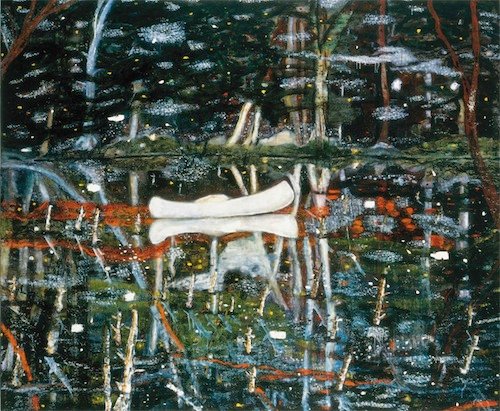
Something a bit more contemporary for a change. Today we have White Canoe, by Peter Doig:

Like so many of these paintings it loses some of the effect when you shrink it right down to 500 pixels — it’s actually eight foot wide. Nice though, innit.

Categories
Culture

Harry’s advent calendar of paintings, day 6: Ingres

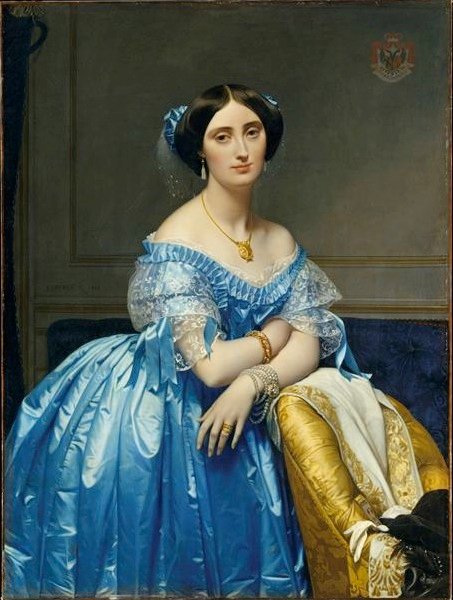
Ah, Jean Auguste Dominique Ingres, what a lot of names he had. And what a fabulous painter he was. Not in a style which is particularly fashionable these days; Neoclassical history paintings and portraits aren’t the sort of thing that would usually draw huge crowds to a London gallery.

But Ingres is brilliant enough and, I think, just odd enough to transcend fashion. He manages to make his subjects look simultaneously seductive and a bit creepy. If this woman (Joséphine-Éléonore-Marie-Pauline de Galard de Brassac de Béarn, princesse de Broglie) turned up in an episode of Doctor Who, you would just know she wasn’t really human. Some kind of hyper-intelligent intergalactic praying mantis disguising herself via a morphobioenergy field, by the looks of her.