Categories
Me Nature Other

Hania, still.

Well, I’ve been to the Hania Archeological Museum, the Cretan Folklore Museum and the Byzantine Museum this morning, so I’m all cultured up good. The Archeology is not doubt a pale shadow of what iwould have seen if the Heraklion museum had been open, but they had some nice stuff. The Folklore Museum was probably the most fun; certainly the most colourful, since Cretan textiles are very flamboyant.  They taken a little house and absolutely packed it with tools, costume, knick-knacks; every conceivable aspect of everyday life from the nuptial bed to the threshing yard. Some of these, like the threshing yard, and illustrated with little models which have exactly the folk-art quality to go with everything else.

This afternoon I think I’ll do some flower ID-ing as preparation for the bio blitz, and take a few pictures.

I had some delicious kolokithokeftedes yesterday; the menu described them as ‘zucchini croquettes’ which didn’t sound that exciting, but they were made of grated courgette, cheese, dill and mint, maybe some onion, and they were delicious. Then I had some kind of slow-cooked baby goat which was also nice but didn’t excite me as much as the keftedes.

I was slightly disappointed in  Heraklion to see that all the trendier-looking cafes advertised themselves as espresso places. I mean America and the UK needed the Starbucks revolution because our coffee was crap, but Greek coffee is delicious. I hope it’s not just becoming an old man’s drink.

Thanks to the very helpful municipal tourist office I have a couple of days birding planned – to the Aghi Triada monastery on Aktrotiri and Agia Lake. So that’s good; I was starting to worry about how much actual birding I would be able to do.

Categories
Me Nature

Knossos

blogger bioblitz

It turns out the Heraklion Archaeological Museum is closed for renovations until July. Which is disappointing, because it holds a world-class collection of Minoan artefacts and I was looking forward to going there.

Oh well. Instead I got on a bus to Knossos, one of the sites where a lot of the stuff in the museum came from. Knossos isn’t the most evocative archeological site I’ve ever visited: too much reconstruction, too much concrete and too much scaffolding. But it was quite interesting to see it, and it was a nice sunny day, on and off, and there were hooded crows and collared doves and goldfinches and things around the place. Wood Warbler and Willow Warbler passing through on their migration north. Best bird was Italian Sparrow, which my field guide treats as a ‘stable hybrid’ of Spanish Sparrow and House Sparrow, but Avibase has as a full species. So it was either a half tick or a full tick for my life list.

After looking round the site I had a plate of chicken and chips and went for a birdy wander. Not that much around, but I saw Hoopoe, which is always a pleasure. There are lots of flowers everywhere. When I do the Blogger Bio Blitz, wherever that ends up being, there should be plenty to keep me occupied even if I don’t have a good bird day. That barn owl bio blitz button, btw, is derived from a photo on Flickr by Nick Lawes used under a by-nc-sa licence; the button is therefore available under the same licence. Not that there’s anything wrong with the Jennifer’s BBB buttons, but I wanted something to match my colour scheme.

Categories
Culture Nature

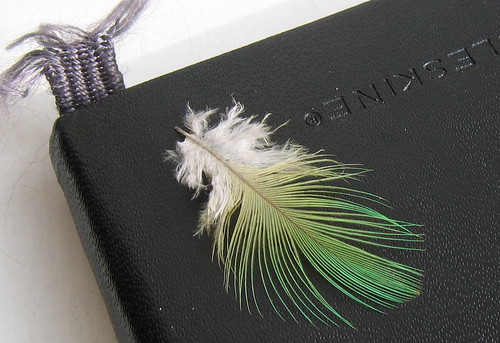
Parakeet feather on Moleskine


Parakeet feather on Moleskine

I bought a new notebook yesterday for my upcoming trip to Crete. This is the previous one, with a feather I found near the birdfeeders, presumably from a parakeet. I do like Moleskine notebooks. I’ve used masses of different notebooks of various kinds over the years both for birdwatching and poetry, but these are the only ones I really enjoy as objects in their own right.

They’re a fine example of why you can’t judge a product just on its functionality. Any old notebook which contains a supply of paper and is small enough to be portable would fulfil my requirements; I hardly ever use them for sketching or anything, just noted jotted in biro. The elastic to keep the notebook shut, the ribbon bookmark and the built-in pocket are nice touches but not really necessary.

It’s just a likeable object. It looks good: simple, old-fashioned, functional, ungimmicky. Even more important is that it’s very tactile; the oilcloth cover, good quality paper and twangy elastic all make it a nice thing to hold. I think it’s worth paying three times as much to get a notebook that gives me pleasure as well as doing its job. I just wish I got as much enjoyment out of using, say, my mobile phone.

Categories
Nature

Wildlife round-up

I was pruning back a rosemary bush to get rid of what I vaguely thought were frost damaged leaves left over from winter, so I’d have some less manky rosemary to cook with, and found these:

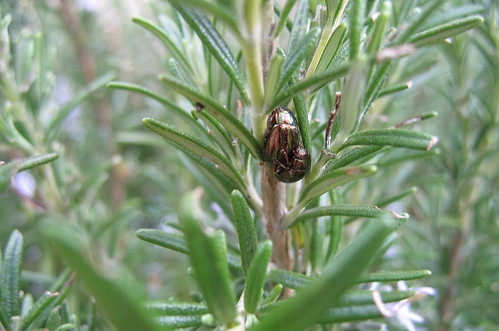
rosemary leaf beetles shagging

Which I immediately recognised from a photo in the London Wildlife Trust newsletter, though I couldn’t remember what they were called. It turns out they’re Chrysolina americana, the Rosemary Leaf Beetle.

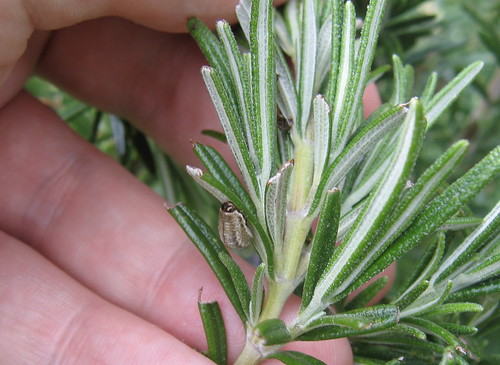
Pretty, aren’t they? Something I’d be much more enthusiastic about if the little bastards weren’t eating the rosemary that I want to eat. Apparently they’re native to southern Europe and can’t fly, but have become an established pest in England, especially London, over the past ten years. No doubt they got here on rosemary and lavender plants (which they also eat) and I guess they must crawl from plant to plant, guided perhaps by their sense of smell. The suggestion is that they’ve only become established over the past decade because global warming has brought milder winters, so they’re a harbinger of doom as well as a pest. Here’s one of the grubs, and a rare shot of part of my hand:

rosemary leaf beetle grub

You can also see some of the damage, though it was a lot worse than that on other parts of the plant.

More evidence of spring, apart from the randy beetles: I’m up to four butterfly species for the year (Small White, Brimstone, Peacock and Comma). On the bird front, I saw my first summer visitors of the year last week; Chiffchaffs singing in the woods. Although according to that page, a few hundred of them now overwinter each year in southern England—probably another sign of global warming—so perhaps the ones I saw haven’t come from Africa after all.

There are ducklings and cootlings in the park, and a pair of Little Grebes—a contender for the cutest bird in Europe— haphazardly dragging around bits of weed as though they were about to build a nest. Which is exciting because it’s the first time I’ve seen them there. My sense is that they are becoming more common in London; certainly in my copy of the Atlas of Breeding Birds of the London Area from 1977, the Little Grebe map doesn’t have many orange blobs on it. That, at least, probably isn’t anything to do with climate change. More likely the grebes are adapting to city life.

Categories
Nature

Epistem [ornith] ology

I went for a walk in the local woods a couple of days ago, and forgot to take my binoculars because in my head I wasn’t birding, I was just going out to enjoy the spring sunshine. That’s silly, of course; its not something you can turn off. Even if I’m in central London, there’s a little bit of my brain ticking over in the background in readiness, just in case something more interesting than a pigeon should fly past. And walking through the woods on a sunny day in late March, with all the birds gearing up for the breeding season and not too many pesky leaves on the trees, it inevitably became a birdwatching walk.

I saw Woodpigeon, Great Spotted Woodpecker, Carrion Crow, Magpie, Blue Tit, Great Tit, Wren, Robin, Blackbird, Song Thrush, Chaffinch, Nuthatch, Treecreeper, and Starling. Nothing very surprising, but reasonable enough for London. And actually I quite enjoyed doing some naked-eye birding; just watching the birds, unmediated by binoculars.

But I was thinking how frustrating I would have found the same walk if I wasn’t familiar with the local birds. By the nature of the thing, most of the birds were some distance away, or partially obscured, or in shadow, and the only reason I could generally identify them quickly and easily was that I knew them well. The same sightings of unfamiliar species would have seemed like glimpses.

It’s an odd experience when you see new species for the first time. It’s almost like you don’t actually see a bird, you see an unstable collection of impressions. Everything can be misleading, depending on the lighting and angle; even the most basic things like size and colour are elusive and untrustworthy. You can catch a flash of white on the head and not know whether it’s the throat or an eyestripe, or see some pale colour on the wings and not know whether it’s white or grey or yellow. You can lose sight of it for a moment and find it again and not be completely sure whether it’s the same bird.

And then there’s a moment, when you’ve seen it enough times, when it abruptly switches from being a inchoate mess of birdiness to a type, a species. And the next time you see one you just recognise it. Since this moment of coalescence is often associated with finding it in a field guide, it sometimes feels as though by naming it, you have given it form.

And if you tick off a new bird without having internalised it in that way, no matter how sure you are of the identification, it’s never quite as satisfying.

Categories
Nature

In your face, folk wisdom!

A green woodpecker has been calling all day, and the sky is clear and blue. There’s a slight haze, but I think that’s all pollen and exhaust fumes rather than cloud.

So that’s one data point against the ‘rain bird’ theory.