-
A photograph to make you feel queasy.
Categories
Full title: 40 Days and 40 Nights: Darwin, Intelligent Design, God, OxyContin®, and Other Oddities on Trial in Pennsylvania. In other words, it’s about the trial in Dover, Pennsylvania where the school board tried to put Intelligent Design into the biology classes and were found to be in breach of the constitutional separation of church and state.
I’m not quite sure why I felt the need to read a second book about this; the blurbs promised a more entertaining read, and it’s certainly livelier and bitchier than Monkey Girl, but didn’t tell me anything new. And despite what Hollywood would have you believe, trials are not inherently charged with drama. Especially this trial, which, with eleven plaintiffs and a bucketload of lawyers and expert witnesses, lacked a personal dramatic focus.
Chapman largely concentrates on personality and anecdote and glides past a lot of the technical evidence; understandably, I guess, but I would have liked more to get my teeth into.
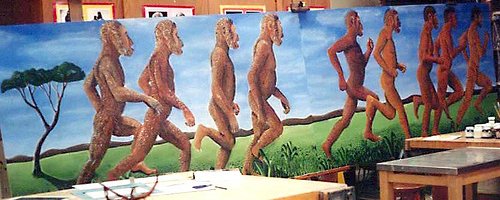
» The photo above, which I found rather unexpectedly on Flickr, is of a mural painted by a student at Dover High School which helped kick off the whole controversy when one of the school board took offence at it and took it on himself to take it away one weekend and burn it. It’s used under a by-nc-sa CC licence.
I went yesterday to see Sacred at the British Library. I nearly missed it; the exhibition closes at the weekend. I’m glad I didn’t, as it was extraordinary.
It’s an exhibition of sacred texts from Islam, Christianity and Judaism, and the selection is seriously impressive. For example, the show includes the Lindisfarne Gospels and a bit of a Dead Sea Scroll as just two exhibits among many. They also have one of the two oldest Christian bibles, from the C4th, an C8th Qur’an, the first printed Mishnah, Henry VIII’s psalter, copies of the Qur’an made for various sultans, a Tyndale New Testament and so on. They haven’t even bothered to include a copy of the Gutenberg Bible, presumably because they have one of those on display in their permanent exhibition anyway.
Staggeringly, with a very few exceptions like the Dead Sea Scroll, all these books were part of their own collection. It’s odd to think of all these books, culturally interconnected but originally separated by many centuries and thousands of miles, having made their way, by who knows what means, from monasteries and mosques in Syria, Armenia, Ethiopia, India; and all ending up in a basement in North London.
Whatever my disagreements with religion, I do feel a reverential instinct towards ancient artefacts and books, so I had no difficulty feeling a sense of the sacred. And many of them are extraordinary objects in their own right. I have a new-found passion for Syriac script.
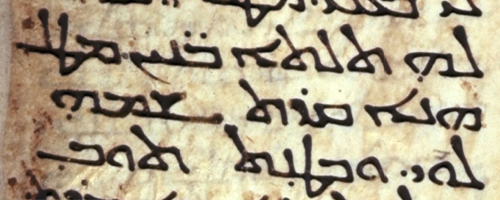
There are zoomable high-resolution images of 67 of the texts available on the website, so those of you who can’t make it London this week can take a look. That’s where all the images illustrating this post came from. I have to say, generally, kudos to the British Library; all the exhibitions I’ve seen there have been excellent (and free).
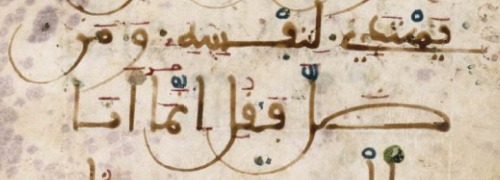
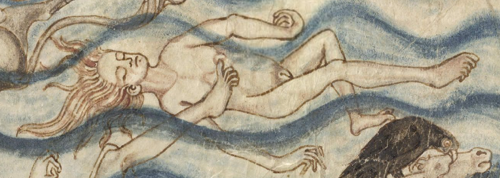
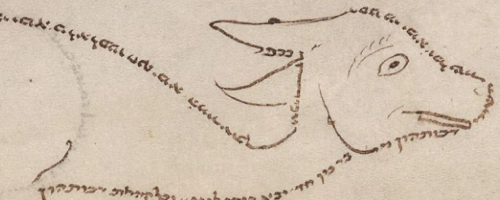
» Pictures, from the top: 1) An example of Maghribi script from a C13th Spanish Qur’an. 2) One of the people drowned in the Flood in the C14th Holkham Bible Picture Book. 3) Micrographic decoration (i.e. made up of tiny writing) from The Duke of Sussex’s German Pentateuch, c. 1300. 4) The bible in Syriac, dated by the scribe to 463/4 AD.