-
Dazzling new images reveal the ‘impossible’ on the Sun – space – 21 March 2007 – New Scientist Space‘The restless bubbling and frothing of the Sun’s chaotic surface is astonishing astronomers who have been treated to detailed new images from a Japanese space telescope called Hinode.’
-
animated Hubble images of Saturn
-
‘Yesterday I posted an excerpt from J Milton Cowan’s brief memoir, “American Linguistics in Peace and at War”. Here’s another sample, about a Chinese course that was as intensive for the instructors as it was for the students.’
-
I have no idea whether this recipe works, but it’s like, so cool.
-
“Wally Wallington has demonstrated that he can lift a Stonehenge-sized pillar weighing 22,000 lbs and moved a barn over 300 ft… he does it using only himself, gravity, and ingenuity.” or: who needs aliens.
-
‘If there’s a tree or plant of any kind in sight, then chances are, depending on the time of season, there’s probably a caterpillar somewhere in the vicinity. Keep that in mind at all times — if you look hard enough, you *will* find caterpillars.’
-
‘Keepon is a small creature-like robot developed to perform emotional and attentional interaction with children. If has four degrees of freedom, a soft rubber skin, two cameras in its eyes, and a microphone in its nose.’ see it dance to Spoon.
-
‘Scientists often stick genes into organism in order to create something new… Give a mouse human vision, for example, and you may learn something important about how our own eyes evolved.’
-
I and the Bird #45 is up.
-
via lamguagehat: “there is little need for formally trained Urdu calligraphers. That is, except for one small ink-stained corner of Chennai where the world’s last hand written newspaper still churns out 20,000 broad sheets a day.”
-
via cityofsound: ‘The [archeological] researchers have become adept at taking advantage of the circus hunger of television for discovery events’. An excellent post about archaeologists investigating Passchendaele.
-
via cityofsound: “Self-defence with a Walking-stick: The Different Methods of Defending Oneself with a Walking-Stick or Umbrella when Attacked under Unequal Conditions”. The pictures are fabulous.
-
‘Andrew Vande Moore digs deep in his information channels to gather the most interesting forms of data visualization.’
Year: 2007
there’s only one Ronaldo
For the benefit of those of you who don’t know who he is, this is Christiano Ronaldo, who is, this season, a contender for the best footballer in the world:
George Boateng, captain of Middlesbrough FC, talking about a particularly unsubtle tackle by one of his teammates on Ronaldo:
“I’m not saying Morrison wanted to spoil his career or I’d ever do anything like that.
“But one day somebody will do it — whether in an international or in the Premier League. People don’t like it.
“People have pride in the game. No one likes to have the mickey taken out of them. One day, someone will hurt him properly and he’ll be out for a long time.
“When you’re playing Sunday football with your mates, it’s great.
“But at the top level, people don’t want to have the mick taken out of them. As professionals, we know he can do it. But if you want to do it, do it when it’s 0-0 or it’s important. Don’t do it when you’re winning 1-0 and there’s only two minutes to go.”
The reaction people have to Ronaldo really amuses me. He seems to outrage some deep streak of puritanism in the English football fan. It’s as though he was some kind of decadent affection on the part of Manchester United, a bit of imperial bling they brandish around just because they can.
I can see why he would irritate some people even without all the step-overs; he seems to have a blissfully unwavering sense of his own wonderfulness. But I think that Boateng is essentially right in his analysis: Ronaldo is in fact taking the mickey. He is showing a lack of respect. I think he knows that ‘at the top level, people don’t want to have the mick taken out of them’ and does it anyway. He’s rubbing their noses in the difference between playing at the top level and being one of the best in the world.
The mistake is to confuse a lack of respect for his opponents with a lack of seriousness, and to think that he’s failing to take the English league as the very serious business it likes to imagine it is. He wouldn’t have scored 20 goals this season if he was just goofing around. On the contrary, I think he embodies the confrontational nature of sport just as much as someone like Roy Keane. All his tricks and flicks are the equivalent of Keane’s tooth-rattling tackles, designed to impose himself on his opponents; the fact that people keep muttering about how much they’d like to kick him is a clear sign it’s working.
And if they really want to take him down a peg or two, the solution is simple enough: just cleanly and legally take the ball from him whenever he comes near. How hard can it be, right?
Links
-
check out ‘over Roswell’. Via someone – Coudal, maybe?
Today we start with the word ‘plover’.
plover (‘plʌvə(r)). [ME. and AF. plover = OF. plovier, later L. *plovārius belonging to rain, f. L. pluvia rain; in mod.L. pluvārius pluviārius; cf. Sp. pluvial plover, ad. L. pluviālis rainy, also Ger. regenpfeifer, lit. rain-piper, and Eng. rain-bird.]
Belon, 1555, said the birds were so called because most easily taken in rainy weather, which modern observation contradicts.
I’ve never tried to take a plover myself, so I couldn’t judge. I’d like to believe that the OED have a crack avian behavioral research squad who were sent up into the Peak District in rainy weather with strict orders not to come back until they checked this. But probably not. It carries on with more suggestions:
…because they arrive in flocks in the rainy season… because of the restlessness of the bird when rain is approaching… Others have attributed it to the appearance of the upper plumage, as if spotted with rain-drops.
The most appealing of these, the last one, strikes me as the least likely. But judge for yourself:
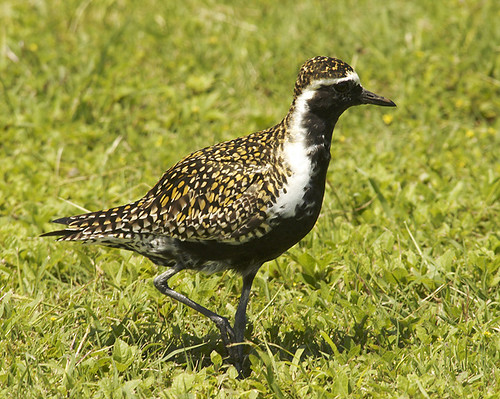
Pacific golden plover, originally uploaded by Doug Greenberg.
As the caption says, that’s actually a Pacific Golden Plover, whereas the original plover was presumably either the European Golden Plover or the Grey Plover (what Americans call Black-bellied Plover). But the appearance is very similar.
Plovers aren’t the only birds to be associated with rain, of course. In Britain, the obvious one is the Green Woodpecker, Picus viridis, known as the rain-bird because its call is supposed to mark the approach of rain. I can’t say I’ve ever noticed this to be true myself. The call is one of the classic sounds of the English countryside; you can hear it here. It’s often described as laughter, although if you heard a person laughing like that you’d be a bit worried. Their other common name—yaffle—is derived from the call. This is typical yaffle behaviour; hunting for ants in someone’s garden lawn:
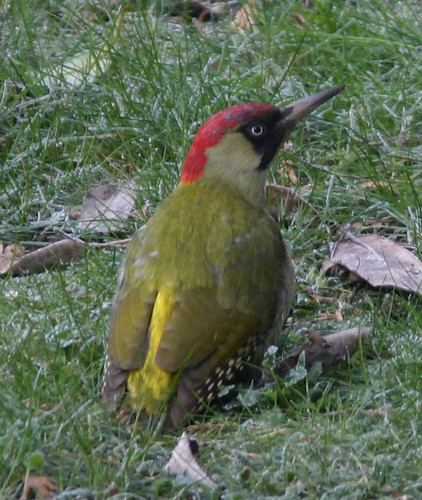
Yaffle II, originally uploaded by vlad259.
The dictionary has two other entries for ‘rain-bird’. The first is a bit vague: ‘A Jamaican cuckoo’. A little detective work narrows it down to the Jamaican Lizard-Cuckoo, Saurothera vetula. I don’t know what the connection is with lizards, but I can tell you that it’s also known as Old Woman Bird because of its cackling laugh.
Jamaican Lizard-Cuckoo, originally uploaded by Langooney.
Finally, the OED also mentions a couple of Australian usages. This is one of them, the Grey Butcherbird, Cracticus torquatus:
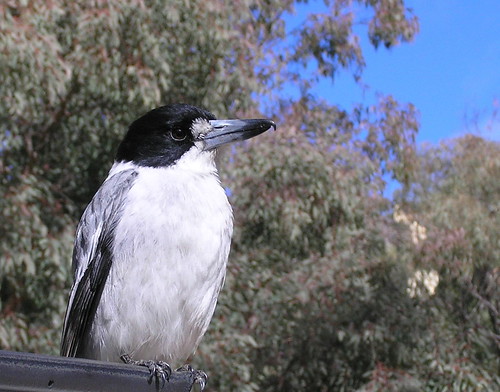
Grey butcherbird, originally uploaded by pierre pouliquin.
The other is the Channel-billed Cuckoo. In fact, though, Google turns up another Rainbird in Australia, the Asian Koel, also known as Stormbird; ‘Stormbird’ in turn can also refer to the Pheasant Coucal. For some information about the Stormbird’s place as an aboriginal storytime character, go here.
I know it might seem like I’m being too thorough here, but bear with me. Under the entry for rain, we also learn about the ‘rain crow’. Which isn’t actually a crow:
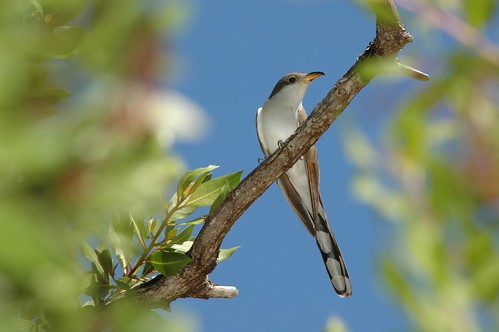
Dry Tortugas April 2006 Yellow Billed Cuckoo, originally uploaded by Jay Bass.
To quote Meriwether Lewis’s journal entry for 16th July 1806 from the Lewis and Clark expedition (which is one of the dictionary citations)
I saw both yesterday and today the Cookkoo or as it is sometimes called the rain-craw.
And yes, it does appear to be ‘craw’ unless there’s a typo in the dictionary, though all the other citations are for ‘rain-crow’. I guess you don’t employ explorers for their spelling.
As I said earlier, I am sceptical about the claim that the woodpecker’s call is an accurate predictor of rain. Some people have a disproportionate respect for traditional wisdom; in my experience it’s rather hit and miss, and weather lore is exactly the kind of area that’s likely to attract a lot of dubious theories. However, it’s very striking that of the seven birds I’ve mentioned, no less than five are cuckoos or their relatives: koels and coucals are both members of the Cuculidae. And in separate parts of the world people have, presumably independently, decided that they call more before the rain. It seems like more than a coincidence. If anyone reading this lives in one of the places where these birds live, I’d be interested to hear what you think.
Returning to plovers; the dictionary lists no less than 60 from ‘bastard plover’ to ‘yellow-legged plover’. A few of them—Crab Plover, Ringed Plover—are still standard species names, but most are old or local names for waders we now know as something else. It really makes you appreciate standardised naming. There are ten names for ‘Golden Plover’, and eleven for ‘Grey Plover’; a few can mean either. Least helpful of all is ‘stone plover’ which can apparently mean Stone Curlew, Grey Plover, Ringed Plover, Dotterel, ‘any shore plover of the genus Aesacus‘, Bar-tailed Godwit, or Whimbrel.
One last thing before I finally put an end to what was originally intended to be a short post. One of the dictionary’s citations for plover is this:
1486 Bk. St. Albans F vj b, A Falle of Woodecockis. A Congregacion of Pleuers.
The Book of St. Albans, by Dame Juliana Berners, is a book about hawking, hunting, and ‘fysshynge wyth an angle’, and is presumably one of the sources for all those irritating lists of collective nouns: a murder of crows, a heckle of alligators, a flashback of policemen. I don’t care if it does go back to the fifteenth century, I just don’t believe that anyone has ever actually called a flock of plovers anything other than a flock. All it proves is that whimsical linguistic pedantry is a 500 year old English tradition.
Today’s top tip
If your shaving gel doesn’t seem to be foaming up much, consider the possibility that you’re trying to shave with hair gel.
Links
-
via BLDGBLOG: ‘The 11,700 acres allocated for [the planned city] Centennial are part of Tejon Ranch, one of the last great California ranches. Comprising more than 270,000 acres, or 426 square miles, the ranch is roughly 1/3 the size of Rhode Island.’
-
Khoi Vinh runs through a hypothetical example of grid-based design for a Yahoo!-type website.
-
‘…. but an example of how species emerge. And this is not just a newly discovered species (indeed, not that new, it was discovered a few years ago). It is a species that is believed to have evolved recently as well. And it’s a North American Bird.’
-
‘Photography wasn’t the obvious subject to teach at Governor Morehead School for the Blind.’
-
“Walking through the halls of the convention, it is easy to see the genesis of tactics deployed in the Florida recount and by the Swift Boat Veterans for Truth. Republicans learn how to fight hard against Democrats by practicing on one another first.”
-
via languagehat: ‘The following is a list of speakers that Joseph Sargent Hall interviewed in the Great Smoky Mountains in 1939. The page for each speaker contains one or more excerpts from the interview including a transcript and sound file.’


