Until this morning I’d never heard of Michael S. Hart, but it turns out he invented the ebook and was the founder of Project Gutenberg. So it was sad to learn of his death.
I remember when Wikipedia appeared, it seemed like this was a great new model which would be applied to all kinds of as-yet unimagined things, that the internet would be full of brilliant resources created communally by volunteers in their spare time.
It turned out not to be quite as easy as that; you can’t just apply the Wikipedia model to everything. But Project Gutenberg is one of the great success stories, as remarkable in its own way as Wikipedia. Tens of thousands of out of copyright books of all kinds, from great literature to obscure C19th pamphlets, available for free to everyone: it really is amazing, and it’s amazing how quickly we come to take these things for granted. And if you’ve ever tried reading one of those ebooks from Google Books which has just been run through text-recognition software and left unedited, you get some sense of how much work must have gone into proofreading the 36000 volumes on Project Gutenberg.
One of the great things about Project Gutenberg is that Michael Hart had the foresight to set it up at a time when ebooks were still a niche idea. Now, as the Kindle and the iPad make the idea mainstream, this incredible resource is already there, ready and waiting.
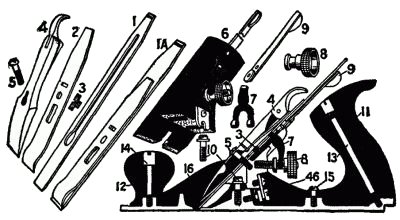
» The illustration is from the Project Gutenberg EBook of Carpentry for Boys, by J. S. Zerbe.
I was listening to the Guardian’s Science Weekly podcast, and I heard Mo Costandi mention that people’s perceptions of what they’re reading are affected by its physical characteristics, including weight. My ears pricked up at that because I was complaining about large-format paperbacks on this blog just the other day.
So I asked him for details over Twitter, and he pointed me to this article he wrote in June. It’s full of odd results, but the most relevant one is this. I’ll quote the whole paragraph, rather than trying to summarise it:
In the first experiment, 54 passersby were asked to evaluate a job candidate on the basis of a CV attached to either a light (0.34 kg) or a heavy (2 kg) clipboard. Those given the CV on the heavier clipboard generally rated the candidate as being better and having a more serious interest in the position than those given the lighter clipboard, even though the CVs used in both cases were identical. Those given the heavy clipboard also rated their accuracy on the task as more important than those given the lighter one, but did not report putting more effort into it. They did not, however, rate the candidate as more likely to get along with co-workers. This suggests that the weight cue affected their impressions of the candidate’s performance and seriousness, but not the irrelevant trait of social likeability, and that the observed effects were not due their perception of their own actions.
So physical weight is apparently makes the reader attribute seriousness and quality to what they’re reading — at least in a CV. You can see why a publisher might want to get some of that action. Particularly a university press publishing a literary novel which they are asserting deserves to be considered a classic.
But it makes you wonder what other effects the extra weight might have: does it make a novel more or less funny? Does it makes the characters more or less likeable? What does it do to the prose style? Or the plotting?
Such speculation aside… I actually wonder whether it’s unambiguously positive to be perceived as more serious, even for a literary novel about important subjects. I mean, I like novels to be more literary rather than less and I’m not intimidated by big fat books, but I still find that serious literature requires a degree of concentration and discipline, even for a book you’re enjoying and reading for pleasure. Anything that emphasises the literature-as-Serious-Business aspect is only going to make it more likely that reading starts to feel like a chore.
That’s from the series Stellar by Ignacio Torres, who says
This project began from the theory that humans are made of cosmic matter as a result of a stars death. I created imagery that showcased this cosmic birth through the use of dust and reflective confetti to create galaxies.
I wasn’t so keen on Torres’s other work (too much of a fashion magazine aesthetic for my taste), but I thought these were rather lovely. Worth clicking through and checking out the whole series.
Two altered medieval works: the tomb of Pope Clement V in Avignon, with a modern addition by Spanish artist Miquel Barceló; and a Byzantine mosaic that was the subject of a bit of Stalin-style editing to remove any evidence of heretics.
Going back even further in time: a remarkable photo of a Chinese archeological dig; and an ancient Greek grave marker.
For those of you who don’t know, Stewart Lee is a stand-up comedian. This book is built around the transcripts of three of his shows, each heavily footnoted with his own technical comments: why he thinks things are funny, notes on delivery, where jokes came from, his comedic influences and so on. Preceding each transcript is a chapter explaining that show’s genesis which inevitably involves a lot of stuff about his personal life and the state of his career. The result is a book which combines autobiography with a lot of thoughtful commentary about the art of stand-up.
I was going to say that the book serves as a record of the stand-up routines, but perhaps that’s not right. To quote one of the footnotes, on the subject of the video embedded above:
The chiselling here, where I tapped the mic stand with the mic, went on at some length, sometimes uninterrupted for minutes at a time, with me varying the rhythm and intensity of the tapping. This doesn’t work on the page, and ideally, my ambition is to get to a point where none of my stand-up works on the page. I don’t think stand-up should work on the page, so the very existence of this book is an indication of my ultimate failure as a comedian. The text of a stand-up set should be so dependent on performance and tone that it can’t really work on the page, otherwise it’s just funny writing. You don’t have to have spent too long thinking about stand-up to realise that even though critics and TV commissioners always talk about our art form in terms of its content, it is the rhythm, pitch, tone and pace of what we do — the non-verbal cues — that are arguably more important, if less easy to identify and define.
So the DVDs are the record of the performance; the book is a critical commentary on the DVDs.
It’s certainly a slightly odd experience reading the routines on the page. They have relatively few clearly defined jokes in them, and although you can see where the humour is, they feel anaemic and formless without a performance to hold them together. And I’ve only seen some parts of the routines, on YouTube, and I know that they’re funny, but it’s hard to recapture that on the page. Even more so for the bits I haven’t seen before.
It’s a fascinating form, stand-up. Lee draws a comparison with fooling and clowning traditions, like the pueblo clowns of the southwestern US, who are given special licence to behave in disruptive, socially transgressive ways. And I can entirely see the strength of that comparison. The comparison that occurred to me, though, was with oral traditions, whether the verse traditions of Homer and Beowulf or non-verse oral storytelling traditions. You have one man standing up in front of a crowd and entertaining them by performing long stories from memory, but with a degree of flexibility and improvisation, varying from performance to performance. And one reason that stories from oral cultures often seem slightly odd when you read them may be the lack of performance. Of course in many cases, not only do we have a recording of the actual performance, we don’t even have a verbatim transcript of one particular telling of a story; instead we have some well-meaning anthropologist’s version of what the story is about.
Anyway, I have wandered off topic. It’s a good book.
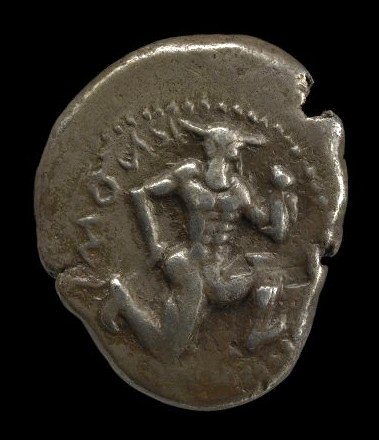
I think my favourite thing I posted to Tumblr this week was this Minoan coin from Knossos. It has a minotaur on it!
I thought this article about the dropping of the case against Dominique Strauss Kahn and the differences between the French and US legal systems and legal cultures was interesting.
wooow, take a fancy to your things concerning Heraclitean The stake » The vapidness of swollen books (and the felicity of of small account paperbacks
Yup, the spambot has just run the post title through a thesaurus.
The idea of course is to generate fake comments which are genuine-sounding enough to avoid being deleted. It’s an ingenious idea, even if the results are a bit peculiar. I guess it might have worked better if the original post title was something shorter and less elaborate.
If nothing else, ‘the vapidness of swollen books’ is quite a nice line of iambic tetrameter.