Poetry should sing.
Categories
Poetry should sing.
In which I review books without actually having read them, based only on the titles. Starting with Kent Johnson’s Lyric Poetry After Auschwitz, which has been the buzz of the blogs recently.
The title is of course a quote, from (Google tells me) Theodore Adorno, who said that poetry after Auschwitz was ‘barbaric’ – though he also said that ‘literature must resist this verdict’.
So, we have a book of poetry which gets its title from a quote about poetry from a culture theorist. First deduction: this book is full of self-consciously intellectual poetry that isn’t afraid to approach its subject through a layer of heavy-handed irony.
In fact, there’s no way someone who would choose this title would be gauche enough to to use the phrase ‘lyric poetry’ in a straightforward way. It’s a further irony – the poems in the book are not in fact lyrics at all!
On the other hand, despite all the irony sloshing around the place, there are certain magic words that are too important to make light of, even for people who read cultural theorists. Theory fans are generally earnest about their politics anyway, but mentioning Auschwitz in the title means this a book of Very Serious Poetry.
The poet must have a Very Serious point to make – I’m guessing he thinks Auschwitz was a bad thing. He probably also draws in some more contemporary events as well, for topicality.
So we have non-lyrical (in fact, anti-lyrical) poetry about Auschwitz, Srebrenica, Iraq and so on. But it’s not just about the sadness of the human condition – no, it’s highly politicised. And it’s very aware of irony but has no sense of humour.
As you may have gathered, I hate this title. It’s aggressive, holier-than-thou, patronising, self-important and heavy-handed.
This is such an obvious choice that two people had chosen it by the end of the initial item on the Today programme announcing the poll. But I would have picked it anyway. Probably.
It’s usually called The Battle of San Romano, but according to the NG website the full title is Niccol
Since the poll is not to find the best painting in a British collection, but the best-loved, I thought I’d mention the first favourite painting I remember having.
It’s the choice of a young boy – Whaam! by Roy Lichtenstein. It used to hang prominently in the old Tate (i.e. what’s now Tate Britain), before they split off the modern collection into a separate building. Somehow I don’t think my appreciation for it had anything to do with the semiotic interplay between pop culture and ‘Fine Art’. I just thought it was cool.
The text in the thought bubble is a bit hard to read at this scale, but I can still remember it by heart: “I pressed the fire control and ahead of me the rockets blazed through the sky”.

The Execution of Maximilian is an Impressionist painting that seems to form a link between Caravaggio and Picasso. The Impressionists weren’t always at their best painting people, but this is an exception. I also think the fact it’s in fragments adds to the appeal, though I’d be hard-pressed to explain why.

I’ve been finding this paintings-choosing business a bit frustrating, because in the spirit of the poll, I’m limiting myself to paintings in British collections, and many of the finest paintings I’ve ever seen in London were in temporary exhibitions. So you’ll just have to imagine all the El Grecos and Matisses and Whistlers I’m not including here.
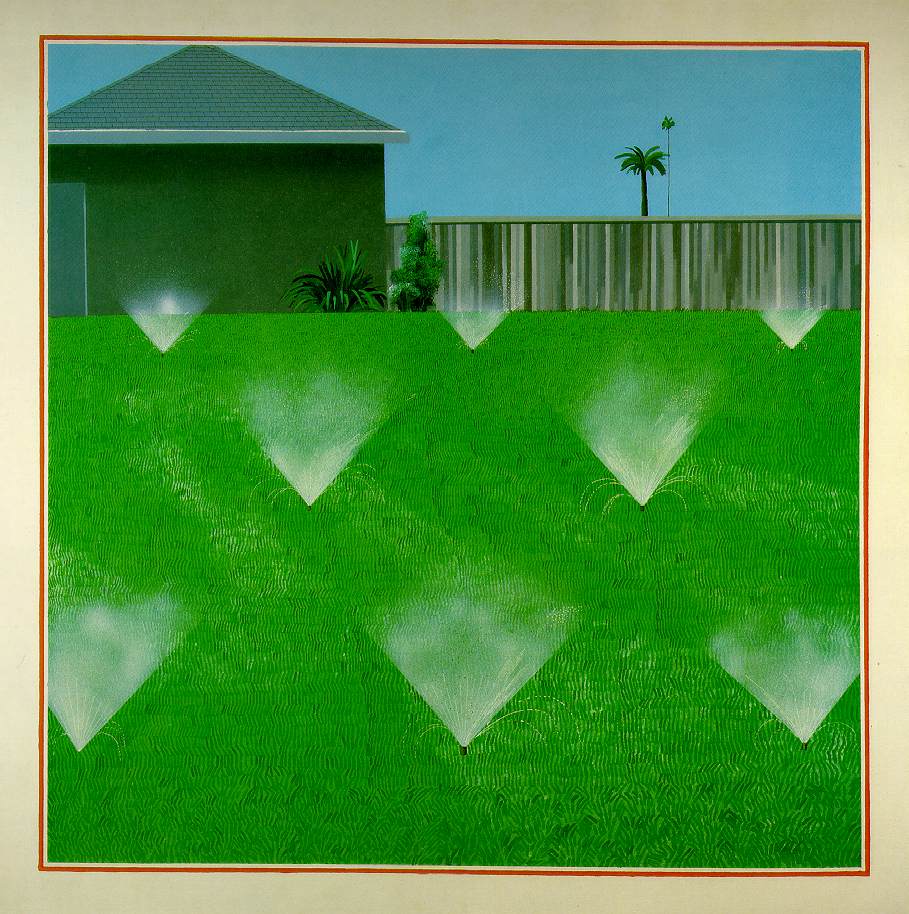
Anyway, on to Mr and Mrs Clark and Percy by David Hockney. I think Hockney is a genuinely great artist. He’s done a lot of stylistic flitting over the years, and not all his work is equally successful, but the best of it is fabulous. The use of light, colour and composition remind me of Vermeer – they have very different palettes and rather subject matters, with Hockney generally favouring exterior scenes, but they both produce paintings of everyday scenes that have a poised, luminous quality. I went for Mr and Mrs Clark and Percy, although if I wasn’t restricted to paintings in the UK I’d be tempted by various others including this one.