Flickr set of the week is Phnom Penh Garbage Dump by primitivenerd.
Categories
Flickr set of the week is Phnom Penh Garbage Dump by primitivenerd.
For the benefit of those of you who don’t know who he is, this is Christiano Ronaldo, who is, this season, a contender for the best footballer in the world:
George Boateng, captain of Middlesbrough FC, talking about a particularly unsubtle tackle by one of his teammates on Ronaldo:
“I’m not saying Morrison wanted to spoil his career or I’d ever do anything like that.
“But one day somebody will do it — whether in an international or in the Premier League. People don’t like it.
“People have pride in the game. No one likes to have the mickey taken out of them. One day, someone will hurt him properly and he’ll be out for a long time.
“When you’re playing Sunday football with your mates, it’s great.
“But at the top level, people don’t want to have the mick taken out of them. As professionals, we know he can do it. But if you want to do it, do it when it’s 0-0 or it’s important. Don’t do it when you’re winning 1-0 and there’s only two minutes to go.”
The reaction people have to Ronaldo really amuses me. He seems to outrage some deep streak of puritanism in the English football fan. It’s as though he was some kind of decadent affection on the part of Manchester United, a bit of imperial bling they brandish around just because they can.
I can see why he would irritate some people even without all the step-overs; he seems to have a blissfully unwavering sense of his own wonderfulness. But I think that Boateng is essentially right in his analysis: Ronaldo is in fact taking the mickey. He is showing a lack of respect. I think he knows that ‘at the top level, people don’t want to have the mick taken out of them’ and does it anyway. He’s rubbing their noses in the difference between playing at the top level and being one of the best in the world.
The mistake is to confuse a lack of respect for his opponents with a lack of seriousness, and to think that he’s failing to take the English league as the very serious business it likes to imagine it is. He wouldn’t have scored 20 goals this season if he was just goofing around. On the contrary, I think he embodies the confrontational nature of sport just as much as someone like Roy Keane. All his tricks and flicks are the equivalent of Keane’s tooth-rattling tackles, designed to impose himself on his opponents; the fact that people keep muttering about how much they’d like to kick him is a clear sign it’s working.
And if they really want to take him down a peg or two, the solution is simple enough: just cleanly and legally take the ball from him whenever he comes near. How hard can it be, right?
Today we start with the word ‘plover’.
plover (‘plʌvə(r)). [ME. and AF. plover = OF. plovier, later L. *plovārius belonging to rain, f. L. pluvia rain; in mod.L. pluvārius pluviārius; cf. Sp. pluvial plover, ad. L. pluviālis rainy, also Ger. regenpfeifer, lit. rain-piper, and Eng. rain-bird.]
Belon, 1555, said the birds were so called because most easily taken in rainy weather, which modern observation contradicts.
I’ve never tried to take a plover myself, so I couldn’t judge. I’d like to believe that the OED have a crack avian behavioral research squad who were sent up into the Peak District in rainy weather with strict orders not to come back until they checked this. But probably not. It carries on with more suggestions:
…because they arrive in flocks in the rainy season… because of the restlessness of the bird when rain is approaching… Others have attributed it to the appearance of the upper plumage, as if spotted with rain-drops.
The most appealing of these, the last one, strikes me as the least likely. But judge for yourself:
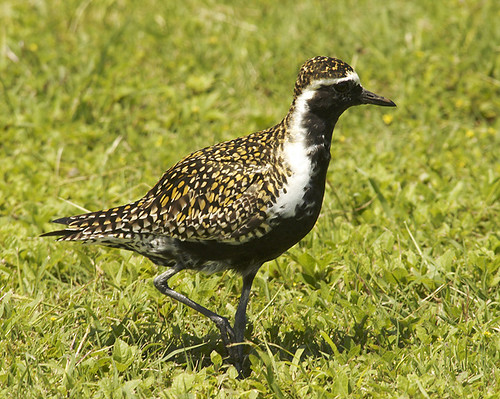
Pacific golden plover, originally uploaded by Doug Greenberg.
As the caption says, that’s actually a Pacific Golden Plover, whereas the original plover was presumably either the European Golden Plover or the Grey Plover (what Americans call Black-bellied Plover). But the appearance is very similar.
Plovers aren’t the only birds to be associated with rain, of course. In Britain, the obvious one is the Green Woodpecker, Picus viridis, known as the rain-bird because its call is supposed to mark the approach of rain. I can’t say I’ve ever noticed this to be true myself. The call is one of the classic sounds of the English countryside; you can hear it here. It’s often described as laughter, although if you heard a person laughing like that you’d be a bit worried. Their other common name—yaffle—is derived from the call. This is typical yaffle behaviour; hunting for ants in someone’s garden lawn:
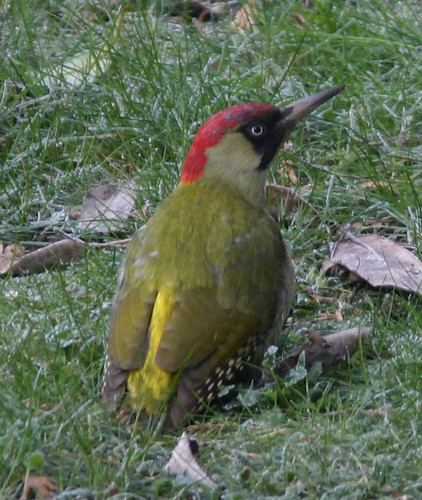
Yaffle II, originally uploaded by vlad259.
The dictionary has two other entries for ‘rain-bird’. The first is a bit vague: ‘A Jamaican cuckoo’. A little detective work narrows it down to the Jamaican Lizard-Cuckoo, Saurothera vetula. I don’t know what the connection is with lizards, but I can tell you that it’s also known as Old Woman Bird because of its cackling laugh.

Jamaican Lizard-Cuckoo, originally uploaded by Langooney.
Finally, the OED also mentions a couple of Australian usages. This is one of them, the Grey Butcherbird, Cracticus torquatus:
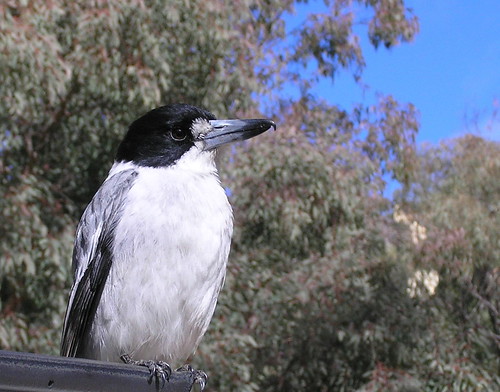
Grey butcherbird, originally uploaded by pierre pouliquin.
The other is the Channel-billed Cuckoo. In fact, though, Google turns up another Rainbird in Australia, the Asian Koel, also known as Stormbird; ‘Stormbird’ in turn can also refer to the Pheasant Coucal. For some information about the Stormbird’s place as an aboriginal storytime character, go here.
I know it might seem like I’m being too thorough here, but bear with me. Under the entry for rain, we also learn about the ‘rain crow’. Which isn’t actually a crow:
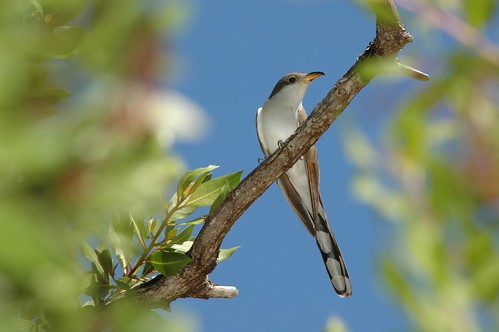
Dry Tortugas April 2006 Yellow Billed Cuckoo, originally uploaded by Jay Bass.
To quote Meriwether Lewis’s journal entry for 16th July 1806 from the Lewis and Clark expedition (which is one of the dictionary citations)
I saw both yesterday and today the Cookkoo or as it is sometimes called the rain-craw.
And yes, it does appear to be ‘craw’ unless there’s a typo in the dictionary, though all the other citations are for ‘rain-crow’. I guess you don’t employ explorers for their spelling.
As I said earlier, I am sceptical about the claim that the woodpecker’s call is an accurate predictor of rain. Some people have a disproportionate respect for traditional wisdom; in my experience it’s rather hit and miss, and weather lore is exactly the kind of area that’s likely to attract a lot of dubious theories. However, it’s very striking that of the seven birds I’ve mentioned, no less than five are cuckoos or their relatives: koels and coucals are both members of the Cuculidae. And in separate parts of the world people have, presumably independently, decided that they call more before the rain. It seems like more than a coincidence. If anyone reading this lives in one of the places where these birds live, I’d be interested to hear what you think.
Returning to plovers; the dictionary lists no less than 60 from ‘bastard plover’ to ‘yellow-legged plover’. A few of them—Crab Plover, Ringed Plover—are still standard species names, but most are old or local names for waders we now know as something else. It really makes you appreciate standardised naming. There are ten names for ‘Golden Plover’, and eleven for ‘Grey Plover’; a few can mean either. Least helpful of all is ‘stone plover’ which can apparently mean Stone Curlew, Grey Plover, Ringed Plover, Dotterel, ‘any shore plover of the genus Aesacus‘, Bar-tailed Godwit, or Whimbrel.
One last thing before I finally put an end to what was originally intended to be a short post. One of the dictionary’s citations for plover is this:
1486 Bk. St. Albans F vj b, A Falle of Woodecockis. A Congregacion of Pleuers.
The Book of St. Albans, by Dame Juliana Berners, is a book about hawking, hunting, and ‘fysshynge wyth an angle’, and is presumably one of the sources for all those irritating lists of collective nouns: a murder of crows, a heckle of alligators, a flashback of policemen. I don’t care if it does go back to the fifteenth century, I just don’t believe that anyone has ever actually called a flock of plovers anything other than a flock. All it proves is that whimsical linguistic pedantry is a 500 year old English tradition.
Sometimes, when I’m struggling to get something to work, or find a piece of information, or something just seems a lot less simple than it ought to be, I have to remind myself just what a young medium the internet is, and how far we’ve gone already.

The most obvious reason is, of course, that it’s so ugly. Let me rephrase that: it’s sooo ugly. Seriously, is you leave the average MySpace page open on your computer and go away for a long weekend, don’t be surprised if if you come back and find that it has physically sucked all the beauty out of the room around it, and your Koryo dynasty maebyong vase has turned into a World’s Greatest Dad coffee mug.
I don’t mind the people who customise their MySpace pages to make them ugly; I’m a fan of the internet’s role as a venue for unbridled creativity, and good taste is just another bridle for people to cast aside like a squeezed-out tube of toothpaste. Customizing MySpace pages is a vibrant contemporary folk art and adds to the joiety of nations. In fact, the internet is rapidly becoming the world’s largest repository of outsider art, and we should celebrate that. I don’t actually want to look at your eye-melting MySpace page, read your horribly sincere poetry or look at your drawings of scantily clad Dark Elves, any more than you want to read my ill-informed pontification about art, religion and cricket, but the internet is comfortably big enough for all of us.

I think it’s good people can choose to make their MySpaces ugly. What’s less forgiveable is that there’s no apparent scope for making them attractive. The default appearance is crappy and the customisation possibilities are intentionally crippled in a way that makes it as hard as possible to create the effect you want. But despite everything I’ve just said, the ugliness isn’t what prompted me to write this post. Nor is it the fact that the site is slow and buggy, or that it keeps logging you out, and when you need to log in, you get redirected to another page entirely which takes forever to load.
No, what really irritates me is this. On MySpace, you can edit your profile to choose what information to display: not just the usual stuff like age, webpage and interests, either. It has dedicated options for your marital status, religion, home town, level of education, whether you smoke, even your income, and for any of them, if you choose not to answer it simply omits that piece of information. The absolute bare minimum of information is: your marital status and your star sign. Your star sign!
I mean, really, what the fuck is that about? I can choose to assert my freedom from superstition by proudly identifying myself as an atheist, but the site is still going to make sure people know what cosmic influence I was born under according to a demonstrably false system invented over 3000 years ago by people who didn’t even know what stars and planets were? According to a calendar which isn’t in time with the stars and planets any more anyway?
As you may be able to tell, this makes me geniunely and disproportionately angry. The idea that a lot of people actually take this stuff seriously is enough to make me start physically twitching with my irritation. Though that may also be the five cups of coffee.
Flickr set of the week is Rocks, Minerals, Crystals and Gems by adamantine.


