-
“Convention in session, 3 a.m.” Supporters of House Speaker Champ Clark for president at the Democratic nominating convention in Baltimore, June 1912.
Categories
Stalin: The Court of the Red Tsar is a biography of Stalin, focussed on his domestic life and the tightly-knit group of people around him: his own family, and politicians, bodyguards, and their families.
As a piece of history, it’s very impressive. It’s clearly the result of a huge amount of research by Montefiore: he seems to have personally interviewed just about every living relative of the major figures, quite apart from the endless reading of archives and memoirs that must have been involved. As a casual reader I found it slightly hard going at times. I didn’t do it any favours by largely reading it in bed at night, but even allowing for that, I found it hard to keep track of all the people involved. I found I was having difficulty remembering which was which even of the most important figures, like Molotov, Mikoyan and Malenkov.
I don’t know if that’s an inevitable result of a book with quite so many people in it — it’s not a subject I’ve read about before, and all the unfamiliar Russian names didn’t help — or if it’s my fault for reading it while drowsy, or if there’s more Montefiore could have done to fix the various people in my mind. I didn’t find I got much sense of their various personalities that would have helped me keep them separate. Still, what I did get was a strong sense of Stalin himself, and his trajectory from a charming (though ruthless) young man living an almost campus lifestyle at the Kremlin, surrounded by the young families of his colleagues, to a sickly, garrulous old despot wandering nomadically from dacha to dacha and living in a vortex of terror and awe.
But even a sense of what Stalin was like to live and work with doesn’t get you much closer to understanding his motivations and the motivations of people around him. Was it just about power or did he believe to the end that he was acting in the interests of Russia and the party? The inner clique around Stalin clearly knew at some level that all the denunciations and show trials were arbitrary and could attach to anyone: they saw the process happen over and over again. And when colleagues they had known for years confessed to ludicrously unlikely accusations, they surely can’t have believed it. But the things they said and wrote suggest that at the same time they sort of did believe it, and remained theoretically committed to the ideology to the end. It made me inclined to reread 1984, because the concept of ‘doublethink’ is so startlingly apt.
In some ways the Stalinist purges are even more incomprehensible than the Holocaust. The Holocaust at least has a kind of simple central narrative: an attempt to exterminate the Jews. It fits into a thousand year history of European anti-Semitism as well as a broader human history of racism and genocide. The purges don’t offer any kind of similarly clear story: at different times they focussed on different things. It might be a whole social class, a profession, an ethnicity, or it might start with one or two individuals that Stalin was suspicious of and spread out through their colleagues and families to take in hundreds of people. Targets included kulaks, engineers, doctors, army officers, Poles, Jews, ethnic Germans, Chechens, Estonians, Latvians, Ukrainians, Koreans: in fact any ethnic minority that could provide a possible focus for dissent. The total number of deaths, including not just those executed but those who died in slave labour camps or famine, is disputed; but 20 million is apparently a plausible ballpark figure.
At one stage Stalin was setting two quotas for the different regions: the number to be shot and the number to be arrested. These numbers were in the tens or hundreds of thousands, but the regions were soon writing back and requesting that their quotas be extended — out of ideological zeal? In an attempt to demonstrate their loyalty? Or just because these things have a momentum of their own?
It’s a staggering story and despite the slight reservations I expressed earlier, this is a very impressive book.
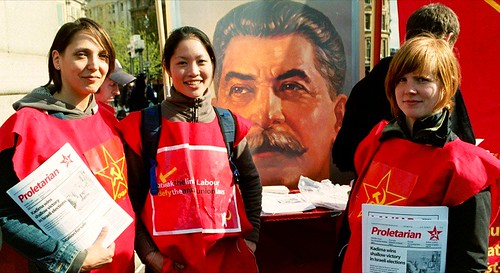
» The photo, Posing for communisim, was posted to Flickr by famous boxer and is used under a by-nc-nd licence. It was taken at the 2006 May Day protest in London and shows members of the Communist Party of Great Britain (Marxist-Leninist). The CPGB-ML website has a link to the Stalin Society, “formed in 1991 to defend Stalin and his work on the basis of fact and to refute capitalist, revisionist, opportunist and Trotskyist propaganda directed against him.” Which just goes to show… well, I don’t know what, really.
In my last Thames Path post, I commented that London’s medieval history is rarely visible except in the shape of a few street names. Which reminded me of something. When the Queen Mother (gbh) died in 2002, her coffin was laid in state in Westminster Hall for people to go and pay their respects. I was going to meet some friends for lunch, and when I arrived at London Bridge, I was startled to find myself at the end of the queue, which started in Westminster, went over the river, and ran all the way along the south bank. There was something about that moment that struck me as weirdly medieval; not just the fact that thousands of people were queuing to view the coffin of a dead royal, but the idea of a queue stretching from Westminster Abbey to Southwark Cathedral.
I know some people who think that the ceremony surrounding the Royal Family — the gold and ermine and glittery carriages — is the best reason for having them. And I can see the argument; it adds a bit of colour and texture to British life which is broadly harmless.
But it makes me twitchy. As long as the royals confine their activities to opening museums, launching ships, inspecting troops and so on, they don’t bother me at all. But all that pomp brings out the Oliver Cromwell in me. The symbolism of it all, of crowns and sceptres and thrones, of aristocrats in red robes and bishops in big hats is, well, medieval. In a bad way. And I know that very few people would admit to taking that symbolism seriously — it’s just a historical relic, right? — but it must surely have a powerful subconscious impact.
Though having said that, the massed pipes and drums of the Scottish and Irish regiments playing appropriately dirge-like music at the Queen Mother’s funeral were just fabulous.
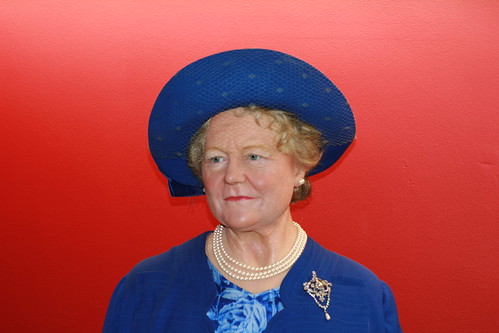
» The photo is of the waxwork in Madame Tussauds. ‘The Queen Mother (Gawd bless’er)’ was posted to Flickr by xrrr and is used under a CC by-cc-sa licence.