Categories
Nature

Proper summer visitor news!

I noticed someone had uploaded some photos of Lesser Spotted Woodpecker to Flickr which were taken in ‘Bushy Park, London’. It turns out to be the Royal deer park next to Hampton Court Palace, so I thought I’d check it out. I didn’t have much luck with the woodpeckers — some Great Spotted, loads of yaffling Green, but no Lesser Spotted.

But there were skylarks singing, a chiffchaff doing some half-hearted chiffing and chaffing, and my first proper summer bird of the year, Northern Wheatear, Oenanthe oenanthe:
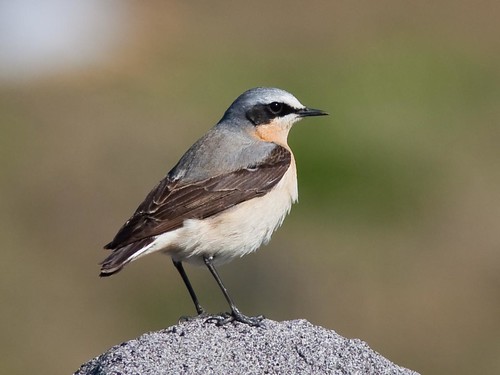
Not my photo, btw; this picture is from Iceland (© Ómar Runólfsson and used under a CC by-nc-sa licence). I did try the iPhone and binoculars trick but I wasn’t really close enough. I don’t wish to boast, but my birds were even more attractive than that one; two absolutely pristine males looking gorgeous.

The reason I say ‘proper’ summer bird is that the stonechat from a few days ago is a bit of a borderline case: some European populations are migratory, but others, including most British stonechats, are not. The specific individual I saw was presumably migrating, because there’s no other way one would turn up in a garden in south London. Perhaps it was a Swedish bird heading back after spending the winter in Spain. But you can see stonechats here in winter.

The wheatear, though, is a proper summer visitor, passing through London on its way back from Africa. In fact they have one of the most remarkable migrations of all. It’s impressive that a small bird should migrate from Sub-Saharan Africa to England, but that’s just the start: some of them carry on not just to Iceland but across the Atlantic to Greenland and Eastern Canada. Meanwhile, they also breed in Northern Asia, all the way around to Alaska, and those birds also migrate to Africa for the winter, crossing the whole of Asia to do it.

And every schoolboy birdwatchers’ favourite fact about wheatears: the name comes from the Anglo Saxon hwit aers: that is, ‘white arse’. And they do indeed flash a big white rump when they fly.
Categories
Nature

Hot migrant bird news!

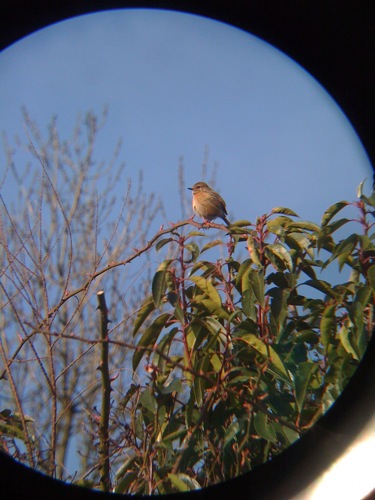
In the garden this afternoon, a female stonechat, captured here via the magic of holding my iPhone up to a pair of binoculars:

It doesn’t look like much, especially compared to the summer males, which are positively glamorous, but it’s a pretty good sighting for south London and a patch tick for me.

Interestingly a couple of other London birders who are on Twitter also had stonechats today — there was one at Wormwood Scrubs this morning and another at the London Wetland Centre in Barnes. So they are obviously passing through at the moment. It’s an unexpected benefit of Twitter, for me, the way it acts as a kind of antenna for bird movements and the changing seasons; I haven’t seen my own first butterfly of the season, but I have seen one on someone else’s twitter feed…

EDIT: and a very handsome male in Regent’s Park, as well.

Categories
Other

Cooking tips: boil potatoes in cold water

Another thing I wish someone had told me when I first started cooking: you should cook potatoes in cold water. Obviously you do need to apply heat, otherwise you just get wet potatoes. The idea is to put them in a pan of cold water and then bring it up to the boil.

I think I learned this from a TV show where it was simply stated as Truth without explanation, but you can see why it makes sense: you don’t want the outside of the potato to be cooked while the middle is still raw. That’s not a problem with something like green beans, so those can be put straight into a pan of boiling water.

So for example, to make delicious boiled new potatoes: put the potatoes into a pan, add enough cold water to just cover them, and heat it until the water starts to boil. Add some salt, put a lid on the pan, and leave it on a low heat until the potatoes are cooked (test by sticking a knife into them). Drain the water off, chuck a bit of butter and some salt and pepper into the pan. Add some chopped chives or something, if you like. Swirl the potatoes around a bit to coat them with butter, take them off the heat and leave with the lid on for a few minutes so they absorb some of the butter and seasoning.

The potatoes will retain their heat for a surprisingly long time in a covered pan, so I often put the potatoes on the heat even before I’ve decided what else I’m cooking. They’ll still be fine after sitting around for twenty minutes or so.

The other cunning tip about boiling potatoes is: don’t just throw away the water you cooked them in. It serves as a sort of basic stock, just a bit more savoury than plain water. I always use it in the gravy when I’m cooking a roast, for example. I’m not suggesting you keep little tubs of it in the freezer; just don’t tip it straight down the sink, in case it comes in handy.

» New potatoes is © Jack Hynes and used under a CC by-nc-sa licence.

Categories
Culture

‘The Kingdom of Ife’ at the British Museum

I went to the BM to see the exhibition of art from the medieval west African kingdom of Ife (now in Nigeria). Ife is most famous for some extraordinarily high quality naturalistic heads cast in brass or copper, although the exhibitions also has various other pieces, including terracotta heads in the same style, jewellery, animal pieces and so on.

These heads are of such high quality that one of the first Europeans to see them felt they couldn’t possibly have been made by Africans: instead he hypothesised that they were evidence for the lost civilisation of Atlantis. Which is, umm, a bit cringeworthy. You know you’ve got a bit of a blind spot when you think that Atlantis is a more likely explanation than a previously unknown African kingdom with a strong metalworking tradition. Its especially embarrassing because while it sounds like something some Elizabethan explorer might have come up with, it was in fact… in 1900. Yikes.

He was at least right that these are genuinely remarkable objects, superbly crafted and of great beauty. In fact if you judge art by how much it looks like the thing it portrays — the Daily Mail school of art criticism — there is something extraordinary about this little flowering of naturalistic sculpture in a continent dominated by various kinds of highly stylised art. Certainly that was the Western press reaction when the bulk of the work was found; references to an African Donatello, to African sculpture standing comparison with the great works of Greece and Italy, and to these sculptures being a great mystery of African art. Because, of course, there is no higher ambition than to produce work which fits tidily into the European tradition, and it is inherently mysterious that Africans should be able to do it.

I’m being a bit glib, but actually the exhibition had me examining my own preconceptions about art (I haven’t reached any conclusions yet). Although these days we are all much quicker to see beauty in ‘primitive’ art, not least because its profound influence on Modernism helped change our expectations of what ‘fine art’ looks like, I think most of us have at least an implicit sense of a hierarchy which sees exquisite representational art as, if not better, then more developed or more sophisticated than the highly stylised carvings which we normally associate with Africa. And so these Ife heads seem to carry a significance beyond their beauty.

But the emergence of naturalism really require any special explanation? I guess it might need a society wealthy enough for some people to work as nearly full-time artists, but beyond that maybe all it needs is a shift in fashion. In fact, perhaps representational art is the kind that needs least explanation, since the logic of ‘making things that look like other things’ is so straightforward.

All such questions aside: it’s a marvellous exhibition and if you’re passing through London in the next three months you you should go and see it.

Categories
Culture

Internet shopping WIN

I ordered some books online at 8:15am and they arrived at 1pm. Free delivery and everything! I realise they can’t reproduce this level of service for everyone — it turns out I live very close to the publisher — but it was still kind of cool.

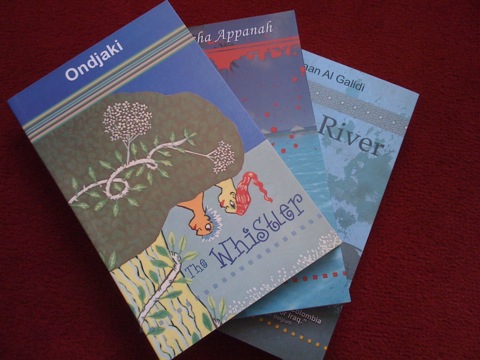
The publisher in question is Aflame Books, incidentally, a small press specialising in translated fiction from Africa, Latin America and the Middle East who I learned via the complete review are having financial difficulties. And since I need books for the Read The World challenge it made sense to order a few books from countries I haven’t ticked off yet.

Meanwhile, a minor internet shopping FAIL from Amazon via their package tracking service. Last Thursday they put some books into a van for me, drove them around south London, decided they had an incorrect address and sent them back to the depot. Harumph. They are now once again in transit; let’s see if they can find the house this time.

Categories
Culture

Céleste Boursier-Mougenot and Ron Arad at the Barbican

I went along yesterday to see the new commission by Céleste Boursier-Mougenot in the Curve gallery at the Barbican. You may have seen it on YouTube, where it has been a bit of a hit:

The set-up in the video isn’t exactly the same as the one in the gallery, but it gives you the idea: a flock of zebra finches in a room with electric guitars and up-turned cymbals, who ‘play’ the instruments by hopping around and perching on them. They are free-flying in the gallery, and you can walk on paths between the instruments.

It’s an immediately appealing idea and quite memorable, so it will probably be something of a hit, at least by the standards of contemporary art installations. To be honest, though, I thought it was less striking in reality than it was in neatly-edited little close-ups on YouTube. It was more like being in a slightly odd aviary than in some kind of extraordinary art-place. People did seem to be enjoying it, though. I slightly wonder how much of that was just the pleasure of being in among all these very tame little birds, but perhaps I’m just projecting my own reactions. I did inevitably go into birdy-man mode, noticing that they were piking up nesting material and looking in vain for somewhere to put it, wondering why they were pecking a concrete wall, looking for mating behaviour.

And while zebra finches aren’t exactly imbued with an enormous amount of dignity at the best of times, there was something slightly off-putting about seeing these little birds with their own aims and desires in life being cajoled into being art. I’m not suggesting it was inhumane: they had grass and food and water, and lots of room, so by cagebird standards it seemed like pretty good accommodation.