-
'Our forebears considered casting a “secret ballot” cowardly, underhanded, and despicable; as one South Carolinian put it, voting secretly would “destroy that noble generous openness that is characteristick of an Englishman.”'
Categories
This Yemeni novel, in what I assume is a coincidental parallel to Orwell, was written in 1984 but set in 1948; it’s about a boy who has been taken hostage by the Imam to ensure his father’s political obedience and is sent to work as a duwaydar in the Governor’s palace. A duwaydar was a personal servant, a pre-pubescent boy who filled the role that would once have been given to a eunuch: being able to work in the women’s areas of the palace without any risk to their chastity.
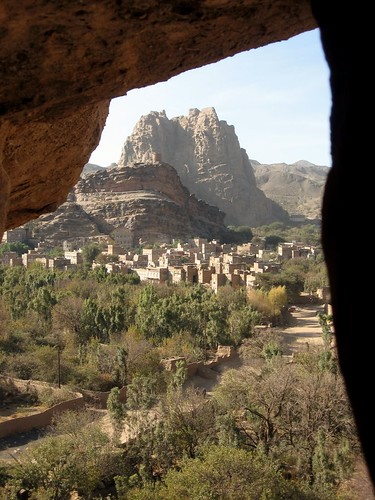
However, the women of the palace do in fact seek out the boys in search of sexual gratification; this is a novel about loss of innocence, about people who are trapped (the women as well as the hostage), about a somewhat toxic intersection of emotional, sexual and power relationships. It is also, I think, a political novel in its portrayal of the Imams’ rule as decadent and arbitrary. And in the background political events are rumbling, although they only appear as echoes within the tightly circumscribed world of the novel.
I find it quite difficult to pick passages to quote for these posts — something which more or less stands alone and gives some idea of what the book is like. But anyway. Here, our hero has just smoked his first cigarette.
It left me floating in a daze, and all I could remember next morning was that my friend hadn’t stayed therewith me, because two women, neither of them Zahra, had taken him and sat on the palace steps, kissing him and squeezing further pleasures out of him. When he came back, I remember, he slammed the door violently behind him, then sank down to sleep more deeply than I’d ever seen him sleep before.
How difficult it was to wake up in this city, so different from the fortress in the mountains, with its fresh, invigorating air! In the city, you always seemed to wake with the feeling that you’d been beaten black and blue, with your body swollen like a drum or the stump of a palm tree and your eyes drooping. From the very beginning there was a lingering feeling of nausea and depression, and you didn’t usually feel the least desire for breakfast or coffee. All you wanted was cool water, and that was only to be found, if at all, in the soldiers’ jugs.
The Hostage is my book from Yemen for the Read The World challenge.
» Note on the author’s name: there doesn’t seem to be a consensus on how to transcribe Arabic words, and I’ve seen it written in various different ways [Zayd or Zaid, Muttee, Mutee or Muti]. Zayd Mutee‘ Dammaj is the spelling used in this edition; the author’s page in the Library of Congress catalogue is under Zayd Muṭīʻ Dammāj.
The picture is ‘the view of the village from a vindow of the Imam’s palace in Wadi Dhar’ and is © Franco Pecchio but used under a CC attribution licence.
Waiting for the Wild Beasts to Vote is the life story of President Koyaga, the dictator of the (fictional) République du Golfe, as told to him by his court storyteller Bingo.
Bingo is in some ways the ultimate unreliable narrator, portraying Koyaga as a heroic, semi-mythical figure protected by powerful magic, but he is accompanied by an apprentice whose role is to speak truth to power. The result is a portrayal of post-colonial African politics which is brutal, and darkly comic.
It has the sprawling rhythms of oral storytelling, with its repetitions and parallelism, which makes it difficult to pick an excerpt which does it justice and is short enough for me to type out. But this will do: it’s a part of an account of Koyaga’s triumphal march across the country after surviving a coup.
At the entrance to a far-off village, the hunters take the initiative of offering you — since you are a sinbo, a donsoba (a master hunter) — the shoulder of a slaughtered bubale. At the next village there are shoulders, haunches, heads. At the village after that, there is a stinking mound of animal carcasses of every species: deer, monkeys, even elephants. Above the pile, the canopy of trees is black with vultures. In the sky, carrion birds attack each other with terrifying cries. Packs of hyenas, lycaons, lions follow and threaten.
The order is given that hunters should no longer offer you the shoulders of game killed by the hunters that week, need not gratify the master hunter who is their guest as their code of brotherhood demands.
In another village, to set itself apart, the sacrificial priest does not stop at two chickens and a goat, he offers four chickens, two goats and an ox to the manes of the ancestors. The sacrificial priests in neighbouring villages follow suit, they outdo him, they go too far. Soon there are twenty oxen and as many goats and forty chickens. The sacrifice becomes interminable, it is a veritable hecatomb. A call goes out for a limit to be set on the number of sacrificial victims.
Waiting for the Wild Beasts to Vote is my book from Côte d’Ivoire for the Read The World challenge.
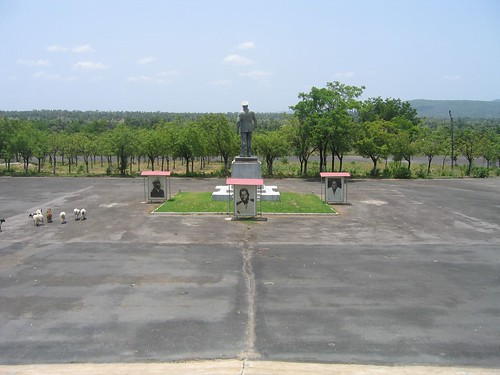
» The picture, Sarakawa Crash Site, Togo, is © Julius Cruickshank and used under a CC attribution licence. Julius explains:
“A huge monument built in the middle of nowhere to celebrate a plane crash that the dictator of Togo survived in the seventies. The photos at the base of the statue (donated by the people of North Korea) are Eyadéma’s generals that died.
The only other visitors were the goats on the left…”