Categories
Culture

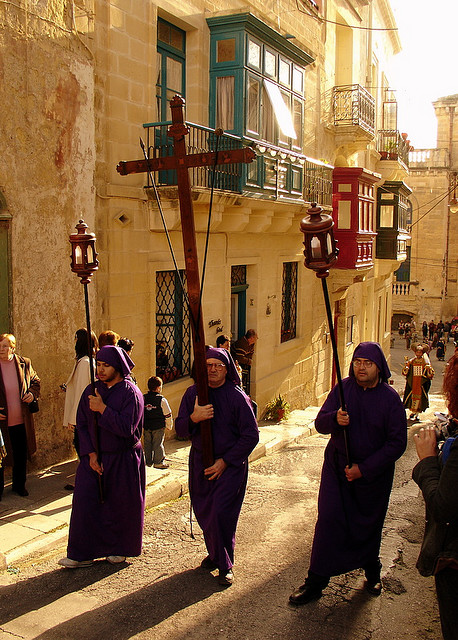
The Maltese Baron… and I Lucian by Francis Ebejer

The Maltese Baron… and I Lucian is my book from Malta for the Read The World challenge. It’s a novel narrated by an old man called Lucian which begins with the return after decades of his childhood friend, the Baron. It is the story of their fractious relationship, and Lucian’s relationship with a woman called Katarina, cutting back and forth between the present and their youth.

It has quite a successful unreliable narrator thing going on — Lucian portrays himself as an upright, moral, dignified man in contrast to the Baron’s promiscuity and vulgarity, whereas we can see that he’s a pompous selfish prick, and that the Baron, despite a few flaws, is practically heroic in comparison.

Otherwise, though, it doesn’t have much going for it. The opening chapter has some prose which is so convoluted that it was practically incomprehensible, and I initially couldn’t tell whether this was supposed to be a way of characterising the narrator, some kind of advanced literary technique that I just wasn’t grokking, or just very badly written. In the end I decided it was a combination: Ebejer was trying to characterise Lucian as stuffy and self-important, but just wasn’t quite good enough to pull it off. The main narrative is more readable, most of the time, but it’s never any better than ordinary.

» Good Friday 2007 – Malta is © Antonio Caselli and used under a CC by-nc-sa licence.

Categories
Nature

Wildlife round-up

I’ve actually done quite a lot of birding this spring, making the most of the freakishly hot weather, but I haven’t really blogged about it. So here are some pictures and whatnot.

First, some audio; this is all recorded with the built-in microphone on my phone, so apologies for the quality. These are marsh frogs, Rana ridibunda, at Rainham Marshes in Essex.

A nightingale, at Brede High Woods in Sussex, with what I think must be a blackcap in the background.

Birdsong in the evening at my local train station. A mixture of chiffchaff, song thrush, blackbird, and automated train announcement.

Another nightingale, this time from the Lee Valley, with ducks and geese in the background.

Man Orchid. So called because the flowers look like little men, although it’s hard to see that on this photo (even more amusingly man-like is the Italian Orchid, which isn’t actually Orchis berlusconii, but probably should be).

Some kind of broomrape. Maybe Ivy Broomrape? There’s something deeply fascinating about these parasitic plants.

A couple of Little Grebes.

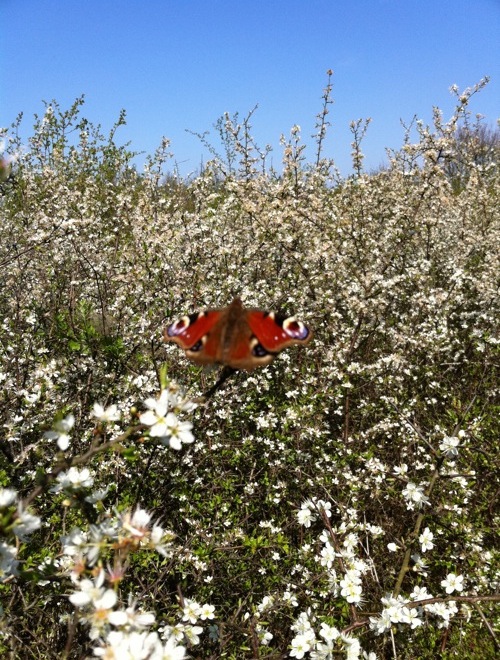
An out of focus peacock on blackthorn.

Some sea-kale, growing down on the shingle by the sea-side at Rye.

And bringing us right up to date, a beetle I found in the garden today which I don’t remember seeing before. This is the Wasp Beetle, Clytus arietis. I initially thought it was some kind of parasitic wasp hunting for food or somewhere to lay its eggs, so I guess the mimicry is working.


Wasp beetle a video by Harry R on Flickr.

Categories
Culture

The Devil That Danced on the Water by Aminatta Forna

Aminatta Forna’s father was a doctor, then activist and politician in Sierra Leone, rising to be Minister of Finance for a while before resigning in public protest at corruption in the government. But she was born in Scotland to a Scottish mother while her father was studying medicine there.

Unfortunately politics in Sierra Leone was a dangerous business. We learn at the very start of the book that, when she was ten, her father was arrested and she never saw him again, but exactly what happened to him emerges over the course of the book, so even though it is in fact a matter of historical record, I suppose the polite thing to do is to issue a MILD SPOILER ALERT before I go on to talk about it.
So, as I was saying, her father (along with fourteen other men) was arrested and charged on trumped-up charges of treason, inevitably found guilty, and hanged. They had supposedly been conspiring to blow up a government minister — an explosion at his house did take place but appears to have been staged for the purpose.

After that Forna moved to the UK permanently, but even before that she had moved frequently between Sierra Leone and the UK according to her father’s fluctuating political fortunes. That in itself would be an interesting subject for a memoir, of course, a mixed race girl with a childhood split between the UK and Africa in the 60s and 70s; but inevitably her father’s story dominates the book, and the second half is the story of her return to Sierra Leone decades later to learn as much as she can about the details of her father’s trial.

I’ve actually been putting off reading this book because it sounded a bit depressing. But once again it reinforces the basic truth: my enjoyment in books is much more dependent on the quality of the writing than the subject matter. I got pleasure from reading this book, despite everything, because it is very well written. The childhood stuff particularly; she’s good at capturing the limited understanding of a small child caught up in a complicated, adult situation.

I thought the second part, her return to Sierra Leone as an adult to investigate her father’s trial, was less interesting. Just because it’s incredibly predictable, really. It was a political show trial organised by a dictator, and it followed the familiar pattern: forced confessions, a jury stuffed with political partisans, a cowed judiciary, ‘witnesses’ motivated by self-interest or fear, the accused denied access to a lawyer. Of course I can understand why Forna felt driven to find answers, but whereas her account of her childhood is full of individual, unique details, the second part just feels weirdly like you’ve read it before. Still interesting, still worth reading, but not as engaging as the first part.

Anyway, here’s a  little extract, from a period when her father is in prison and she is living in London with her stepmother and her siblings.

I used to walk down a road, any road, and say to myself: If I can just hold my breath until I get to the end of this street Daddy will be released from prison. Or, if I was crossing a bridge and a train went underneath, I wished my father would be freed. Sometimes I’d stand there until train after train had gone by, eyes closed, amassing wishes. Three times over three years, as I cut the first slice of cake, I used my special birthday wish so I could have him back. I wished on the full moon and the new moon, and then any moon at all. At Christmas, if I found the silver sixpence Mum hid in the pudding, I wished for my father’s freedom. I wished for nothing else.

As time went on I increased my challenges: to reach the end of the road with my eyes closed without bumping into anyone or anything; to leap every other paving stone, dancing between them, promising myself that if I could make it ten yards, or twelve, or fifteen, I would somehow, miraculously earn his freedom. gradually I upped the ante: I’d work my bike up to speed then aim the front wheel at a pothole or a speed bump. If I don’t fall off, if I can stay in the saddle, then they’ll let him out of prison. Alone in the flat one afternoon I stood in the galley kitchen passing my hand as slowly as I dared across the ice-blue flame of the gas ring, once, twice, thrice, until the smell, like burnt bacon rinds, rose from the scorched ends of my fingernails.

[…]

There’s a good reason exile was once used as a punishment. It is life apart, life on hold, life in waiting. You may begin full of strength and hope, or just ignorance, but it is time, nothing more than the unending passage of time that wears down your resilience, like the drip of a tap that carves a groove in the granite below. Exile is a war of attrition on the soul, it’s a slow punishment, and it works.

The Devil That Danced on the Water is my book from Sierra Leone for the Read The World challenge. Incidentally, although this book is clearly about the politics of a particular country, the name of that country doesn’t appear on the cover once: there are four references to ‘Africa’ and none to Sierra Leone. I know that we have an unfortunate tendency to lump all of sub-Saharan Africa into one entity, but you might hope that the publisher would make some sort of effort even if no-one else does.
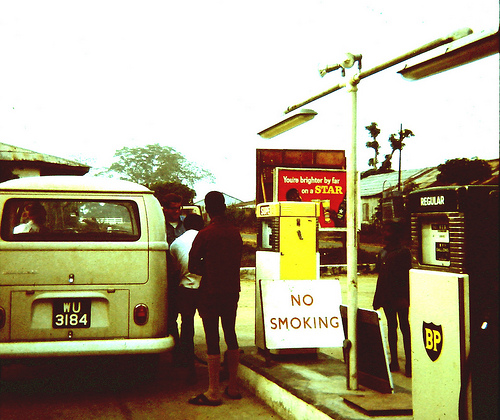
» BP Gas Station in West Africa, 1967 and Lansana Kamara (centre) at his store/pub in Kabala, Sierra Leone (West Africa), 1968 are both © John Atherton and used under a CC by-sa licence.

Categories
Other

Anticipating the Champion’s League final

It’s rather refreshing to approach the Champion’s League final, or any game, with Manchester United as distinct underdogs. I started supporting United in the first place because I was pulled in by the glamour of the big European nights, when English clubs were still feeling their way back into the competition after the Heysel ban. They would go to famous stadiums like the San Siro and the Camp Nou and it all seemed incredibly glamorous and intimidating, and it seemed like a big deal to be in the quarterfinals or the semis.

Whereas for the last few years, the top English clubs have gone away to big clubs in Italy and Germany with everyone expecting them to win, and we’ve had far too many all-English ties for the big games. Manchester United v. Chelsea might well be a good game, but it’s not exactly European. I want to see players and teams that I don’t see every week on Match of the Day.

And while Barcelona are hardly an unknown quantity — I’ve probably seen more of Barça this year than quite a few teams in the Premiership — they are definitely foreign, they’re definitely glamorous, and they’re definitely scarily good. I think United can beat them, but they might need a slice of luck to do it.

Categories
Other

Anyone But England by Mike Marqusee

Subtitle: An Outsider Looks at English Cricket. Mike Marqusee is American, although he has lived in the UK since 1971.

I guess it shouldn’t be taken for granted that an outsider will have a clearer view of cricket than someone brought up with it; it would hardly be surprising if an American who became a cricket fan was seduced by the tradition and history of it, the whole nostalgic, self-serving image cricket tends to have of itself. Paul Getty being the classic example.

But Marqusee is a left-winger who first started watching cricket during the West Indies tour of England in 1976, a series when the race and class tensions surrounding cricket were made more explicit than usual.

And so he is clearly angered, rather than attracted, by the gentility and clubbability and the bacon‑and‑egg ties. In fact, given that all that stuff is such a huge part of English cricket culture, it’s amazing that he became such a clearly devoted fan of the sport.

The result is a very pointed examination of the sins and hypocrisies of English cricket. They picked this brilliant quote for the front cover, from Test Match Special commentator Christopher Martin-Jenkins:

‘A very intelligent book, very cleverly written, with a lot that provokes thought. But I am uneasy about the way he has a go at just about everything that cricketers hold sacred’

I mean, what right-thinking person wouldn’t want to pick it up after reading that?

So it’s comparable to Derek Birley’s excellent A Social History of English Cricket in the way it provides a counterbalance to the game’s self-image; but with the focus mainly on the modern game and with rather more needle to it.

It makes uncomfortable reading at times for an English cricket fan. All those incidents which at the time seem like minor sideshows to the game itself: when you read about them all at once one after another, it starts to look pretty ugly.

I’m not sure that English cricket administrators and journalists are uniquely bad, mind you; I daresay if you subjected Australia or the West Indies or India to the same kind of inquisitorial examination, they would have their own different failings and embarrassments. But that’s a pretty weak defence.

I was reading the third edition, from 2004; one measure of my enjoyment is that when I finished I was left thinking, hmm, I wonder what Marqusee would have said about the things that have happened since: like England’s 2005 Ashes win. Or the IPL. Or Allen Stanford. So yeah, I recommend this book.

Categories
Culture

Flat Earth News by Nick Davies

This book apparently started as an attempt to get to the bottom of a particular news story which went around the world but turned out to be, broadly speaking, a load of cobblers: the Millennium Bug. Davies wanted to trace the process by which a story could start with such limited foundations and keep going round the world, gaining in momentum, and result in governments spending a fortune on what turned out to be a non-problem — as proved by countries like Italy, who didn’t bother to do anything about it and were just fine.

But the book ended up being a much broader condemnation of the news media’s systemic failure to do its their job properly: assuming you think its job is to tell us the truth about what is happening in the world.

Interestingly, the most common accusation — political bias in the interest of newspaper proprietors — actually comes fairly low on his list of worries. The Millennium Bug story is a good example from that point of view; it would take an exceptionally conspiratorial mindset to claim that it was whipped up because Rupert Murdoch had some kind of financial interest in it.

He suggests instead that the biggest single problem is more prosaic and more fundamental: that news organisations are understaffed. The logic of commercial efficiency has led to newspapers employing less people to produce the same amount of content: not just reducing the total number, but shedding particular categories like regional reporters and court reporters. Meanwhile the same process has happened at the local newspapers and wire services that were another source of stories to the national press. And something has to give. Forget real investigative journalism: simple fact-checking becomes a luxury.

And of course journalists don’t need to be malevolent or deceitful to produce bad journalism. They don’t need to actively choose to tell untruths; simply not caring whether something is true is bad enough.

So if the newspapers aren’t employing enough people to gather news properly, how do they find enough stuff to fill their pages? Well, the first source is wire services (the Press Association, AP, Reuters etc). At least those are real journalists, although they are overstretched themselves and only claim to offer accurate quotes rather than true fact-checking. But all the news outlets are getting their stories from the same wire services, so it doesn’t exactly produce variety. The whole system becomes one big echo-chamber.

And the other huge source of content is PR. A huge percentage of so-called ‘news’ is directly reproduced from someone’s press release. Isn’t that reassuring.

The book also gets into the world of government propaganda, including the truly staggering scale of CIA spending on media and propaganda during the Cold War (did you know the the CIA owned loads of foreign newspapers? I mean, seriously, what the fuck?) and the suggestion that the War on Terror has given them an opportunity to ramp up their activity again. It looks into the ‘Dark Arts’; i.e. illegal news-gathering activities by British newspapers, including but not limited to the phone-hacking which has been in the news lately. And there are some case studies of bad practice: the decline of the Sunday Times Insight team (key quote: ‘there are some journalists who would rather inhale vomit than work for Andrew Neil’), the failure of the Observer in the build up to the Iraq War (inexperienced editors seduced by their cosy relationship with Number 10 end up just parroting the government line), and the Daily Mail (for being the Daily Mail, basically, except that the racism of the paper is even more overt than I appreciated).

Anyway, it’s thought-provoking, interesting stuff. I’ve no idea how fair it is, but it all has the dismal ring of truth to me.