Categories
Culture

The Mitfords: Letters Between Six Sisters

The Mitfords: Letters Between Six Sisters, edited by Charlotte Mosley, is a selection of letters between the various Mitford sisters, who were an extraordinary bunch. From oldest to youngest: Nancy was the novelist who wrote Love In A Cold Climate and The Pursuit of Love; Pamela was least remarkable; Diana married Oswald Mosley, leader of the British Union of Fascists; Unity went off to Germany and became a personal friend of Hitler; Jessica ran away from home to join a cousin fighting on the communist side in the Spanish Civil War, and became a civil rights activist and writer in America; and Deborah, the only surviving sister, is now Duchess of Devonshire and spent most of her life working to make Chatsworth House into a profitable outfit.

Among the notable names that crop up: Hitler, Goebbels, Churchill, Harold Macmillan, General de Gaulle, JFK, John Betjemen, Evelyn Waugh, The Duke and Duchess of Windsor, the Queen, the Queen Mother, Prince Charles, Princess Diana, Lucien Freud, Francis Bacon, Patrick Leigh Fermor, Noel Coward… so there’s lots of good material there. 
The main interest in the early part of the book is the Big History stuff: the Nazis and Hitler most of all. I read it trying to get some sense of what appealed to Unity and Diana about Fascism, but although there are lots of letters about Hitler, and going to rallies and so on, I never quite got a handle on it. I suspect that for Diana, it was as much because of her attraction to Oswald Mosley as any ideology, but it can’t have just been that. And Unity seems to have had an with Hitler before she met him in the way someone might have an obsession with Elvis or Princess Diana. She found out where he regularly went to eat and kept going there until she had the chance to wangle an introduction.

I suppose since half of Europe went Fascist in the thirties, there’s no need for a special explanation. The same thing appealed to them as to everyone else: whatever that was. It’s perhaps easier to look back and empathise with the appeal of communism, but still, with that too it would be interesting to know what triggered it: was there some particular conversation or book? What would be enough to make Jessica run off to Spain in pursuit of it?

As the book goes on and the sisters get older and less active, the focus narrows down from these Big Issues onto their family dynamics, which are often made rather tense by the growing interest in them and the various books and TV programmes made by themselves and others. It’s still fascinating, though. 

It helps that they all write well: their letters are chatty, funny, sometimes serious, and frequently quite bitchy. Nancy had the sharpest edge, but they all had their caustic moments. I probably ought to quote something, so here’s a fairly random bit that I thought showed a sharp eye. This is Diana writing to Deborah in 1960; Max is her son. He’s the Max Mosley currently in the news, as it happens.

Yesterday Max fetched me in the Austin Healey Sprite & drove me to Oxford where Jean had made a delicious middle day dinner. The flat is marvellous, not one ugly thing, & a view over playing fields to real country & a garden with an apple tree. ALL the wedding presents were being used — your car, Desmond’s china, Emma’s Derby ware, Viv’s pressure cooker, Muv’s pink blanket on the bed and (pièce de résistance) Wife’s coffee set — also of course Freddy Bailey’s canteen of silver.

Oh Debo, the pathos of the young. Don’t let’s think.

Charlotte Mosley, who edited the book, is daughter-in-law of Diana, so one wonders if she is, or could be, completely objective — it’s impossible to know whether she has quietly laundered anything out, and apparently, even at 800 pages, what appears in the book is a tiny percentage of the total — but I thoroughly enjoyed it.

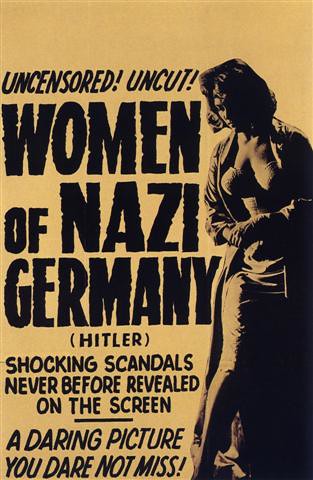
» the image, which has nothing to do with the Mitfords beyond the obvious, is POSTER – WOMEN OF NAZI GERMANY, posted to Flickr by Bristle’s Film Posters [ W1 ]. If it’s working, that is: Flickr seems a little flaky today.
Categories
Culture

Cabaret

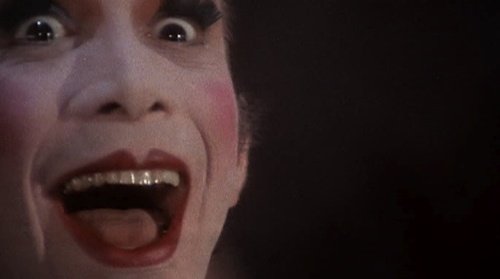
I watched Cabaret again tonight. First thing: it really is a very good film, and if by some chance you haven’t seen it, hurry up and do so.

I was struck by how grown up it seems: it touches on serious subjects (Nazis! homosexuality! abortion!) but does so, mainly, in a stylishly, darkly humorous way. It made me wonder when I last saw a new movie which didn’t talk down to its audience.

It also made me want to read some Christopher Isherwood.

Categories
Culture

Cy Twombly at Tate Modern

I went to the Twombly exhibition at Tate Modern today. What a fabulous name, btw: I tried climbing the Eiffel Tower but the height made me go all twombly.

He’s not someone I knew much about beforehand, and I don’t know how excited I would have been if I had known; he does what you might describe as scribbly abstracts. In fact with some of the the early ones, white covered with scrawly pencil marks, you wouldn’t be totally surprised if you were told they were taken from the wall of a particularly chaotic primary school. Or perhaps, given the presence of crudely-drawn genitalia and thick gobs of turd-brown paint smeared on with the fingers, a nineteenth-century lunatic asylum.

The paintings in the exhibition, which covers his whole career, are nearly all large whitish canvases with various kinds of roughly-applied scrawls, smears and squiggles. The colours, the media used, and the arrangement of the marks all vary, but there’s a clear continuity through the work. Despite the brief outbreak of genitalia they are overwhelmingly abstract; only the titles and a few scrawly bits of text give you a hint of what they are ‘about’. The two main themes seem to be classical myth and particular places, mainly I think in Italy where he works.

'Quattro Stagioni: Autunno' by Cy Twombly

When I say I might not have been excited to see the show had I known what the work was like, it’s because I find myself increasingly unsympathetic towards non-representational art. Which is a bit philistinic, I know, and I don’t want to get too Daily Mail about it — I do know there’s a baby somewhere in the bathwater — but I think it’s just a sense that when abstract art doesn’t work it’s really exceptionally dull, and I’m not sure even the most successful stuff can ever reach the heights, or have the richness, of representational work.

Having said all that, I did actually enjoy this exhibition. Twombly has the knack of producing charismatic objects. Even the paintings which appear most messy and haphazard have a kind of presence to them. I was going to say that they are more than the sum of their parts, but perhaps it’s that they don’t seem like the sum of parts at all: they come across as organic wholes. Why that is true strikes me as a deepish mystery. The sheer size of them helps give them authority: the painting above, which is perhaps 8’×5′, is typical. There’s a room of much smaller works, about 18 inches square, and although I quite liked those too, they were that much easier to ignore.

» The painting, Quattro Stagioni: Autunno, is © Cy Twombly; the picture is taken from the exhibition website.

Categories
Culture

Happy Bloomsday

June 16th is Bloomsday, the date that Leopold Bloom spends wandering the streets of Dublin in Ulysses.

The picture above is taken from Joyce Images, a site ‘dedicated to illustrating Ulysses using period documents’. And here’s a bit of Sirens:

Bronze by gold, Miss Douce’s head by Miss Kennedy’s head, over the crossblind of the Ormond bar heard the viceregal hoofs go by, ringing steel.
— Is that her? asked Miss Kennedy.
Miss Douce said yes, sitting with his ex, pearl grey and eau de Nil.
— Exquisite contrast, Miss Kennedy said.
When all agog Miss Douce said eagerly:
— Look at the fellow in the tall silk.
— Who? Where? gold asked more eagerly.
— In the second carriage, Miss Douce’s wet lips said, laughing in the sun. He’s looking. Mind till I see.
She darted, bronze, to the backmost corner, flattening her face against the pane in a halo of hurried breath.
Her wet lips tittered:
— He’s killed looking back.
She laughed:
— O wept! Aren’t men frightful idiots?
With sadness.
Miss Kennedy sauntered sadly from bright light, twining a loose hair behind an ear. Sauntering sadly, gold no more, she twisted twined a hair. Sadly she twined in sauntering gold hair behind a curving ear.
— It’s them has the fine times, sadly then she said.

Categories
Culture

The Invention of Tradition

The Invention of Tradition, edited by Eric Hobsbawm and Terence Ranger, is a selection of essays by different historians. To quote the blurb: 

Many of the traditions which we think of as ancient in their origins were, in fact, invented comparatively recently. This book explores examples of this process of invention […]

There’s a great quote in the section on the British monarchy. This is Lord Robert Cecil in 1860, after watching Queen Victoria open parliament:

Some nations have a gift for ceremonial. […] This aptitude is generally confined to the people of a southern climate and of a non-Teutonic parentage. In England the case is exactly the reverse. We can afford to be more splendid than most nations; but some malignant spell broods over all our most solemn ceremonials, and inserts into them some feature which makes them all ridiculous… Something always breaks down, somebody contrives to escape doing his part, or some bye-motive is suffered to interfere and ruin it all.

150 years later, the British have bigger, more pompous and more gilt-ridden ceremonies than almost anyone, and we see ourselves as especially good at pageantry: the opening of parliament, coronations, jubilees, royal weddings and funerals, and all of it presented as though it was ancient continuous tradition. And in fact much of the content, at least for the coronation, is ancient: it’s just that between the early 17th and late 19th centuries, the preparation was generally half-arsed and the results shambolic. Apart from anything else, the symbolism was awkward; Britain was a democracy of a sort, and as long as the monarch was a partisan political figure people were reluctant to surround them with all the trappings of divinely-provided power. It was only once the monarch was reduced to a figurehead that we could safely put them in the centre of these grand pantomimes.

The book also has an essay about the Scots (all that twaddle about clan tartans) and the Welsh (druids and the Eisteddfod), but those stories were broadly familiar, so in some ways the bits I found most interesting were about the British inventing traditions out in the Empire. For example, in India, where they had the problem of how best to assert Imperial authority over a ‘country’ which was in fact hundreds of small kingdoms held together by force, and how to project Queen Victoria as the focus of that authority while she was thousands of miles away. And although the British had been in India for a long time by then, this represented a new focus, since it was only in the wake of the Sepoy Mutiny/India’s First War of Independence in 1857 that control of India was taken from the East India Company and taken over by the state.

So in 1876 they held the ‘Imperial Assemblage’ to mark Victoria’s accession to her imperial title as ‘Kaiser-i-Hind’ when Indian kings/princes/maharajas gathered with their entourages at a site near Delhi to take turns to approach a pavilion decorated in British heraldic imagery, and each was presented with a banner which had a coat of arms in the European heraldic tradition, designed for the occasion by a Bengal civil servant called Robert Taylor. It sounds like an extraordinary event: apart from the basic weirdness of it, the scale was immense; ‘at least eighty four thousand people’ attended in one role or another. Sadly I haven’t managed to find a picture of the event, but below is the banner presented to Rajabahadur Raghunath Savant Bhonsle, the ruler of Savantvadi.

banner presented to the ruler of Savantvadi

Thinking about all this reminded me of my own little moment of inventing tradition. When I was at university, there a couple of people at my halls of residence who wanted to start an all-male discussion club where the members would take turns to present a little speech on some interesting topic, and then everyone would drink sherry and discuss. A couple of friends and I took great delight in coming up with a ludicrously silly constitution for the club, which laid down arcane traditions and provided bizarre titles for the various officers. For example, every meeting was supposed to start with ‘the toasting of the Pope’: a different Pope each week, working through them in chronological order from St Peter onwards. There was no Catholic connection, pro or anti; I think it was just that the phrase ‘the toasting of the Pope’ was amusing. In the event there was one meeting and then the club fizzled out. And a good thing too, frankly.

Actually, though, the whole episode was rather fitting; after all, the University of Bristol itself is an institution whose landmark building is a vast Gothic edifice built not in the middle ages, or even at the height of the Gothic Revival in the mid C19th, but in 1915. Pretending to be older than it is — pretending to be Oxbridge, really — is what Bristol does.

Anyway, the book is interesting; some of the essays are better than others — Hobsbawm’s own contribution struck me as especially weak — but I’m glad I read it. A slight typographical gripe: irritatingly, quoted passages are marked only by the left margin being indented exactly as much as the first line of each paragraph is indented, which makes it extremely unobvious which paragraphs are quoted. I’m not suggesting that’s a reason to avoid the book; I was just irritated by it.

» img364, posted to flickr by Black and white archive, shows the 1953 Coronation celebrations in Edith Road, Smethwick. The banner is from the British Library.

Categories
Culture

The Muybridge Problem

I was wondering this morning why it is that narrative paintings always seem to fall so flat for a modern viewer (i.e. me). Not just those cheesy C19th paintings with titles like A Soldier Returns; even paintings by artists I find more sympathetic — Rembrandt, Goya, Velazquez — seem very obviously unconvincing when they try to capture a spontaneous moment. It occurred to me that the explanation might simply be what you could call the Muybridge problem.

Famously, Eadweard Muybridge started taking his high-speed photographs in an attempt to answer the question: do horses ever have all four hooves off the ground when they gallop? The answer turned out to be yes: but not quite what everyone expected. Before that, even someone as devoted to the careful study of the horse as Stubbs had painted galloping horses with all four feet off the ground when their legs were outstretched; in fact a galloping horse only has all feet off the ground when they are bent underneath it.

But if you have seen lots of photos of running horses, all those old paintings of horses flying like Superman over Epsom Downs look faintly but irretrievably ludicrous. Photography has permanently changed what we think things look like; and that doesn’t just apply to horses.

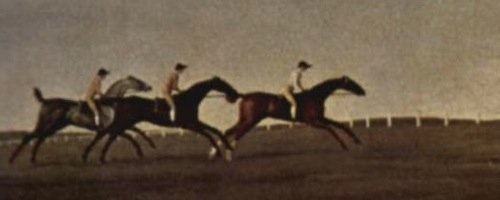
» The Stubbs is a detail from Gimcrack on Newmarket Heath, with a Trainer, a Stable-Lad, and a Jockey; the Muybridge is a detail from The Horse in Motion, both from Wikimedia Commons.