Categories
Culture

The Mabinogion trans. Sioned Davies

I didn’t do my normal thing of looking for appropriate reading materials before going on holiday — I mean, I’d already read How Green Was My Valley and Under Milk Wood, so there didn’t seem to be much point in looking for anything else.*

But when I was running out of reading matter and went to the bookshop in St David’s, I was half-looking for something Welsh and settled on the Mabinogion. I knew the name but nothing else about it; as it turns out, it’s not one work at all; it’s a selection of medieval Welsh stories from several manuscripts. Some of them form connected groups, but it was the C19th translator Lady Charlotte Guest who put this selection of stories together and gave them their usual title.

See

Many of them are set in the court of King Arthur, and the most conventional seemed just like the equivalent English stories. I’m open to persuasion that, as the translator’s introduction claims, there is some kind of distinctive Welsh character to them; but I can’t bring myself to care very deeply. I tend to find all those medieval romances kind of boring.

Some of the stories are more distinctive, though, and more interesting: most notably the ‘four branches of the Mabinogi’ from which the collection takes its title. I think with most Arthurian stories, even though they feature magic and strange creatures, they operate according to a narrative logic that seems familiar to us, whether because it was in some way the ancestor of the modern novel, or because of the regular bursts of of medieval revivalism that have revisited the material. With the ‘four branches’ that doesn’t seem true: they are odder and untidier. It’s hard to explain; you might have to read them if you’re curious.

They reminded me slightly of the Haida stories translated by Robert Bringhurst, so I wonder if it’s a property of oral storytelling that we just get glimpses of in the remnants of oral culture that survive here and there in manuscript form. Partially perhaps it’s an episodic form: the story teller pulls together various episodes and mini-stories, and the emphasis is different every time, without perhaps the need to tidy it into a neat overall narrative. Or maybe there’s a kind of dynamic that’s created when you’re telling stories to people who already know them. 

This is apparently a very new translation, only in the shops a week or two before I bought it. I can’t possibly assess it as a translation, since I don’t know any Welsh and haven’t read any other editions, but I found it readable and the introduction and notes were helpful, so I give it a thumbs up.

*No, not really. It just didn’t occur to me to think about it until too late, for some reason. Incidentally, How Green Was My Valley was, in a slightly cheesy way, a much better book than I was expecting. I think I ended up leaving my copy in Tokyo, though.

The picture, incidentally, is a bit of cosplay from a fan of the Korean MMORPG called Mabinogi.

Categories
Culture

The Transit of Venus by Shirley Hazzard

Like Marilynne Robinson’s Housekeeping, I bought this on the basis of a Bryan Appleyard article where he mentioned Hazzard as one of his contenders for greatest living novelist; in fact, he entertained the possibility that The Transit of Venus was ‘the most perfect novel written in the past 100 years’.

I was less taken by this one than the Robinson. Don’t get me wrong, it’s a good novel: lots of strong characters, a sense of time and place, a rich and engaging plot. And occasionally it’s very funny; there’s a vein of acid social satire running through it which just helps give it a bit of an edge. There’s an account of the changing reputation of a poet over his career which is absolutely superb, for example.

And yet… it never quite wowed me as much as Housekeeping. That novel, for me, had a touch of magic and uniqueness to it that made it really stand out. ToV by comparison seems ordinary. A very good example of a conventional novel, but conventional nonetheless. It didn’t help that I never quite settled with the prose style. It has a kind of staccato portentousness that, even after a couple of hundred pages, still kept niggling slightly.

If I sound rather negative, it’s only relative to the claim that the book is the most perfect of the past 100 years; it’s a good book, I’m glad I read it, and I’d generally recommend it. But for whatever reason of personal taste or mood, it didn’t blow me away. Shrug.

Categories
Culture

The Secret Agent by Joseph Conrad

This is one of the great novelistic portraits of London: a London full of smoke and fog, seedy backstreet pubs, horse-drawn cabs, and gaslights. That’s what I like best about it, really, the London it creates and the grotesque characters that inhabit it: Verloc himself, the secret agent and seller of pornography, his coterie of seedy, ageing and probably ineffectual foreign anarchists and revolutionaries, the police chief on his trail, the idiot brother. All of that is done brilliantly. One vaguely assumes that as a European immigrant to London himself, Conrad was drawing on personal experience in his portrayal of the anarchists, but it’s just as possible that he made it all up. In fact, reading my own description of it, it makes it sound like he set out to write a parody of a Sherlock Holmes novel.

On the whole, I think that when it gets into the psychodrama at the end — his wife’s reaction to what has happened — it becomes a bit less interesting. But it’s still a great book.

Categories
Culture

Shakespeare: The Biography by Peter Ackroyd

The definite article in the title seems a little hubristic. I don’t know if this is the definitive biography of Shakespeare — haven’t read any of the hundreds of others — but I certainly enjoyed it.

I don’t know if I completely trust Ackroyd as a historian; it’s probably unfair, but I just get a nagging sense sometimes that he’s a bit too fond of a good story. He has clearly done a ton of research, though, and as you’d expect he’s very good at providing historical context. And he writes well.

bar in Neuchatel, found on flickr, used under a CC licence

There’s a perception, perhaps, that we have very little historical record of Shakespeare other than the plays themselves, so if anything I was surprised by how much material there was: legal stuff, references to him in other people’s writing and so on. Certainly there’s enough to build up a broad-brush picture of his life. What there isn’t is much that is truly personal: no letters back and forth between London and Stratford, no learned essays on theatrical technique, no gossipy personal journal.

So instead of the common pattern of literary biographies, where the biographer tries to use the details of the life to shed light on the work, here it’s more often the other way round: trying to mine the plays and poems for details that might tell us something about his life. It’s all hints and scraps, and any conclusions are tentative and contingent, but it’s all quite interesting even so.

In the end, I think Shakespeare remains elusive: but then, if we knew every moment of his life, I suspect it would only serve to emphasise the fundamental mysteriousness of genius. What biographical detail could possibly be adequate as an explanation?

» Pub sign in Neuchatel, Switzerland, posted to Flickr by iwouldstay (Stefan) and used under a by-nc-sa licence.

Categories
Culture

Prokudin-Gorskii photographs

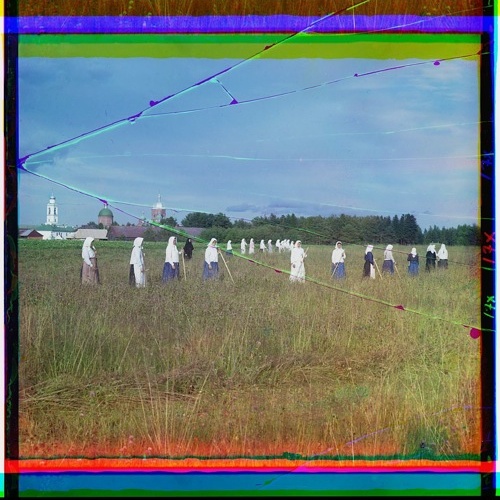
I’ve actually linked to these before, but a post over at i heart photograph reminded me about them and I was browsing through them again. Sergei Mikhailovich Prokudin-Gorskii was a Russian photographer taking colour pictures in the years before the Great War. He took three black and white negatives of each subject using different coloured filters, then reassembled them using a projector and coloured light.

The Library of Congress have used a digital version of this process to recreate the images and have put them online. The one above is a harvest scene from 1909, but also check out i.e. Woman in Samarkand, dog, Siberian scenery, Georgian woman in national costume. [as Jean points out, those links don’t work: you’ll just have to browse the collection]

I find the particular aesthetic of the lurid coloured borders as appealing as the subjects, though those clearly have historical and ethnographic interest. 

Categories
Culture

The Century of Revolution by Christopher Hill

The full title is The Century of Revolution, 1603-1714; i.e. the century in question is the longish C17th from the death of Queen Elizabeth to the death of Queen Anne. I guess most centuries are centuries of revolution somewhere, and in one way or another, but the C17th was the only time the English have had an actual literal political revolution. In fact we had two, or one and a half. The first one, in the 1640s, definitely was a revolution — with parliament deciding to put an axe through the king’s neck, and power resting with the army and so on — but is usually referred to as the ‘Civil War’. The second one is referred to, at least by the English, as ‘the Glorious Revolution’, but was really something else: half invasion, half coup. It’s probably a bit strong to describe it as the Dutch conquest of England, but it was probably something closer to that than a ‘revolution’.

I bought this book because I was aware of a gaping hole in my knowledge of British history when it came to this period; I mean, my historical knowledge is patchy anyway, but I’ve read quite a few books about the C18th and C19th, and some about the Tudors and the medieval period, whereas my knowledge of the C17th didn’t go much beyond the clichés; right but repulsive vs. wrong but wromantic, and all that. So I bought this book hoping to get an overview.

And it did provide that; if anything I think I should have gone for something slightly more specific. A book that covers a whole century of history in a few hundred pages is inevitably going to be a firehose of facts; an enormous amount to take in, and not much of the kind of detailed context and human interest that sugars the pill a bit when reading history. Hill divides the period up into four sections, and for each, he organises the material into  ‘Narrative of Events’, ‘Economics’, ‘Politics and Constitution’ and ‘Religion and Ideas’. Which works pretty well, and I do feel that I’ve been given a good grounding in what was going on. I don’t know how much of it I’ve retained, though. If I was really serious about trying to get a handle on the period, I should probably read it again. Which I don’t think is going to happen.

It’s an interesting period, though. The Elizabethans seem so distant and exotic; the Georgians are so modern in comparison, and that difference, that spectacular change, is what makes the C17th so fascinating. Constitutional power shifted from the monarch to Parliament, Cabinet appeared, the civil service started to develop, economic power shifted from the landed gentry to industrialists and merchants, the stock market was established, credit notes removed the need for all business to be done using discs of shiny metal, the religious monopoly of the Church of England was broken, Britain became a dominant naval power, agriculture was modernised. We became modern: or at least more modern than most.

» The photo of a Loyalist mural in Belfast was posted to Flickr by Benjamin Harrison and is used under a CC by-nc licence.