Categories
Culture Other

Yay for Salman

Some of the response to Rushdie’s knighthood has startled me. Take, for example, this letter to the Times:

Sir, Did the genius who recommended Salman Rushdie for a knighthood not realise the offence that it would cause to the Muslim world after The Satanic Verses debacle or was this calculated? And exactly why did he get a knighthood – he has done nothing for Britain other than cost the taxpayer a fortune in police protection for writing a book the majority never read?

I genuinely didn’t expect to see so much of this kind of thing, although in retrospect, I obviously should have. It’s not surprising that Iran and Pakistan should complain, and since it would perhaps be unnecessarily undiplomatic to tell them to mind their own fucking business, I don’t even mind the British government being mildly conciliatory in response.

But letters like the one above are just extraordinary. All questions of free speech aside, surely providing protection for people whose lives have been threatened by dangerous extremists is exactly the sort of thing the police should be doing? And the idea that we should not give a knighthood to someone because we want to avoid giving offence to the kind of people who issue death threats to novelists is horrifying. It goes so clearly against what I would hope were the core values of our society—freedom of speech, freedom of religion and the rule of law, for a start—that I can’t quite believe that I have to actually say so. I vaguely feel that I’m contributing to the kittens are cute and Scarlett Johansson is hot school of blogging the bloody obvious; but apparently there are people who disagree.

The fact that the sensibilities offended were religious is irrelevant, for me. If the people Rushdie had offended were political extremists instead—if, say, the complaints were coming in from the old apartheid South Africa, or China—I would still want them to mind their own fucking business. But then, perhaps if the complaints weren’t wrapped up in religion, we wouldn’t get people writing such pathetic, squirming, weaselly letters about it to the Times.

Categories
Culture Other

We Are At War by Simon Garfield

This is one of a trilogy of books using material from the Mass-Observation archives. To quote Wikipedia:

Mass-Observation was a United Kingdom social research organisation founded in 1937. Their work ended in the mid 1950s … Mass-Observation aimed to record everyday life in Britain through a panel of around 500 untrained volunteer observers who either maintained diaries or replied to open-ended questionnaires.

We Are At War is an account of the period from August 1939 to about the start of the Blitz, compiled from the diaries of five M-O participants. It’s a simple idea and it works brilliantly. The diaries combine the texture of everyday life—people write about the weather or what’s on the radio—with the backdrop of great events happening in Europe.

barrage balloon

[photo from the Museum of London picture library]

People’s moods—not just the diarists, but their workmates and family—are one of the most interesting things: swings between optimism and pessimism about the war, including, in the early stages, whether it was even going to happen; the stress of expecting air raids for months before they actually start happening; endless gossip about German spies supposedly having been arrested after committing some faux pas to reveal their identity; a distrust of official news and an uneasy fascination with listening to Lord Haw-Haw.

One thing that’s noticeable is a gradual hardening of attitudes towards the Germans; initially people try to maintain some kind of distinction between the Nazis and the German people, and express some kind of regret at news of German casualties, but they get increasingly ruthless as time goes on and British casualties rise.

I could quote almost any chunk of this book; but this will do, from February 1940 in Glasgow:

Recently Miss Crawford saw a notice in a fish shop: ‘Fish cheap today.’ On looking closer she found the stock consisted of a few pieces of sole at 3s 4d. Since the war broke out I have stopped looking at the fish shops for I know the prices would be too high. It transpires that practically everyone has ceased to eat fish, but the price is not the sole cause. Miss Carswell said she could not bear to eat fish because she remembered what perils the fisherman had been through to get it. Then she continued that she could not bear to eat fish in case they had been feeding on all the dead bodies. Her mother had offered her tinned salmon. ‘for that had been canned before the war began’.

(As usual, this review has also been posted to my recently read books section.)

Categories
Culture

Welcome to a Golden Age

Apparently someone has declared that poetry is dead again. Or still dead.

As a critical stance this lacks originality, but never mind. I’m just surprised anyone thinks they can tell. Looking back at the canon, the total difference between a Golden Age Of Poetry and a leaden one is two or three great poets who happen to live at the same time. And if you think you can tell whether any of the dozens of good poets currently writing will be regarded as great in 50 years time, let alone 100: you’re kidding yourself. Even if none of the established names make the cut, those three poets might be starting their careers somewhere right now. Perhaps they are recent graduates of one of those MFA programs that always seem to be one of the targets of these essays.

Categories
Culture Nature

Video digiscoping experiment

It just occurred to me a couple of days ago that since my digital camera has a video mode, I could try digiscoping some video. I thought it came out fairly well, considering. I just hold the camera up to the telescope, so it’s a bit wobbly, and the audio is dominated by aeroplane noise, and the YouTube conversion hasn’t improved it, but I’ll certainly consider doing it again next time I’m doing proper birding. This is a greenfinch, btw.

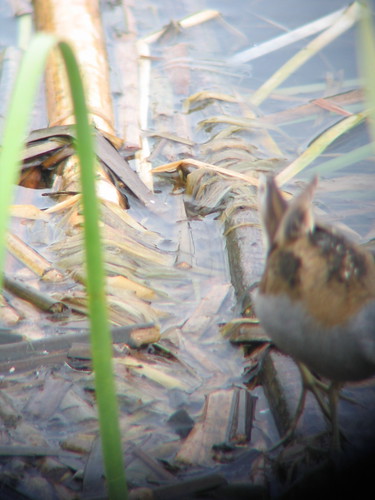
I wish I’d thought of it when I was in Crete, when there was a Little Crake walking backwards and forwards past the same spot over and over again but because of the difficulty of timing the shot, I mainly got lots of pictures like this:

Little Crake walking out of shot

And while I’m on garden wildlife, look what was in the basement light well. His price for being rescued was having his photograph taken with flash. There are lots of frogs and newts, but it’s a very long time since I’ve seen a toad here.

little toad

Categories
Culture

Train songs

Larry has posted a whole compilation of train-themed soul music over at Funky16Corners, which seemed like as good a reason as any to post this video:

Trains are a big presence in American music, of course: blues, jazz, rock and roll all have their great train songs. I don’t think they’ve ever had quite the same associations in Europe, perhaps because our countries are just physically too small. There’s never been a great British road movie, either.

Still, there’s a different kind of romance to European train travel; the idea of buying a ticket in Paris and waking up the next morning in Vienna, or Milan, or Barcelona. Between school and university I went travelling around Europe by train with friends. That was before the Channel Tunnel, so it was a long first day: London-Dover, then the ferry, then a train to Paris, then walking across Paris from the Gare du Nord to the Gare de Lyon to get a train heading south. But the next morning, I took one look out of the window and could see we were in Italy; the buildings, the whole look of the landscape, had changed.

Going by easyJet just isn’t the same.

Categories
Culture

‘Surreal Things’ at the V&A

Last week I went to ‘Surreal Things: Surrealism and Design‘ at the V&A. It explores the influence of Surrealist art on design, and demonstrates how quickly surrealist imagery was recycled as a design style; initially in very chic and expensive contexts and then in mass-market commercial design. And demonstrated in the process that it’s a very rare image that still manages to be startling, unsettling and generally unheimlich when used as curtain fabric.

Ruby Lips Brooch by Salvador Dali

That’s true even before the adoption of this imagery into the mainstream. One part of the exhibition was about the house of an art collector who was an early enthusiast of Surrealism. His house was painted purple; it had plaster shapes on the walls to look like sheets hanging out of the windows and huge model palm trees on either side of the door; he had the iconic Dali lobster telephones and Mae West Lips sofa, wolf pawprint carpets, and specially designed china, lamps and so on.

But if Surrealism is a radical exploration of the subconscious, dreams, sexuality and so on, what does it mean to fill a whole house with surreal objects? I suppose the collector might have claimed that the whole house was one Surrealist artwork, but it seems to me that once you’ve decided to use Surrealism as a interior design choice, you’ve already neutered it; it just becomes a set of visual tics.

'Eine Kleine Nachtmusik' by Dorothea Tanning

Surrealism is always very vulnerable to that loss of power; like a lot of modern art, the moment the audience stops taking it seriously, it’s very hard to recapture the mystique. The most iconic, striking surrealist works—the lobster telephone, the fur-lined cup, some of those Magritte paintings—are also the most easily absorbed as likeable mainstream objects. You can enjoy them as visual jokes or intellectual puzzles and they are memorable and interesting; but without the unsettling, dangerous quality that I think Surrealism aspires to. There’s a very easy slippage from powerfully strange to amusingly quirky.