Categories
Other

Nkosi Sikelel’ iAfrika

So, the World Cup is almost upon us, and inevitably our attention has been narrowed in on the nervy minutiae of squad selections and injury worries and tactical arguments. So before the action starts, can I just take a moment to say how fucking marvellous it is to see the World Cup being hosted in Africa.

I do understand that there are commercial and practical reasons why the USA and Japan both got to host the tournament before an African nation, but it’s not particularly edifying to watch a desparate FIFA trying to break America like some bloated, bombastic Robbie Williams.

How much nicer it is to see the World Cup finally go to the third great heartland of football, somewhere where the locals will be hugely excited to have it. And having seen the ICC manage to host a cricket tournament in the West Indies without any Caribbean atmosphere, let’s hope that the clammy corporate hand of FIFA doesn’t manage to drain all the Africanness out of the experience.

Categories
Other

Horsetrading and backroom deals?

We’ve heard a lot in the last fortnight about horsetrading and haggling among our politicians, and some commentators profess to be deeply offended by it all. But surely negotiation and compromise is how policy is always arrived at: it’s just not usually so obvious.

Even within a normal single-party majority government, there must be disagreements about policy; and even when they broadly agree, different ministers must have their own priorities and pet projects. And since most policies cost money, the Treasury has to be involved; and civil servants and advisors will have their own input. In public, all ministers and civil servants are required to stick to the government line, which may give the impression of a Borg-like unity of purpose; but presumably the government line is arrived at in the first place by a process of negotiation, of horsetrading, of deals that take place in back rooms.

If anything, the negotiations between Clegg and Cameron provided a rather greater degree of transparency than normal. We can compare the coalition agreement to the two party manifestos and it becomes apparent exactly what compromises have been made, what deals have been struck. And we can judge for ourselves whether they were good compromises or bad ones. That seems to me like a Good Thing.

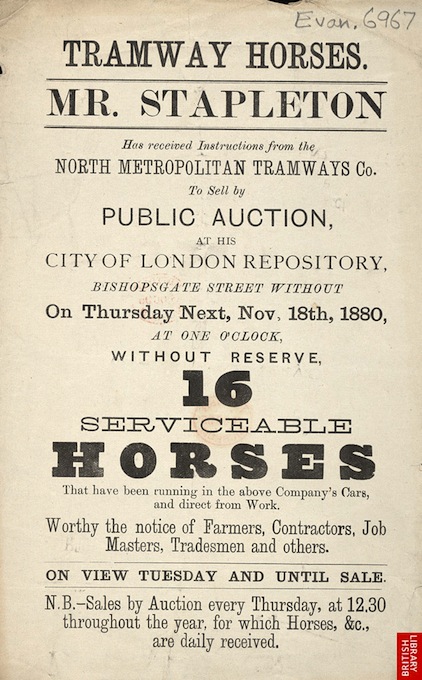
» The advert is from the Evanion collection of ephemera in the British Library.

Categories
Other

Election debrief

Going in to this election, it became clear that whoever was in government would have to raise taxes and cut spending, but no politician was willing to spell out the details. So the best we voters could hope for was a government which shared our priorities when making those decisions.

On that basis, the result could have been worse. I’m not thrilled to have David Cameron as the new PM, but the Conservative Party in coalition with the Lib Dems is hopefully a slightly different animal than the Conservative Party in the raw.

I do find it encouraging that Cameron seemed genuinely quite keen to form a coalition, rather than fighting on with a minority government. I guess it could be a simple political calculation — he wants the votes — but I still think it says something about his personality. I can’t imagine Margaret Thatcher doing the same.

It also suggests that, when trying to get legislation through the Commons, Cameron would rather be dependent on the Lib Dems than the right wing of his own party and the DUP. Which may go some way to answering the question of whether he really is a centrist and moderniser by instinct, or just the shiny new face of the Nasty Party.

At the very least, anything that reduces the power of sectarian fundamentalist Protestants in parliament has to be a good thing.

And while AV isn’t full blown proportional representation, it does at least eliminate the tactical voting which is my personal bugbear.

So that’s a relatively upbeat assessment of the situation. I’m equally capable of coming up with alternative scenarios where it all gets very messy indeed, but I guess we might as well try to hold on to optimism for as long as possible.

Categories
Other

Why I like STV

I’ve been mulling over the various flavours of voting reform available and I’m most tempted by Single Transferable Vote — which is, as it happens, also the system favoured by the Lib Dems at the moment, although that’s not particularly why I like it. No, what I like about it is that it allows you to express some nuance in your vote.

A quick explanation for those of you who haven’t been geeking out over voting reform over the past few weeks.

Rather than the current system with one MP per constituency, STV would have larger multi-member constituencies. So under one particular example that someone came up with, I would be in a constituency called ‘South Central London’, consisting of Southwark, Lambeth and Wandsworth, which would have 6 MPs. And so each party would have multiple candidates standing in each contistuency. And instead of marking a cross next to one candidate, the voter chooses candidates in order of preference – writing in 1 2 3 4 5 in the boxes.

Since there are 6 MPs, any candidate who is first choice for 1/6th of voters is elected. Let’s pretend here are 600,000 voters to make the maths easy; so 100,000 votes means you’re elected. If you got 120,000 votes, the 20,000 surplus votes would be redistributed to other candidates in the proportion that they were the second choice of all 120,000 votes. So if it was a Labour candidate, it’s quite likely that most of those 20,000 votes would be distributed to other Labour candidates. That process is repeated until all the seats are filled; but if at any time the votes are split such that no-one has 100,000 votes (which is quite likely with a lot of candidates) the candidate with the fewest votes is eliminated and their votes are redistributed in the same way.

Notice that the system doesn’t actually attempt to be proportional across the whole country, it is just locally proportional; but that’s good enough, really. Most constituencies would elect at least one representative from each of the major parties, so all the parties would be trying to win votes in all parts of the country; MPs would be tied to a local constituency, though a slightly larger one than we’re currently used to. It also effectively creates a certain minimum threshold for minor parties: for example, the BNP got about 2% of the national vote on Thursday, so strict proportionality would give them 12 MPs; but using STV, they wouldn’t have any MPs unless enough people voted for them in a particular constituency. So in my theoretical example, 100,000 people in South Central London would have to put the BNP as one of their choices for them to win any of the seats. Whether you think that kind of minimum threshold is a good thing or not is another question: it might be more democratic to let the fruitcake parties have a presence in parliament.

But the reason I like STV is that it actually allows you to vote with a bit more nuance. You have a choice of candidates from each party: if you’re an old fashioned socialist, you can try to find a Labour candidate who seems more left wing for your first choice. If you believe in small-government but you’re socially liberal, you might be able to choose Tory candidates who share those views and avoid voting for the ones who seem overly motivated by religion. Or you might want to vote across party lines: my small government socially liberal voter might vote for some combination of Conservative and Lib Dem candidates. If, like me, you don’t necessarily want the Green Party to be running the government but you do want a strongly pro-environment voting bloc in parliament, you could vote Green>Lib Dem>Lib Dem. Because although each voter nominally only has one vote, hence Single Transferable Vote, in practice you have a sort of mixed vote which you can share out among the candidates. You don’t know in advance quite how much of your vote is going to count for which candidates, because the maths is far too unpredictable, but it does at least make some allowance for the fact that most of us don’t completely agree with any of the parties.

Categories
Other

FPTP makes politicians lie to us (hypocrisy update)

Yet another leaflet through the door, this one from the Conservatives, folded so that on one side it says, in great big shouty letters:

Honest Politics?

on the other side, it quotes the Lib Dem leaflet as saying

“Only the Lib Dems can beat Labour here…”

with a big arrow pointing at the quote and in even shoutier all-caps:

IS THIS ACTUALLY TRUE?

The leaflet points out, accurately enough, that it isn’t true, and quotes the Conservative candidate, who is of course outraged by this:

“I got involved in politics because I was tired of dishonest politicians. At a time when we desparately need to restore trust in politics, it is a shame that my opponents seem intent on misleading people and using dirty tactics.”

“What does this say about them? How will they behave if elected?”

All of which would be very reasonable, if she hadn’t put her own leaflet through my door with this quote on it:

“Only the Conservatives can beat Labour here”

Which is exactly the same kind of blatant attempt to mislead the voter. The hypocrisy of it is breathtaking, and frankly they should all be ashamed of themselves.

A pox on all their houses. This kind of crap is exactly why we need electoral reform.

Categories
Other

First Past The Post makes politicians lie to us

Here are some direct quotes from leaflets delivered in this constituency:

Labour leaflets: ‘Only Labour can keep the Tories out here’ ‘It’s a straight choice between Labour and the Tories round here’

Lib Dem leaflet: ‘Only the Lib Dems can beat Labour here’

Conservative leaflet: ‘Only the Conservatives can beat Labour here’

All of them accompanied by bar charts that purport to show why their party is the only one that can fend off the dreaded enemy.

It’s not exactly inspiring to have politicians try to win your vote in this way. It doesn’t do much to counteract people’s disenchantment with politics. But more sinister is the fact that at least two of those statements are in direct contradiction with each other. In other words, someone is telling porky pies.

In fact, when you read their explanations carefully, it is hard to pin down any statements of fact which are outright falsehoods; but all of them are, I would say, intentionally misleading.

The actual situation is that this constituency has been a Labour seat since 1992, and at the last election the vote split like this:

45% Labour
24% Lib Dem
22% Conservative
7 % Green

The boundaries have changed slightly, but the best guess is that it won’t make much difference; it is almost certainly a safe Labour seat, but with the Lib Dems and Conservatives pretty much equal in second place.

The statement which comes closest to being true is ‘Only Labour can keep the Tories out here’. If your main priority is keeping out the Tories, then a Labour vote is the safest option. On the other hand, the statement ‘It’s a straight choice between Labour and the Tories round here’ is pretty close to an outright lie. And it is illustrated with a shocker of a graph:
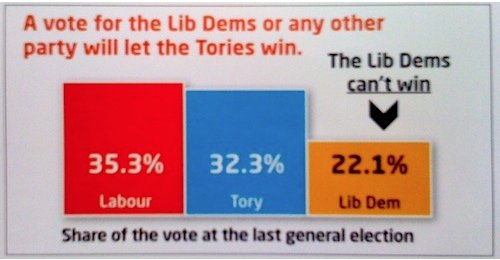
Yup, that’s right, a local election leaflet showing the ‘share of the vote at the last general election’, and it’s not using the votes cast in this constituency, but the national vote share. Classy.

And the Lib Dems and the Conservatives directly contradict each other. So who’s lying? Well, both of them. Since they both got about the same number of votes last time, it is completely unclear who has more chance to overtake Labour this time. The Lib Dems have gained more in the polls since 2005 than the Tories have, but how it is likely to play out in particular constituencies is totally unknown.

And yet both leaflets have clear bar charts showing why they are the ones to vote for! The Conservative leaflet even has the Lib Dems in 4th place behind the Greens:
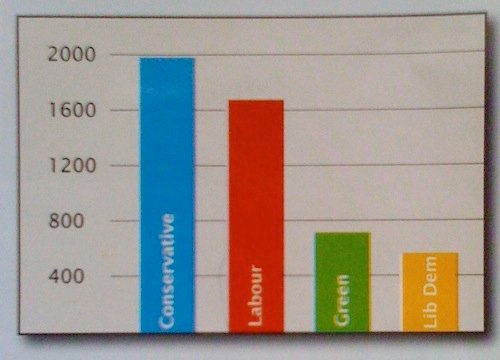
And when you look closely, that’s because the chart illustrates the vote for each party’s leading candidate in the council elections to one electoral ward in 2006. Only the leading candidate, out of three, in only one ward out of the eight that make up the constituency. The chart is accurately labelled, but incredibly misleading on a leaflet which is mainly about the parliamentary candidate.

The Lib Dem leaflet uses a less ridiculous but still dubious trick: it shows what purports to be a ‘bar chart’ which illustrates the last general election result in this constituency:
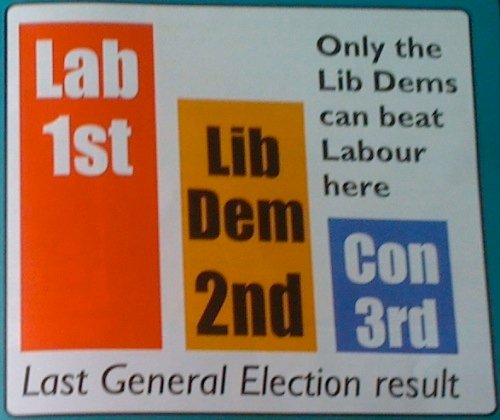
But it’s not really a graph in the mathematical sense at all: the length of the bars is not proportional to the number of votes cast. An accurate chart would have the yellow and blue bars almost exactly the same height, both about half the height of the red bar.

What’s most depressing about this is that it is completely normal. This is how British elections are fought, all around the country, every time. Tactical voting is so deeply engrained in our political culture that we expect to have to vote negatively, and candidates consistently bend the truth to present themselves as the tactical vote of choice.

I am sick of it. I just want to make a choice based on policy and vote accordingly.