Categories
Culture Other

Notes from the war

Not the current debacle in Iraq, the ’39-’45 war. I’m reading the second volume of the Mass-Observation diaries (see my post about the first one here), and I thought I’d just pick out a couple of quotes. After the battle of Alamein:

The newspapers are in ecstasies. There are more maps than ever, showing arrows pointing in all directions, arrows inside arrows, arrows straight and arrows coiled and curving like snakes, and various other wonderful symbols. It is a military map-makers paradise. As Mr H said, ‘You’d think the war was over from the Daily Express headline.’

From a different diarist, this made me laugh:

A neighbour called and left us a Homeopathic tract, and a report on the analysis of some other neighbour’s urine. The latter was probably an oversight.
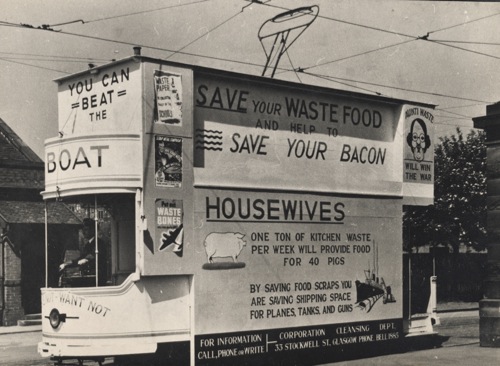
wartime tram in Glasgow

A wartime tram; picture from The Glasgow Story. You can see a bigger version on their site.

And here’s a woman who has just started work for the United States War Shipping Administration in Glasgow:

I don’t get told much in my new job. At first I thought my new boss Captain Macgowan did not intend to give away secrets till he knew me, but there are many indications that he trusts me – I have a key to the safe where all the private papers are put away. A reserved disposition is a big element, coupled, I think, with a belief that I should be upset if I knew ‘all about’ submarine attacks and the like.

The captains of American vessels have instructions to look us up on arriving and most of them like being in an American atmosphere so much that they come back again and again. They talk freely enough and I am getting to know heaps about life and sea and what seamen are like on shore.

It is a novel environment for me. A woman’s woman, an ardent feminist, a patron of cultural clubs with cups of tea and little cakes (not too plentiful nowadays) me, to be suddenly plunged into a super-masculine world. I must say that viewing them at close quarters, men are getting much better than I thought them before – by men meaning American captains.

I’ve got to the point where the worst of the war, from a British POV, is past, although the diarists don’t know that. The Russians and Americans are both now in the war on the Allied side, the threat of invasion has receded, the Germans have lost the battles of Alamein and Stalingrad. There’s a long way to go, but the Third Reich has peaked.

After the 7/7 bombings, the idea of the Blitz spirit was thrown around a lot, especially by Americans: the time when the British stood alone against the world and kept a stiff upper lip. i couldn’t help feeling, though, reading the diaries of the period, that if you were going to be anywhere in Europe during WWII, Britain was really quite a good choice. Admittedly, and it’s an important point, none of of the diarists are living in the East End of London—or Coventry, or Plymouth, or any of the hardest-hit areas—but still, there were no battles fought street-by-street across Birmingham or Ipswich, no occupation, no starvation, no concentration camps.

You still sometimes see a few left-over anti-tank fortifications if you go for country walks in Kent; if they’d ever been needed, if the Panzers had ever been rolling across Romney Marsh, the pluckiness of the British would have had a real test. The fact that some of those who name-checked the Blitz a couple of years ago were probably the same people who made cheese-eating surrender monkey jokes about the French in the build up to the Iraq war is particularly nauseating.

I guess everyone tends to see world history with themselves at the centre, though. I remember someone posting a poem at an online workshop once which referred to Ireland as having a ‘blood-soaked’ landscape. Well, I know that Ireland’s history has been pretty brutal at times, but blood-soaked compared to Russia? or France? China? Poland? Cambodia? My point being… I don’t know, really. Be wary of self-mythologising, I guess.

Categories
Other

Politician of the day…

Anna Lo

… is Anna Lo, a member of the Northern Ireland Assembly, about whom I know nothing except that she was on the radio today and has the most extraordinary accent I’ve ever heard. I remember hearing a Swede who had lived in Liverpool for some time, and that was quite something, but I think a Sino-Ulsterian accent tops it.

Categories
Culture Other

Imperial Life in the Emerald City by Rajiv Chandrasekaran

Imperial Life in the Emerald City by Rajiv Chandrasekaran has the subtitle ‘Inside Baghdad’s Green Zone’; the Green Zone being the seven square mile compound in Baghdad centered around the Republican Palace, where the Coalition Provisional Authority (CPA) under L. Paul Bremer III attempted to rule Iraq for about 12 months after the fall of Saddam Hussein.

Chandrasekaran paints a picture of a little American bubble where the water and electricity are always working and the air conditioning is on high, the buffet is piled with pork, there are bars and bible study classes, no-one speaks Arabic, and the huge blast-proof walls keep out the noise of gunshots and the call to prayer. Even the food, down to the water the hot-dogs were boiled in, was all shipped in from approved suppliers outside Iraq.

Swimming pool at the Republican Palace, 2003

Swimming pool at the Republican Palace, 2003. Image taken from Wikipedia, and used via a GFDL licence.

Here’s a story which captures some of that disconnection between the people inside the compound and the world around them. It takes place at a farewell party about six weeks before the handover of sovereignty:

It had been a quiet night. No mortar thunderclaps. No messages from the Giant Voice warning people to take cover.

Then came the gunshots. A pop-pop-pop in the distance. Alex Dehgan, a State Department employee at the pool party, dismissed it as a firefight between soldiers and insurgents. So did his colleagues.

But the popping grew louder, more intense. It seemed to be coming from every direction. Orange tracer rounds arced into the night sky. Bursts of AK-47 fire echoed across the Tigris.

Dehgan began to panic. This is it, he thought. The full-on assault. They’re going to crawl over the walls.

He and everyone else by the pool scurried indoors. Some ran into the basement shelter. Others retreated to their offices but stayed away from the windows. They began to wonder if they’d have to leave by helicopter, like the last staffers at the American embassy in Saigon.

Hours later they heard the news: Iraq had defeated Saudi Arabia 3 to 1 in a soccer match, earning a berth at that summer’s Olympics in Athens.

Baghdad was celebrating.

As I hope that story shows, the book is a great read and full of good anecdotes. It would be funny if it wasn’t so incredibly depressing.

Ham station, originally uploaded by Kjirstin. Used under a CC by-nc-sa licence. This picture was taken in the Green Zone, but it’s from after the CPA period; the Green Zone is now the US embassy compound.

If these people had some other, less important job, this might not matter very much. But they were supposed to be running the country. Here’s another quote that seems typical:

Agresto [senior adviser to the Ministry of Higher Education] knew next to nothing about Iraq’s educational system. Even after he was selected, the former professor didn’t read a single book about Iraq. “I wanted to come here with as open a mind as I could have,” he said, “I’d much rather learn firsthand than have it filtered to me by an author.”

In fact Agresto turns out to be, relatively speaking, one of the good guys. When he got to Iraq and encountered the reality of the situation there, he was adaptable enough to set aside his grandiose plans for Iraq’s university system and focus on the pragmatic business of trying to help the universities recover from the damage done by sanctions, war and looting. He didn’t actually manage to achieve much, because he didn’t have the staff or money to do it, but at least he responded to the situation by changing his plans. Most of his colleagues seem to have ploughed on regardless. Still, that mindset, that a career in American academia and an open mind were all the preparation he would need, seems typical of the overconfidence and naivety of the CPA.

Also typical was the choice of a Republican loyalist rather than someone with specific experience of the Middle East or reconstruction in a war zone. Not, I think, out of simple corruption or nepotism, but because it was an operation being run by ideologues from the White House downwards; people who seem to have believed that democracy, privatisation and a free market were some kind of magic wand, and if they could just pass the right laws, the recovery of Iraq would take care of itself. The problem wasn’t so much the fact that they were trying to impose their own political beliefs on the Iraqis, but that they were focusing on theory while Iraq was lawless, unstable, and suffering 40% unemployment and shortages of electricity and fuel.

And that’s just the start of it. There were failures of communication—or overt hostility—between the Pentagon and the State Department, between the CPA and the Iraqis, and between the CPA and the army. They were more worried about how news would play in the US than in Iraq. They didn’t trust the Iraqis to do things for themselves. They didn’t have nearly enough money or enough staff. They allowed the timetable to be driven by the American elections. Over and over again, it all seems to come back to the looting which was left to go unchecked in the week or so after the fall of Saddam, both because it established a pattern of lawlessness and because it crippled half the institutions in Iraq. Hospitals, universities, ministries, schools and businesses lost the equipment they needed to function.

My impression is that the White House and the Pentagon simply didn’t take what they were doing seriously enough. I don’t care how confident they were that, with Saddam out of the way, the Iraqis would gratefully embrace freedom and democracy: they still needed to make plans. Even with the best possible outcome, they would still have been running a whole country, and they seem to have thought they could just wing it.

Anyway. From a British point of view, I would have liked some kind of indication of how my own government fit into the whole situation, but this is a very good book: vivid, thorough, funny, and deeply sad.

Categories
Culture Other

Yay for Salman

Some of the response to Rushdie’s knighthood has startled me. Take, for example, this letter to the Times:

Sir, Did the genius who recommended Salman Rushdie for a knighthood not realise the offence that it would cause to the Muslim world after The Satanic Verses debacle or was this calculated? And exactly why did he get a knighthood – he has done nothing for Britain other than cost the taxpayer a fortune in police protection for writing a book the majority never read?

I genuinely didn’t expect to see so much of this kind of thing, although in retrospect, I obviously should have. It’s not surprising that Iran and Pakistan should complain, and since it would perhaps be unnecessarily undiplomatic to tell them to mind their own fucking business, I don’t even mind the British government being mildly conciliatory in response.

But letters like the one above are just extraordinary. All questions of free speech aside, surely providing protection for people whose lives have been threatened by dangerous extremists is exactly the sort of thing the police should be doing? And the idea that we should not give a knighthood to someone because we want to avoid giving offence to the kind of people who issue death threats to novelists is horrifying. It goes so clearly against what I would hope were the core values of our society—freedom of speech, freedom of religion and the rule of law, for a start—that I can’t quite believe that I have to actually say so. I vaguely feel that I’m contributing to the kittens are cute and Scarlett Johansson is hot school of blogging the bloody obvious; but apparently there are people who disagree.

The fact that the sensibilities offended were religious is irrelevant, for me. If the people Rushdie had offended were political extremists instead—if, say, the complaints were coming in from the old apartheid South Africa, or China—I would still want them to mind their own fucking business. But then, perhaps if the complaints weren’t wrapped up in religion, we wouldn’t get people writing such pathetic, squirming, weaselly letters about it to the Times.

Categories
Other

The sad decline of West Indies cricket

There was a good documentary on last week about the West Indies tour of England in 1976. The tour was notable in part because before it started the South-African born captain of England, Tony Greig, said in an interview

“These guys, if they get on top they are magnificent cricketers. But if they’re down, they grovel, and I intend, with the help of Closey [Brian Close] and a few others, to make them grovel.”

The West Indians, not surprisingly, took offence at his phrasing—it doesn’t sound any better for being in a South African accent, either—which gave the series had a bit of an edge to it. Here’s some frankly scary film of Michael Holding bowling to Brian Close. I know most of the people who read this blog probably aren’t really interested in cricket, but if you’re ever going to watch a cricket video, make it this one:

It was also the great heatwave summer in the UK, and a time of distinct racial tension in England anyway, including a riot at the Notting Hill Carnival. They had some great footage filmed in Brixton that year by a young black amateur filmmaker to compliment the film of the cricket and all the talking heads.

It gave me a kind of sweet and sour fake nostalgia. Fake I don’t remember 1976; I was a toddler, and presumably spent most of the summer being uncomfortable because of the heat and making sure my mother knew about it. But there’s nothing like a bit of 1970s sports footage to create a sense of instant retro.

Sweet and sour because, as a documentary about race relations in the UK, it was possible to look at it and feel we’ve come a long way in the right direction. These days no one worries that the Notting Hill Carnival is going to develop into a full blown race riot. But as a documentary about West Indian cricket, it made a sad contrast with the West Indies team currently playing in England.

That team in 1976 thrashed England, with particularly spectacular performances from Holding and Viv Richards; but it was just the start of a period when the West Indies completely dominated world cricket. After Greig’s ‘grovel’ comment, it was 13 years and 19 matches before England managed to beat the West Indies again. And that wasn’t because England were rubbish. Between 1976 and 1996, the West Indies played 39 Test series against all opposition; they won 26, drew 10 and lost just 3.

For a whole generation of people, including me, the West Indies was synonymous with cricket. They were the best and most exciting team in the world. They seemed to have an endless supply of terrifying fast bowlers; towering men whose bowling had a real physical threat to it. Their batsmen were pretty special too. Here’s a little compilation of the great Viv Richards playing against England:

The West Indies team in England this summer produced some good individual performances, but England won the series comfortably without needing to be ruthless or brilliant to do it. It’s not just that they don’t live up to the great teams of the late 70s and 80s; they are really quite bad. Their situation has become so desperate that it’s not even much fun beating them any more. The West Indians on the commentary team, including Sir Viv himself, were simmering with frustration at having to watch it.

It’s not just the falling standards of West Indies cricket that stood out, though. The crowds have changed as well. In the film of the matches in 1976, the crowd is full of black faces—the West Indian population of England turning out in force to support their team. It’s most striking at the Oval, only a couple of miles from Brixton. You can see it in this film of Michael Holding (again), notably in the pitch invasion when he takes Greig’s wicket. Notice, as well, how the heatwave has bleached the grass:

That kind of local support isn’t there any more when the Windies tour in England. And whereas at one stage there were plenty of British West Indians coming up through county cricket and indeed playing for England, apparently they too have largely disappeared. I guess this is a sign of increasing integration; cricket isn’t the most fashionable of sports, and if all the young men from West Indian backgrounds are more interested in playing football, it only puts them in line with their contemporaries. But it does make cricket matches between England and the West Indies just that bit less interesting.

Meanwhile, there are now a lot of players from Asian backgrounds playing county cricket and starting to come through to play for England. And when England play Pakistan in Manchester, the children and grandchildren of Pakistani immigrants come out in numbers, blowing horns and waving flags in support of Pakistan. I guess it’ll be a sign of that their position in Britain has been normalised when they lose interest in cricket. Perhaps the next generation of potential fans will be bored stiff by their fathers’ misty-eyed reminiscences about watching Shoaib Akhtar and Mohammad Yousuf, and just want to play for Manchester United.

Categories
Culture Other

We Are At War by Simon Garfield

This is one of a trilogy of books using material from the Mass-Observation archives. To quote Wikipedia:

Mass-Observation was a United Kingdom social research organisation founded in 1937. Their work ended in the mid 1950s … Mass-Observation aimed to record everyday life in Britain through a panel of around 500 untrained volunteer observers who either maintained diaries or replied to open-ended questionnaires.

We Are At War is an account of the period from August 1939 to about the start of the Blitz, compiled from the diaries of five M-O participants. It’s a simple idea and it works brilliantly. The diaries combine the texture of everyday life—people write about the weather or what’s on the radio—with the backdrop of great events happening in Europe.

barrage balloon

[photo from the Museum of London picture library]

People’s moods—not just the diarists, but their workmates and family—are one of the most interesting things: swings between optimism and pessimism about the war, including, in the early stages, whether it was even going to happen; the stress of expecting air raids for months before they actually start happening; endless gossip about German spies supposedly having been arrested after committing some faux pas to reveal their identity; a distrust of official news and an uneasy fascination with listening to Lord Haw-Haw.

One thing that’s noticeable is a gradual hardening of attitudes towards the Germans; initially people try to maintain some kind of distinction between the Nazis and the German people, and express some kind of regret at news of German casualties, but they get increasingly ruthless as time goes on and British casualties rise.

I could quote almost any chunk of this book; but this will do, from February 1940 in Glasgow:

Recently Miss Crawford saw a notice in a fish shop: ‘Fish cheap today.’ On looking closer she found the stock consisted of a few pieces of sole at 3s 4d. Since the war broke out I have stopped looking at the fish shops for I know the prices would be too high. It transpires that practically everyone has ceased to eat fish, but the price is not the sole cause. Miss Carswell said she could not bear to eat fish because she remembered what perils the fisherman had been through to get it. Then she continued that she could not bear to eat fish in case they had been feeding on all the dead bodies. Her mother had offered her tinned salmon. ‘for that had been canned before the war began’.

(As usual, this review has also been posted to my recently read books section.)