I’ve been investigating more avian etymologies, looking for things of interest. There isn’t much to say about most bird names, because they’re self-explanatory (oystercatcher, wagtail) obviously onomatopoeic (chiff-chaff), or just dead-ends. For example, checking up on ‘merlin’, the dictionary says:
merlin (mɜ:lın). ME. [– AFr. merilun, aphet. f. OFr. esmerillon (mod. émerillon), augment. of esmeril :– Frankish *smeril = OHG. smerlo, smiril (G. schmerl).] A small European falcon, Falco æsalon.
Which is admirably thorough (and useful if you’re ever travelling in Old High Germany and need to talk about falconry) but doesn’t actually get us any closer to an ‘original’ meaning.
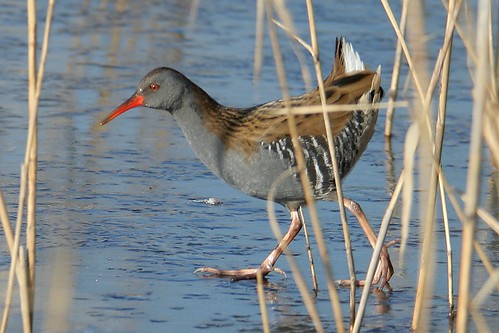
Water Rail, originally uploaded by markkilner.
Another word whose origins the OED refuses to offer an opinion on, beyond mentioning that it’s from the Norman-Picard (no relative of Jean-Luc), is ‘rail’. Fortunately for us, the American Heritage Dictionary is recklessly willing to take a guess:
rail n. Any of various marsh birds of the family Rallidae, characteristically having brownish plumage and short wings adapted only for short flights. [Middle English raile, from Old French raale, perhaps from Old French raler, racler, to scrape, from Old Provençal rasclar; see raclette.]
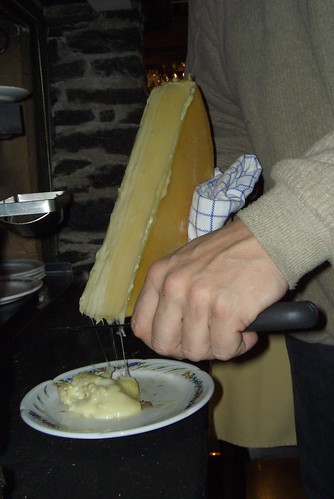
Raclette, originally uploaded by Alfesto.
Dictionary.com describes raclette as ‘a [Swiss] dish made by heating a piece of cheese, as over a hearth, and scraping off the melted part onto a plate: served with boiled potatoes[…] the cheese used in making this dish’, which is why the name is derived from ‘to scrape’. But what about ‘rail’? Well, I think it must be onomatopoeic. The only bird referred to as a rail by British birders today is the water rail, as pictured above (but also see the fabulous picture here). Water rails make all sorts of noise, including, according to the Collins Bird Guide, ‘a discontented piglet-like squeal, soon dying away’, as well as ‘a weary, ‘all in’, choking moan’, but none of them sound much like scraping. However, as well as the water rail, there is a bird which used to be known as a ‘land rail’, and now usually called a corncrake.
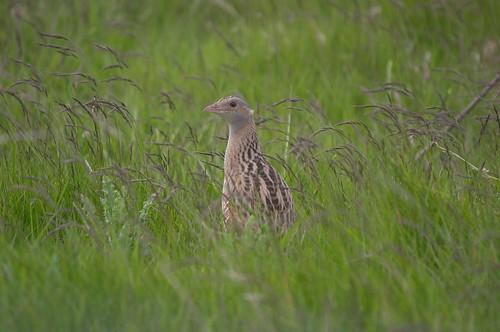
Corncrake at Balranald, originally uploaded by citrineblue.
To see a corncrake in the UK now, your best chance is to go somewhere like North Uist, where that photo was taken, but they used to be common. A poem by John Clare; it’s on the long side but I think it’s worth quoting in full. Of all the poets who have been called ‘nature-poets’, John Clare is by far the most observant and the one who comes closest to being a naturalist-poet.
The Landrail
How sweet and pleasant grows the way
Through summer time again,
While Landrails call from day to day
Amid the grass and grain.We hear it in the weeding time
When knee deep waves the corn,
We hear it in the summer’s prime
Through meadows night and morn;And now I hear it in the grass
That grows as sweet again,
And let a minute’s notice pass
And now ’tis in the grain.‘Tis like a fancy everywhere
A sort of living doubt,
We know ’tis something but it ne’er
Will blab the secret out.If heard in close or meadow plots
It flies if we pursue,
But follows if we notice not
The close and meadow through.Boys know the note of many a bird
In their bird-nesting rounds,
But when the landrail’s noise is heard
They wonder at the sounds;They look in every tuft of grass
That’s in their rambles met,
They peep in every bush they pass
And none the wiser yet,And still they hear the craiking sound
And still they wonder why—
It surely can’t be under ground
Nor is it in the sky,And yet ’tis heard in every vale,
An undiscovered song,
And makes a pleasant wonder tale
For all the summer long.The shepherd whistles through his hands
And starts with many a whoop
His busy dog across the lands
In hopes to fright it up.‘Tis still a minute’s length or more
Till dogs are off and gone,
Then sings and louder than before
But keeps the secret on.Yet accident will often meet
The nest within its way,
And weeders when they weed the wheat
Discover where they lay,And mowers on the meadow lea
Chance on their noisy guest
And wonder what the bird can be
That lays without a nest.In simple holes that birds will rake
When dusting in the ground;
They drop their eggs of curious make,
Deep-blotched and nearly round—A mystery still to men and boys
Who know not where they lay
And guess it but a summer noise
Among the meadow-hay.
As Clare makes clear, the corncrake is famously difficult to see, and usually found via its ‘craiking’ call. Pleasingly the corncrake’s Latin name is pretty much a transcription of the call: Crex crex. You can listen to the call of the corncrake here. I’ve heard you can attract a corncrake by scraping the spoon from a miniature tub of icecream along the zip of your waterproof jacket (and if you’re birding in the Outer Hebrides, you will have a waterproof jacket with you), or by rubbing a comb across the edge of a matchbox. But I’ve never had a chance to try either trick.
So what about the word ‘corncrake’? That’s obvious—it’s clearly derived from the call, right? Well, not directly. ‘Crake’ is derived from the Old Norse krâka, which means crow, and that’s the first meaning the OED gives:
1. A crow or raven. north. dial.
2. A name of birds of the family Rallidæ, esp. the corn-crake (also bean-crake) or landrail
3. The cry of the corn-crake
We’re told that
In sense 2, perh. orig. the same word (corn crake = corn crow), but now viewed as directly derived from the grating cry of the bird, as in sense 3
The Old Norse krâka is itself onomatopoeic (‘croak’ is derived from the same word), and if ‘corn crake’ did originally mean ‘corn crow’, it was in reference to the call, but still, I find the idea of a ‘corn crow’ surprising and appealing. The word ‘crow’ is, not surprisingly, also originally onomatopoeic but from the Old High German crâwan.
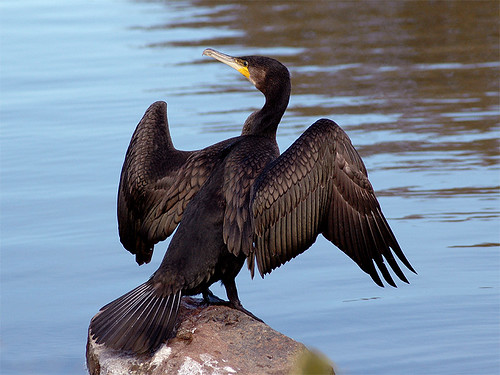
Cormorant, originally uploaded by Rune T.
One last bit of related etymology. Cormorant is from the French cormoran with a ‘parasitic t’; i.e. the ‘t’ has no particular linguistic logic, it just got glommed onto the word by analogy with words like ‘elegant’ and ‘reluctant’. The same is apparently true of ‘peasant’ and ‘pheasant’ (paysan and faisan in French). Cormaran in turn is deduced to have been something like corp marin in Old French, and is derived from the Latin corvus marinus: ‘sea raven’.
So there you are; corn-crows and sea-ravens.
[ Unless noted otherwise, dictionary extracts are from either the Shorter Oxford Dictionary or the slightly insane ‘compact’ OED (the whole 2nd edition printed in such tiny writing that it fits in one huge volume). The poem is from “I Am”: The Selected Poetry of John Clare, edited by Jonathan Bate. As ever with Clare, the punctuation is editorial, that version of the poem is presumably © Jonathan Bate. The photographs are all from Flickr and © the respective photographers. ]