Categories
Other

The Incredible Hulk smoothie

Let me just make it clear, in case any of the lawyers from Marvel Comics (soft drinks division) should happen to be watching: by using the phrase ‘Incredible Hulk’, I’m not claiming that Marvel Comics endorse, recognise, or know of the existence of, this drink. Or indeed that it gives you a short temper or superhuman strength.

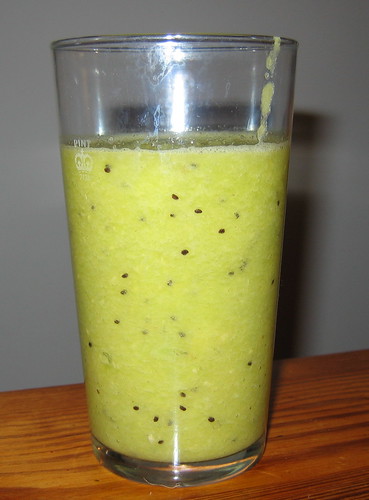
But you have to admit, it’s certainly green:

The flesh of a small pineapple and three kiwi fruit chucked in a blender, since you ask.

Categories
Nature Other

Birding the dictionary

I was watching a dunnock in the garden earlier
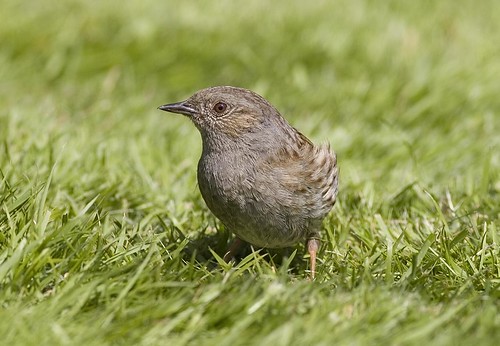
dunnock

and it suddenly occured to me that there might be a parallel between the word ‘dunnock’ and ‘ruddock’ – the old name for a robin.
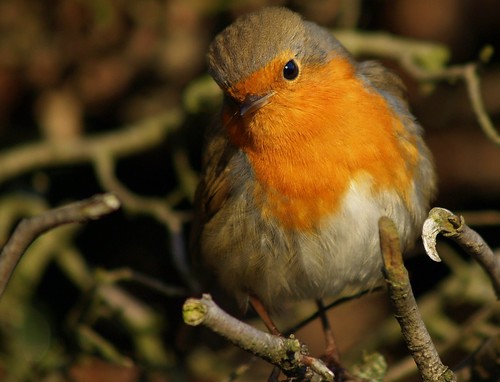
robin on Flickr

And having got that far, I thought maybe ‘dunnock’ derived from ‘dun cock’ and ‘ruddock’ from ‘ruddy cock’. So I got out the dictionary. Turns out I was part right.

dunnock (‘dʌnək). [app. f. dun a. + -ock dim. suffix; from the dusky brown colour of the plumage. Cf. dunlin.]

In other words, ‘dunnock’ pretty much translates as that classic birder’s term, LBJ — Little Brown Job [btw, while I was looking for dunnock photos on Flickr, I discovered that the Dutch for dunnock is ‘heggemus’ — presumably ‘hedge mouse’. But let’s stick to one language at a time].

The reference to ‘dunlin’ intrigued me.
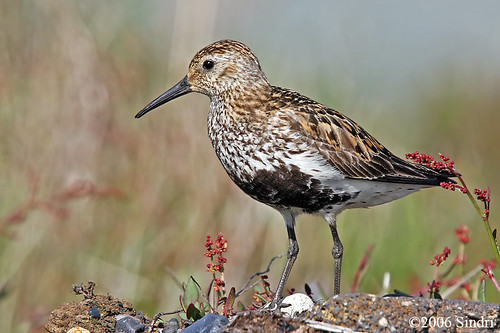
dunlin on Flickr

And at dunlin I learnt that it’s f. dun a. + -ling. ‘ling’ is a familiar diminutive suffix of course; ‘darling’ and ‘duckling’ are the most obvious examples. But there’s another small sandpiper called a sanderling, and I was curious how that fitted in.
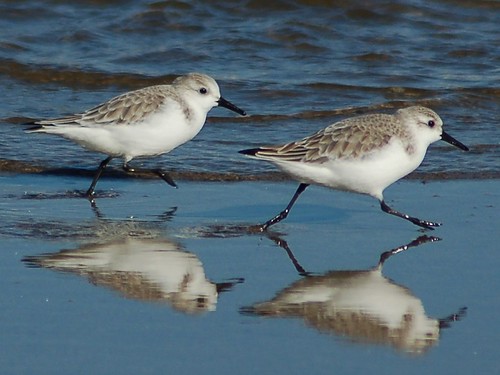
sanderling on Flickr

Well, pleasingly, the OED’s best guess for the origin of sanderling is the Old English sand-yrðling; i.e. ‘sand-earthling’. Not as in ‘take me to your leader’; ‘earthling’ meant ‘ploughman’. Ploughman of the sand.

Getting back to my -ock birds. I looked up ‘ruddock’, and sure enough it says

ruddock (‘rʌdək). [OE rudduc, related to rud sb., ruddy a. : see -ock.]

I also learned that a ruddleman is a digger of, or dealer in, ruddle; a raddleman. But that’s not important right now. Seeing ‘rud’ written as a word helped me make the connection that ‘ruddy’ is cognate with ‘red’. Which probably should have been obvious but I never thought about it. There was one last entry that needed to be checked out. It has such a load of great words in it I’m going to type it out in full.

-ock, suffix, forming diminutives. A few examples of dimin. –oc, –uc, occur in OE., as bealloc ballock, bulluc bullock. In mod. Eng., the chief instance of the dim. suffix is hillock (found already in Wyclif); but other examples occur in the dialects, esp in Sc., e.g. bittock, lassock, queock or queyock, whilock, wyfock, also proper names as Bessock, Jamock, Kittock. Several names of animals, esp. birds and fishes, have the same ending and are prob. orig. diminutive; among these are OE. cranoc, cornoc (dim. of cran), crane; ruddoc (read red) redbreast, ruddock; cf. the modern (some ME.) dunnock, haddock, girrock, paddock, piddock, pinnock, pollock, puttock; also, as names of things, buttock, hattock, tussock. In other words (some of which, as bannock, hassock, mattock, go back to OE.) -ock appears to be of different origin.

The actual word ‘robin’, btw, is from the habit, going back at least as far as the middle ages, of applying personal names to birds: Robin Redbreast, Jack Daw, Mag Pie. ‘Magpie’ is especially apt because ‘mag’ was used to mean ‘chat’, ‘chatterbox’, or ‘to chatter’. ‘Mag’s tales’ were what we would call ‘old wives’ tales’.

NB. The pictures are all from Flickr and © the people who took them; you can click through to the page on Flickr. The dictionary extracts are all from the OED.
Categories
Culture Other

FSotW: Stereographic Projections

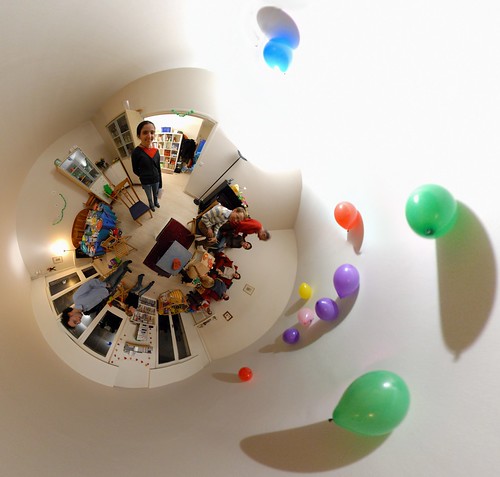
Flickr set of the week is Stereographic Projections by Seb Przd. I don’t understand the details of how these are made, but he starts with a panorama and applies some kind of mathematical wizardry to it. As always, click on one of the photos to go to the page on Flickr.

Categories
Other

John Amaechi, Tim Hardaway and homophobia

I only wandered onto this by accident, so a note for those like me who are outside the US and may have missed this story: John Amaechi is a former basketball player who recently came out. Tim Hardaway is another former player who had some comments about it, as you can see:

There are all sorts of interesting aspects to this story, not least the segment where the ESPN host interviews the radio host whose interview with Hardaway kicked off the incident. I kept expecting someone to unambiguously express outrage at Hardaway’s hate speech, but it just didn’t happen. See, similarly, this article, which frankly made me feel a bit queasy. Or the comments on this other YouTube video.

Every time a sportsperson in a major sport comes out, it has to be a step in the right direction, but it’s clearly not going to be easy any time soon. From a campaigning point of view, John Amaechi probably isn’t ideal as the first NBA player to come out. He wasn’t particularly successful or famous, which reduces the impact. He’s also extremely articulate, and British. Articulate would normally be a good thing in these situations but it doesn’t exactly run counter to gay stereotypes. And that articulacy delivered in an English accent makes him, I imagine, something of an outsider in basketball culture; at one remove from the emotional centre of the game.

As I’m British, I don’t actually hear basketball players talk very often. Perhaps I’m being unfair in my assumption that they aren’t generally intellectual and hyperarticulate. If anything, American athletes often seem more verbally fluent than their British counterparts, possibly because the college sport system keeps them in education longer. But they aren’t employed for their speaking skills, after all.

As I don’t follow basketball, I can’t suggest the kind of player who would make the most impact by coming out. I guess it would be the equivalent of a Roy Keane or John Terry — someone who is the very embodiment of the qualities the supporters like to think are most important in the game.

Categories
Other

Wii tennis

I decided yesterday to try to work out how the computer-operated characters in Wii tennis get such vicious side spin on the ball. After a lot of experimentation, I have a much better grasp of how it works, but trying to concentrate on how I was moving the remote completely hammered my timing and my score dropped by about 1000 points, enough to make me lose my Pro status.

It’s much more subtle than it initally appears; when you first start playing it seems to be all timing, but actually you have quite a lot of control over your shots. What it’s not is much like playing tennis.

I find the way wii games use the controller quite interesting; it measures tilt and acceleration in multiple directions, so it has a lot of information to play with. But it’s not magic; it measures relative movement but it doesn’t actually know the position of the controller. The ideal tennis game would be able to measure the entire shape of your stroke and the angle of racket at the moment of contact and use that to model the shot. If they could do that, someone who played real-world tennis would actually be able to just pick up the game and play all the shots they wanted. Instead, although it uses all the information available to subtly vary the shots, it doesn’t manage to create the illusion of really playing tennis.

It’s still a fun game, though.

Categories
Other

Doublehard Goans

I made ‘rechad’ spice paste today. It’s a recipe from Goa; Goa was a Portuguese colony, and the name is apparently from the Portuguese recheado, ‘to stuff’, because the Goans use it to stuff fish*. I used some of it tonight to make a particularly good Goan seafood curry called ambot tik which uses the paste with some tamarind to make a hot, fragrant, sour dish. I got both recipes from Madhur Jaffrey’s Flavours of India. Her ambot tik recipe uses squid; I made it with prawns today.

I’ve made the paste a few times before, but I noticed something today. Her recipe calls for ‘about 45’ dried chillies, and even the first time I made it I thought that seemed a lot and toned it down to about 15. That still makes something with a kick to it, and my ambot tik tonight seemed quite hot enough to me. But actually the recipe calls for ‘1oz of dried chillies (about 45)’. She’s clearly using chillies which are bigger and heavier than mine – I’ve got the little tiddly ones, and 45 of them barely weigh enough to register on the scales. I weighed out an ounce, and I reckon my paste is about one-twentieth as fiery as her recipe suggests.

Even allowing for variable hotness in the chillies, all I can say is: OMG. Those Goans are like superheroes with lips and tongues and throats and indeed whole digestive tracts of steel.

*Similarly, ‘vindaloo’ is derived from ‘vin d’alho’ because it’s derived from a Portuguese dish made with wine and garlic.