-
“Which parts of the human body could you design better?”
-
Using prisoners to train guide dogs. Which helps both the dogs and the prisoners. Via Metafilter.
Categories
Do you like Memling? I don’t know, I’ve never tried it. [boom boom]
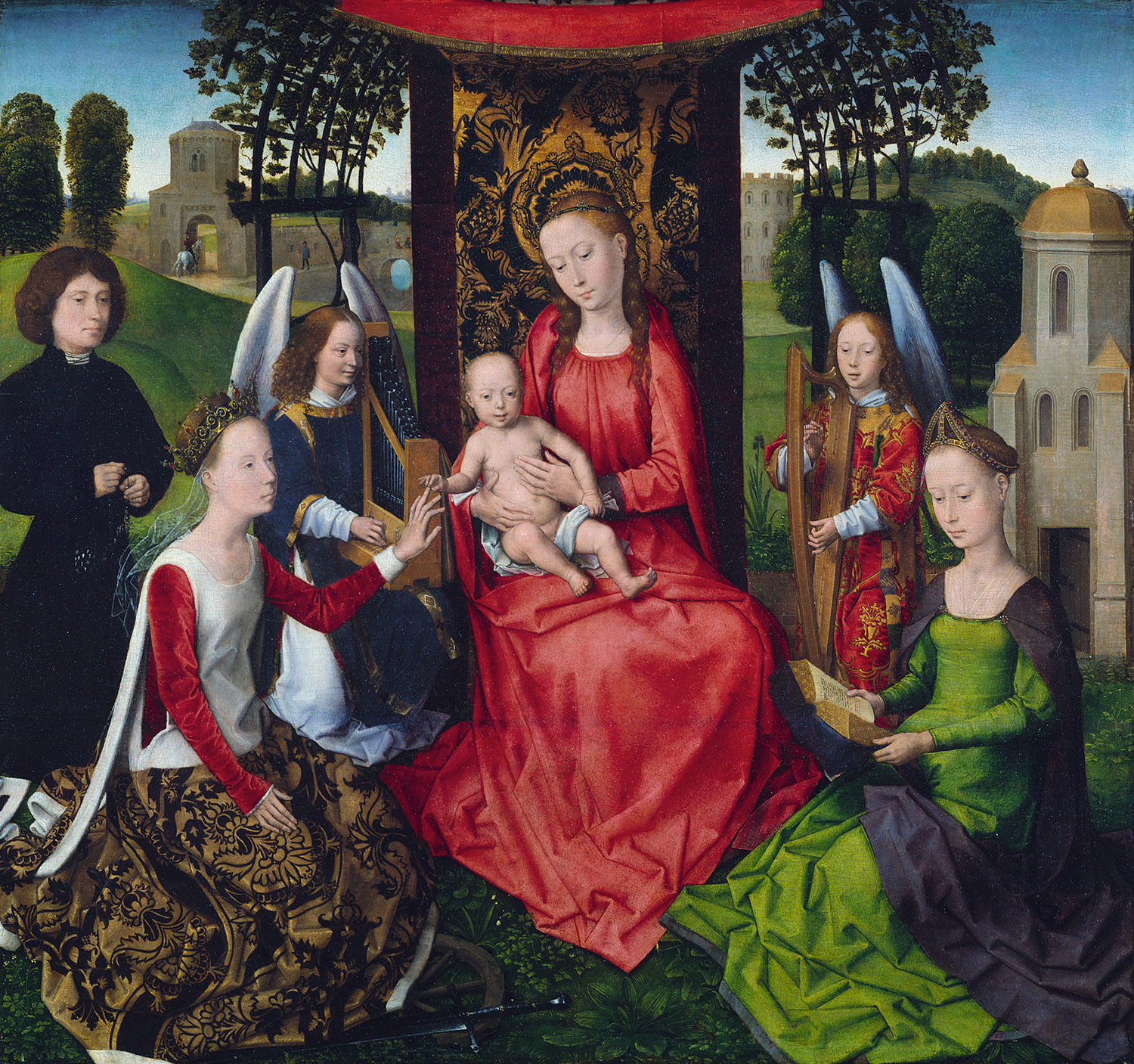
Gotta love that Northern Renaissance.
I went to a lecture about fabric and fashion in art recently which used as an example a painting which I think wasn’t actually this one, but was very very similar. Possibly Memling painted various versions of it. Anyway, I can tell you that the black and gold cloth behind the Virgin and on the skirt of one the kneeling saints would have been made in Italy.
While I’m here posting about nothing in particular, I’ll throw in one of my occasional plugs for my photoblog, Clouded Drab. There’s a cute cat picture on the front page…
» The painting, Virgin and Child with Saints Catherine of Alexandria and Barbara, is in the Met, and this photo is from their website. It was painted in 1479 by the Netherlandish painter Hans Memling as an altarpiece.
A big-budget Hollywood version of Beowulf is obviously going to either be a travesty of the poem or commercial suicide.
When you hear that Angelina Jolie is embarrassed about her nude scenes in the movie, I think it’s pretty clear which one.
Baselitz is a German painter and sculptor. I thought that I knew nothing about him at all, but when I got to the exhibition several of the paintings turned out to be familiar.
Baselitz was born in East Germany, his father had been a member of the Nazi party, and he was studying at an art college in West Berlin when the Berlin Wall went up and separated him from his family and home town. So it’s not surprising that a lot of history and politics gets into his paintings or that they tend to be a bit angry. In fact, his earlier paintings, which are figurative but distorted and blocky, are reminiscent of some of those similarly angry-looking Picassos.

Later he developed a different quirk: upside-down paintings. They are, apparently, actually painted upside-down, but they look like they’ve just been hung that way. It’s a surprisingly effective way of transforming even quite mundane paintings into something more interesting, and the early examples are fairly mundane, as though the point of them is the upside-down-ness and so the paintings themselves are much more straightforward representational works than those he had been doing before. Interestingly, as the paintings then get more abstracted, they stay upside-down, but because the subject is less clear the upside-down-ness is also less obvious.

More recently Baselitz has started producing ‘remix’ paintings: new versions of his early works. So, for example, there’s a painting, I think from the 60s, called ‘The Great Friends’ that depicts two people among ruins and in front of a fallen flag. The new version is the same design, but painted in different colours and with different technique; he’s taken to painting them on the floor, making much use of dripped paint. No doubt this is partially the normal looking back of an old man. It was noticeable in the Louise Bourgeois show at Tate Modern that she has also returned to motifs from her childhood as she gets older. But also it is surely related to the fall of the Berlin Wall and the re-unification of Germany stirring up the whole messy subject of C20th German history.
I got the audioguide for the exhibition, which was interesting if not exactly sparkling, and it included contributions from Baselitz. Rather admirably, he never made any attempt to tell you what the paintings were about, or explain their symbolism or even their personal significance for him. Everything he said was to do with how he painted them and what visual effect he wanted to create. For example, he said about one painting that he wanted as much of the canvas as possible left unpainted and he was pleased because he largely managed to get it right first time and didn’t need to do much overpainting. He didn’t provide any reason why he wanted the canvas left bare; presumably he thinks he paintings should speak for themselves.
» The exhibition website is short of useful pictures, so the two I’ve included are from other sources. They’re not really the examples I would have picked given a free choice, but I wanted some kind of pictures, so they’ll do. The top one, ‘Meissen Woodmen’, is from the National Gallery of Australia; the other is ‘The Gleaner’ from the Guggenheim in New York.