Categories
Culture Other

Samurai William by Giles Milton

William Adam was an English sailor working as a pilot on a Dutch expedition of five ships that set out in 1598 to make money in the Orient. In 1600, after a disastrous voyage during which just about everything went wrong, Adam was one of just 24 men surviving on one of the ships – the Liefde – when it reached Japan, the men too weak with starvation and disease to row ashore.

He rose to become the most influential westerner in Japan, with direct access to Tokugawa Ieyasu, the effective ruler, and was granted a court title normally given only to senior samurai. Samurai William: The Adventurer Who Unlocked Japan is his story, and the story of the early English attempts to set up a trade with Japan. It’s by the same chap as Big Chief Elizabeth, a book about the English settlement at Jamestown.
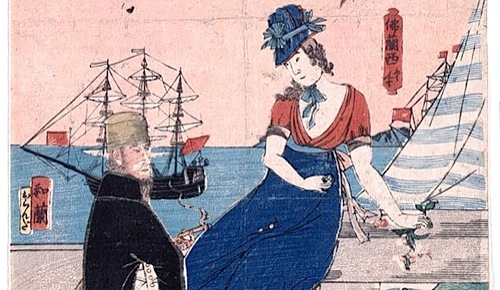
A Dutch man and a French woman

As with that book, the emphasis is on telling a good story rather than exploring the finer ethical and semiotic nuances of colonisation. Which isn’t to say that he glosses over the frequently bad behaviour of everyone involved; just that the book is pitched as entertainment.

And the stories from that period of European exploration are really extraordinary; the men in their tiny little ships sailing off optimistically into unknown waters, and ending up either fabulously wealthy or dead. Or enslaved. Or marooned. It’s like Star Trek, if instead of peaceful, multi-cultural, non-interventionist scientists and diplomats, the Enterprise had been crewed by greedy, heavy-drinking, violent, unwashed men who were only really interested in local cultures if they could make money from them or have sex with them.

» The picture is from over 200 years after the period dealt with in Samurai William, but it seemed too good not to use. It’s a detail from a Japanese woodcut of a Dutch man with a French woman, from an exhibition about the Dutch in Nagasaki on the website of the International Institute of Social History, where you can see a larger version as well as lots of other great pictures.

Categories
Daily Links

Links

Categories
Daily Links

Links

  • ‘Picking highbush blueberries with the Amish, we discover that, unlike the other pickers scattered around the bog, they don’t like to shout back and forth to each other. My brother tells me they prefer to whistle.’
Categories
Culture Other

The Satanic Verses by Salman Rushdie

I bought The Satanic Verses in irritation at all the fuckwits who were complaining about Rushdie getting a knighthood. Not surprisingly perhaps, having bought it as a gesture rather than because of an urgent desire to read it, it ended up at the bottom of my to-read pile. It didn’t help that it has a bit of a reputation as being unreadable.

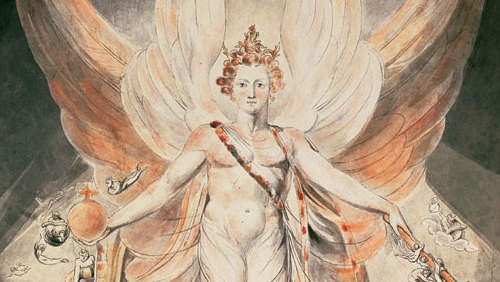
section of ‘Satan in His Original Glory’ by William Blake

You know what, though? It’s actually a really good novel.

It’s full of inventive ideas and images, playful use of language, barbed social comment and, you know, good novelly things generally. It’s magical realism – two men mysteriously survive falling from an exploding plane, only to find themselves transforming, one into the image of the archangel Gabriel and the other into Satan – but the realism part of the equation is strong enough to keep the book grounded in the real world of London and Bombay.

I can understand why quite a few people found it hard to finish, though. It has that rambling quality that quite a lot of Serious Literary Novels have had ever since modernism: lots of characters, lots of narrative threads which are only loosely connected, long digressions which seem a bit irrelevant. I have to admit it’s not a quality I find particularly attractive. It seems like an excellent recipe for a book which is less than the sum of its parts. And a great way of reducing the book’s forward momentum; I don’t demand that everything I read is an un-put-downable page-turner, but I do like to feel it’s going somewhere. There were times, reading The Satanic Verses, when it felt a bit becalmed.

On balance, though, I enjoyed it.

detail of a mosaic of the Archangel Gabriel from the dome of St Sophia Cathedral, Kiev

I suppose I can hardly review the most controversial novel since Lady Chatterley’s Lover without some comment on the controversy. Mohammed is a character in the book – or at least the Gabriel character has dream visions in which Mohammed appears – and he is presented as self-serving, opportunistic and not a real prophet. Which I can understand might irritate Muslims. But actually it wasn’t nearly as inflammatory as I thought it might be. Compared, for example, to the portrayal of Moses in Timothy Findley’s Not Wanted On The Voyage, it’s really very gentle. It just portrays Mohammed as human.

picture credits: the first is a detail from William Blake’s ‘Satan in His Original Glory’ from Tate Britain; the second is a detail of a mosaic of the Archangel Gabriel in the dome of St Sophia Cathedral in Kiev.

Categories
Daily Links

Links

Categories
Daily Links

Links