I’ve just finished The Utility of Force: The Art of War in the Modern World by General Sir Rupert Smith. Rather admirably, he doesn’t actually use those titles on the cover of the book, but his military background is obviously relevant. He joined the military in 1962, and in the last decade of his service he commanded the British Armoured Division in the Gulf War in 1991, was Assistant Chief of the Defence Staff from 92-94, commanded UNPROFOR in Bosnia in 1995, the troops in Northern Ireland from 1996-8, and was NATO Deputy Supreme Allied Commander Europe from 1998-2001. So when he says there’s something fundamentally wrong with the way the military works, his opinion is certainly worth taking seriously.
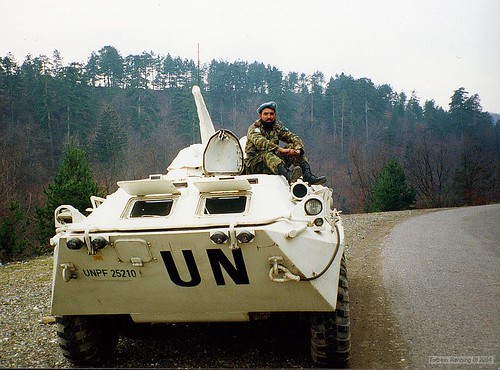
scannet bilde(59)_std, originally uploaded by Torbein.
Years ago, there was a British Army Major on a birding holiday I was on, and at the time I thought how interesting it was to hear him talk about his work, because although the armed forces aren’t exactly secretive, they tend to operate in a kind of parallel world separate from civilian life. Especially since we weren’t involved in any particularly high-profile wars at that point—it must have been just about when Yugoslavia was starting to kick off but before it had pulled in the UN and NATO. Even now, with the Iraq War the biggest political issue of the time, the military aren’t all over the media in quite the way the politicians and pundits are. We tend to get a view of them filtered through all kinds of emotive rhetoric and propaganda, both positive and negative. So the book is interesting just from that point of view, the chance to read a professional soldier’s cool-headed and analytical perspective on the business of using military force.
But the book has a rather more serious purpose than that; it isn’t a memoir, after all. He has a thesis to put forward; basically, that the military—not just the British military, but everyone else’s as well—is set up for doing one kind of job but is called on to do something distinctly different. And that no-one, whether the armed forces, politicians, media or public, has really come to terms with the change yet. So not only is the organisation, training and equipment of the military badly suited to their work, but that everyone around them is having their decisions and judgments distorted by what they think war ought to be like.
The book starts with a historical survey of the development of conventional warfare from Napoleon to the second world war, it terms of changes in tactics, organisation and weaponry, the impact of the railways and so on. War in the form it reached in the two world wars, with the entire industrial capacity of the combatant nations devoted to the war effort, and the military aim of destroying your opponent’s capacity to wage war before he can do the same to you, he refers to as ‘industrial war’.
He also traces the parallel development of guerilla warfare, revolutionary war, terrorism and other kinds of informal warfare over the same period; from Spain in the Napoleonic War, where the word guerilla originated, through the Boer War, the Chinese revolution, WWII resistance movements, Vietnam and so on. He calls these kinds of warfare ‘war amongst the people’.
His contention is that our armed forces are designed to fight an industrial war—against the Soviet Union—and in fact all the conflicts they are involved in are examples of war amongst the people. And not just since the end of the Cold War; for the past 60 years nearly all military engagements have been civil wars, (post) colonial wars, peace-keeping operations and so on; as he points out
the last real tank battle known to the world, one in which the armoured formations of two armies manoeuvred against each other supported by artillery and air forces, one in which the tanks in formation were the deciding force, took place in the 1973 Arab-Israeli War on the Golan Heights and in the Sinai Desert.
Which hasn’t stopped armies buying tanks or even using them; but for the past 35 years, these bits of kit that are supposed to be the technological and military pinnacle of the army’s equipment have not been used to do what they were designed to do. A tank is a fine weapon against another tank, but not very appropriate against a man with an AK-47. The same applies to a modern fighter/bomber; for most contemporary wars it is at the very least hugely over-specified for the job at hand.
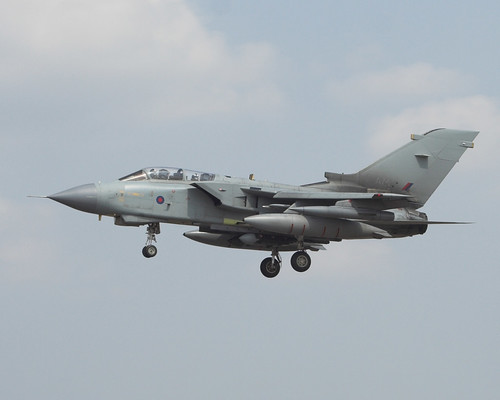
IMG_1825-01, originally uploaded by shish0r.
And it’s not just the equipment, but the whole balance of the army. He suggests that we have too many fighting troops as a proportion of our forces, and not enough men trained to gather information. In a situation like Iraq, with non-uniformed enemies fighting in urban conditions among civilians, there’s a limit to how much force you can usefully apply, but you can never have too much information about how best to apply it. Similarly, in an industrial war, liaising and coordinating with the civilian population and civilian organisations is a secondary task and the branches of the armed forces devoted to it are therefore small and unprestigious; in a war among the people it becomes much more complicated and vital to the success of your operations.
If it was just a book about suggested organisational reforms to the army it would still be interesting but it would have less far-reaching implications. Throughout the book the emphasis is less on the business of fighting than the use of force to achieve a goal; the relationship between the military and politics. For me, the take-home message is that war among the people is by its nature political war. I mean obviously all war is political, but in an industrial war, once it starts, the primary objective is a military one and the politics has to serve that aim. If the military is serving a political aim all sorts of things change. For example, ‘winning hearts and minds’ isn’t just a secondary focus that is important because it makes the job of the military easier; it’s the objective that everything else should be working towards. You can’t destroy a guerilla or terrorist ‘army’ by force; you have to create a (political!) climate where they can no longer operate. That means persuading the civilian population that they are better off with you than with the insurgents.
Similarly, both the military and the politicians need to recognise that the military can only achieve military objectives, not political ones. And so because the aims are political, it follows that these wars cannot be ‘won’ by force. Military and politicians need to get out of the mindset of believing that there is the possibility of a military victory that will solve their problem. That doesn’t mean the military has no role, but they have to be subservient to a political aim; they have to be used to help create the conditions for a political solution to be reached. Military victory cannot be an aim in itself.
Anyway, I’ve gone on long enough and I haven’t even touched on all sorts of interesting observations about, for example, dealing with the media, or working within a multinational coalition. I’m not really in a position to assess all his arguments, although they seem persuasive to me, but I found it an immensely interesting book. If anything I’d just say that the historical stuff about Napoleon and Clausewitz and so on in the first half of the book is relatively dry; don’t let it put you off.
n.b. A duplicate of this post appears in my ‘recently read books’ section; I’ve decided that for longer reviews like this it seems silly not to post them on the front page as well. So from now on that’s what I’m going to do.
