Categories
Culture

‘The Real Van Gogh’ at the Royal Academy

Not that rubbishy fake Van Gogh that other galleries having been fobbing us off with, then.

The exhibition’s full title is ‘The Real Van Gogh: The Artist and His Letters’. The inclusion of some of Van Gogh’s letters supposedly provides a bit of biographical-intellectual-psychological context for the paintings. Which is an interesting idea, but calling it ‘The Real Van Gogh’ is still ridiculous.

The show hardly needs a special hook to attract the public’s attention; it is, somewhat surprisingly, the first major Van Gogh exhibition in London for 40 years, and I’m quite sure that it will be packed for the whole run. And rightly so: it has a lot of marvellous paintings in it. Van Gogh is so universally popular that the bloody-minded part of me almost wants to argue that he’s overrated, but I can’t bring myself to do it. Quite apart from anything else there is to say about his work, there is just such a lot of straightforward pleasure to be had from it.
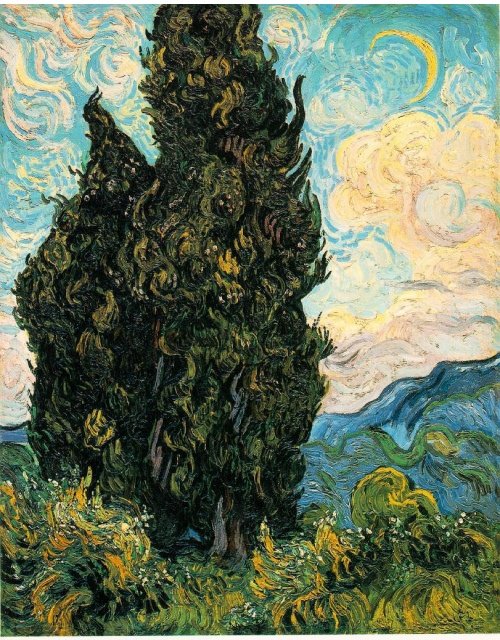
Looking at the late landscapes I found myself thinking of El Greco: the strength of colour, the tension in the distorted forms, the stretching of the possibilities of figurative painting without losing that connection with real objects. By which I mean: he doesn’t seem to have been heading towards abstraction in that way that, in Cezanne’s landscapes, the mountain sometimes seems to be fragmenting into patterns of light and colour. Van Gogh’s landscapes are full of the thingness of things.

So it is a marvellous exhibition which I highly recommend. On the other hand I thought the letters were a bit of a sideshow. Most of them were written to his brother Theo; in the relatively short sections which the curators have translated from Flemish or French, Vincent talks about what he has been doing, how his work is going, and provides little ink sketches of the paintings he has been doing. It’s quite interesting; you do get some sense of his personality, of how articulate and thoughtful he was. And some of what he has to say about the work is somewhat interesting. But even without buying into the Death Of The Author idea that the artist’s life is irrelevant to understanding the work, I do think there is a limit to its value. Artists’ comments about their own work always seem so vague and generic compared to the specificity and particularity of the work itself; which I guess is why they end up as artists rather than writers. And the awkwardness of putting too much text in an exhibition mean that you’re not getting that much of Vincent’s thought anyway.

Perhaps there is a particular value in providing this kind of biographical material for Van Gogh, since he is probably still widely thought of as the mad genius artist. The letters at least give a more rounded sense of a real human being, since he comes across in them as, well, fairly normal. Intelligent, good with languages and incomprehensibly good with paint, but certainly not frothing at the mouth. I guess that point is worth making.

Categories
Daily Links

Links

Categories
Culture

The Guildhall Art Gallery and Roman Amphitheatre

The Guildhall, for those who don’t know, was basically the town hall for medieval London; it is now the only surviving stone building in the City from before the Great Fire which isn’t a church. And, again for those who don’t know, when I say ‘the City’, I don’t mean ‘the city’; i.e. not the whole metropolis of London, but the City of London, the area within the medieval city walls, which now operated as its own special little fiefdom by the Corporation of the City of London. It’s the kind of place where you can’t throw a plate of tapas without hitting a banker or a lawyer.

The Guildhall Art Gallery is another gallery which I decided to check out because it’s on the Art Fund list and I’d never been there. Unlike the Guildhall, the gallery building is fairly new. The original gallery was extensively remodelled by the Luftwaffe in 1941 and didn’t reopen until 1999. And the building is rather grand — though if the City of London couldn’t grub together a few quid to build an art gallery, it’s hard to imagine who could.

The actual art was a bit underwhelming (or at least not my taste). Especially so at the moment as they are between exhibitions, so one of the large rooms was closed. What was left was a load of portraits of royalty and City grandees (Lord Mayors, heads of livery companies, yawn), some scenes of London, and a selection of Victorian/Pre-Raphaelite paintings. Some of their Pre-Raphs are rather famous, but still: really not my favourite thing.

The amphitheatre was quite interesting, although rather less spectacular than the word might suggest. Ephesus it ain’t. They didn’t even know it was there until 1988, when archeologists found it, and they decided to incorporate it into the building of the new gallery. So you go down to the basement and you can see a section that was the entranceway. Basically it’s a few traces of wall and some wooden drain, but it was interesting to see it.

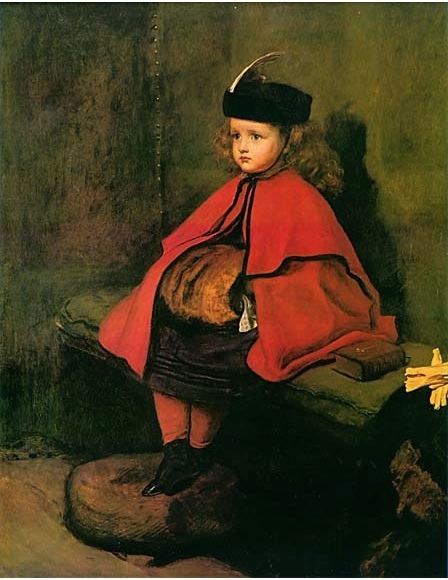
» The painting is My First Sermon by John Everett Millais. The photo is of a bit of the 2000-year-old wooden drain from the Roman Amphitheatre. OPH 2008__0079_Guidhall.JPG is © king_david_uk and used under a CC by-nd licence.

Categories
Nature

RSPB Big Garden Birdwatch 2010

That time of year again, the RSPB’s Big Garden Birdwatch, one of the world’s biggest exercises in citizen science. The usual drill: one hour of birding in the garden, with the counts being the maximum seen at one time.

  • blue tit × 3
  • great tit × 2
  • coal tit
  • long-tailed tit
  • chaffinch × 3
  • goldfinch
  • woodpigeon × 2
  • pigeon × 4
  • magpie × 3
  • blackbird × 3
  • song thrush
  • robin
  • dunnock × 2
  • ring-necked parakeet × 3
  • sparrowhawk

There’s a few fairly regular visitors missing; greenfinch, jay, great-spotted woodpecker, goldcrest, nuthatch. But on balance think it’s a pretty decent list.

Categories
Other

A passing thought on the iPad: handheld ≠ mobile

I think one reason people have a hard time visualising how the iPad will fit into their lives is that they assume it will mainly be a mobile device; i.e. something they will actually carry around with them all the time.

I don’t think that needs to be true for it to be successful. I think it’s significant that Apple had a sofa on stage for the product launch.

Despite the fact that there is more than one real computer in the house, I often use the iPhone at home to look things up on the internet or check my email. Because if you just want to do something quickly, the device which is in the same room beats the one which is somewhere else; but also because sometimes it’s nice to do all that stuff from the comfort of a sofa.

Nintendo recently brought out a larger version of the DS, which might not make sense if you believe that a handheld device is all about portability. But it makes sense to me, because I don’t actually use my DS on the train or waiting for a bus; I sometimes take it on holiday but otherwise it doesn’t leave the house. It’s still nice to be able to just pick it up and play it anywhere. And somehow it feels like less of an effort — you can pick it up, play for a few minutes, put it down — it’s a more casual, comfortable experience than using a ‘real’ games console.

I think the iPad could be a successful product just to have around the house, something to pick up and use for a minute or two as an internet device or for casual gaming; something you can curl up on a sofa with. Something that never leaves the house, except perhaps to take on holiday.

Some people will carry them around, of course, and no doubt people will find lots of ingenious uses for the thing — it is a blank slate — but that may not be the norm.

Categories
Nature

Bird of the Year 2009

Starting with the trainspotter-y listing details: I added three birds to my patch list and three to my British list, one of which was a lifer. Really, that’s not a very good score; I got two lifers and a patch tick in the first week of 2010. But the year had a few highlights nonetheless.

The patch ticks were all in Dulwich Park. One was a fieldfare which turned up when it was snowy in February, which was pleasing but if anything slightly overdue.

There was also a peregrine falcon I spotted flying high overhead in March, which wasn’t actually the first time I saw a peregrine in Dulwich Park; it’s just that the first time, many years ago, what I’d actually seen was a pigeon from a funny angle. It was only a fraction of a second before my conscious brain kicked in, but for that moment I ‘knew’ it was a peregrine (Ivory-billed Woodpecker, anyone?). Back then it would have been a truly staggering sighting; but in the last 15 years London peregrines have gone from 0 to 18 breeding pairs. Which is great news, but downgrades my peregrine sighting from ‘staggering’ to ‘exciting’.

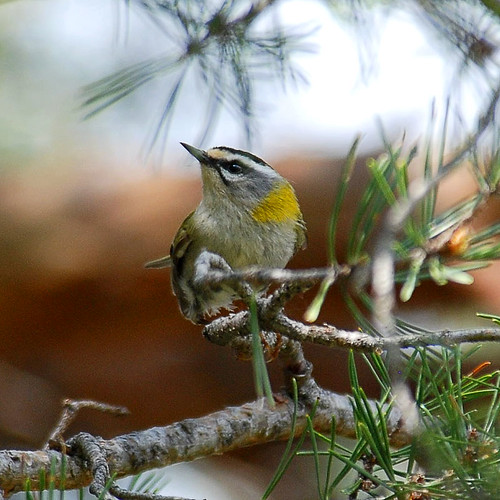
And finally, I saw a firecrest, which was a very gratifying reward for all the times (hundreds? thousands?) I have seen goldcrests and dutifully checked for an eyestripe, just in case.

Two of the three British ticks were from the same jaunt to the Lee Valley Park in June where I had a good day, seeing I think eight species of warbler and hearing several nightingales. But I went there on an actual twitch to see the Savi’s warbler that had been hanging around for a bit. I definitely heard it (they have an extraordinary song) and I saw something which looked roughly like a Savi’s warbler and was in the right place… but was so distant it could have been a reed warbler that just happened to be in the same bit of reedbed. But it’s not a lifer or anything and I definitely heard it, so as far as I’m concerned that’s a tick.

And on the same day I saw a brown flash moving from one bush to another which, equally recklessly, I’m going to say was a Cetti’s warbler. Again, it was definitely there — it was singing beautifully — and it’s not  a lifer, so I’m happy to count it on my British list.

And the third British tick is, slightly embarrassingly, really, little-ringed plover. Which is an attractive wee beastie — the eye-ring makes all the difference — but which lacks the real star quality I’m looking for in my Bird of the Year.

I didn’t see anything new in Provence, but I did get a nice selection of the classic Mediterranean species: nightingales singing all over the place, black kite, the inescapable Sardinian warblers; a short-toed treecreeper nesting under the tiles of the villa where we stayed; Dartford warbler, subalpine warbler, woodchat shrike, woodlark, turtle dove. And one of the cutest birds EVAR, one which I haven’t seen for a few years, crested tit.

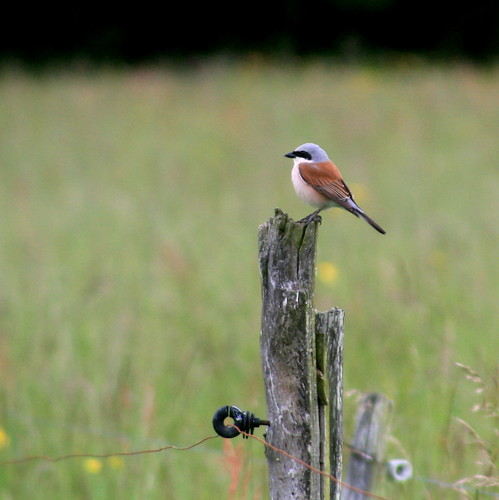
But my bird of the year was a species I’ve only seen once before, I think, in Norfolk many years ago, and that one was a female or a juvenile, so it looked, not wishing to be rude, a bit drab and nothingy. Whereas the male I saw in France looked like this:

That is one good-looking bird. I just love that little highwayman’s mask it has, and it’s such an elegant colour combination: pink, russet, slate blue and black. Just as birdsong is often beautiful but doesn’t really sound like music, birds are often beautiful, but despite what the creationists will tell you, they don’t necessarily look designed. Or at least not by a designer with real flair. They look like what they are, things which have developed organically.

But there are some species where that organic process has produced something which happens to coincide with human ideas of stylishness, and the red-backed shrike is one of those. It looks fabulous. And that is as good a reason as any to make it my Bird of the Year for 2009.

» Firecrest is © Sergey Yeliseev and used under the by-nc-nd licence. Lanius collurio – Pie-grièche écorcheur – red-backed shrike is © arpian and used under a by-nc-sa licence.