-
Great image.
Categories
I had a good day at Rainham Marshes in Essex today. I got a new bird, Bean Goose; also saw peregrine, loads of ducks (wigeon, pintail, gadwall, shoveler, shelduck etc), stonechat, meadow pipit, huge numbers of lapwing, ruff, possible water rail, and the most obliging bird of the day, this extremely tame Slavonian Grebe:
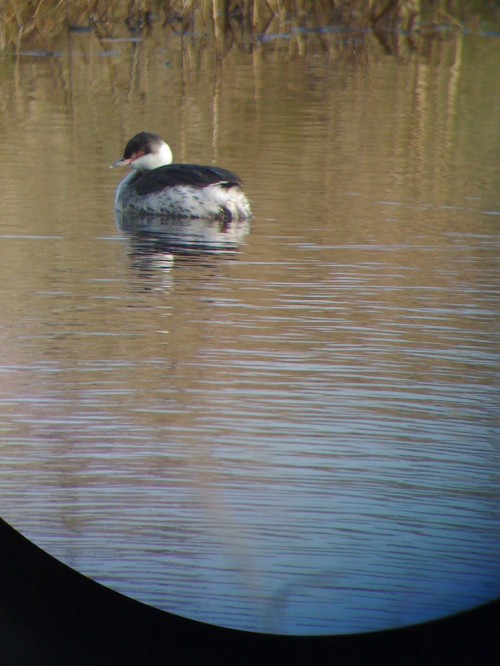
Ah, the wonders of iPhone digiscoping.
And the most entertaining sighting of the day was an extremely manic and not-at-all-shy stoat which was scampering around the place like a mad thing.
Best Plant
Provence in May was just a great place for flowers. I claimed on Twitter to have seen nine or ten species of orchid, although it’s entirely possibly I over-claimed, since there tend to be lots of very similar species, some of them are quite variable, and I didn’t have a book with me. Still, I definitely saw an absolute minimum of six species because I saw six kinds of orchid: i.e. a bee-type orchid, a Serapias orchid, Lizard Orchid, some kind of hellebore and so on. This is a Serapias species:

And there were lots of other flowers: various kinds of rockrose, asphodel, wild Gladiolus, broom, poppies. I love the Mediterranean in spring.
But my plant of the year is lavender. Not the fields of lavender which are such a familiar image of Provence, but the wild lavender, Lavandula stoechas, which was blooming in great swathes of purple out in the scrub:

LATE BREAKING NEWS!!
In a controversial move, the BOTY judges [i.e. me] have made the shock last-minute change to their [my] decision!
I know, you’re excited.
I was browsing through my pictures from Provence, looking for ones to use to illustrate this post, when I came across this shot I snapped with my phone of a weird-looking red thing:
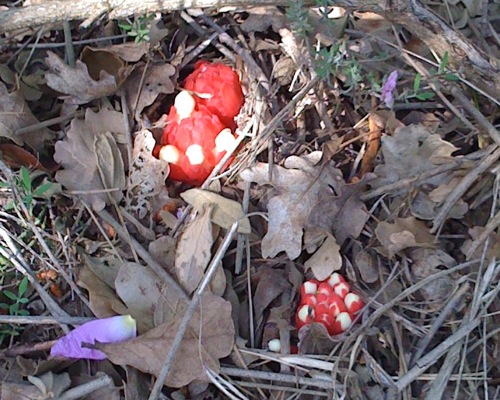
When I saw it, I thought it might be a fungus, but on closer examination it was clearly a plant. The lack of chlorophyll made me wonder if it was some kind of broomrape just emerging, but it didn’t really look right… so I snapped a picture of it and went on.
Well, when I found the photo, I decided to post it to the ID Please group on Flickr, and it turns out it is a different parasitic plant: Cytinus ruber. You can see a more fully open specimen here.
Apparently the Cytinus plant grows entirely inside the roots of Cistus plants — i.e. rockroses; the pink petals in the picture are from a Cistus — and only produces an external growth when it flowers. So it has a lifestyle normally associated with fungi.
So that’s kind of cool. But it gets better (or at least geekier). Cytinus was previously included in the same family as the famous Rafflesia, the amazing genus of plants from southeast Asia which include the largest single flower anywhere and which also live inside their host plant when not in flower.
But DNA testing has revealed that Cytinus is not closely related to Rafflesia at all; it has now been moved to the order Malvales, a large group of largely shrubby flowering plants that includes the mallows, hollyhocks, hibiscus, okra, cotton, baobab and indeed Cistus. So this plant which is so alien-looking and so highly specialised is part of a family of woody flowering shrubs; but it has changed so dramatically that only DNA testing makes it possible to discover the relationship.
So, for being both attractive and completely geektastic, Cytinus ruber is my plant of the year for 2009. Sorry Lavandula stoechas; maybe your turn will come round again another time.
Best Insect
I think that the hornet I saw at the Lee Valley Park deserves a mention. To give it its full name, it was the European Hornet, Vespa crabro, the largest wasp in Europe*, which I rarely see. And another good London sighting was the Summer Chafer I saw on Wandsworth Common.
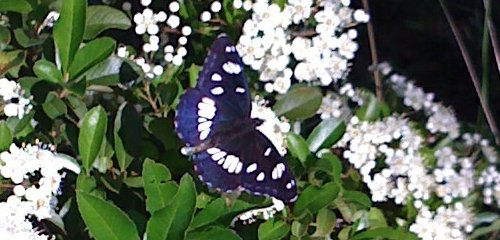
And in Provence in May I saw some nice butterfly species, like Swallowtail and Scarce Swallowtail, masses of little blue ones, Red Admirals, Painted Lady, and the Southern White Admiral, which was new to me:
There was also the extraordinary Libelloides coccajus, which completely threw me for a loop when I saw it. I didn’t have most of my books with me, and I don’t know when I’ve last been so baffled by an animal. Being unable to identify an insect isn’t a surprise; they are really hard, and while I’m a reasonably competent birdwatcher, outside the class Aves I’m a complete lightweight. But to see such a large and spectacular insect and have absolutely no idea what group of insects it belonged to was startling. And cool.
And the insect spectacle of the year was the Great Painted Lady Invasion. Painted Lady butterflies were all over the place in Provence, but although there were certainly a lot of them, I didn’t think much of it; and then they started turning up in the UK in record numbers. Painted Ladies are migratory, and they make it to Britain in fairly small numbers in most years; this year they arrived in their millions. And I initially learned about it on the internet: suddenly references to Painted Ladies, sometimes thousands of Painted Ladies, started popping up in my Twitter feeds and on blogs. By the time they reached London they had spread out a bit, and I never saw more than half a dozen in the garden at once. But they were all tending to travel in the same direction, and they just kept on coming for days. I did a half-hour count on May 29th and saw 36 pass through. One a minute is infrequent enough that you could be in the garden and miss what was happening; but scale up those numbers over the whole of the country — over the whole of Northern Europe, probably — and it’s a staggering phenomenon. And all because of a particularly good thistle-growing season in Morocco the previous year, apparently.

But despite stiff competition, my insect of the year was Narrow-bordered Bee Hawkmoth, Hemaris tityus, which, as you can see at that link, is a moth which looks like a bee, right down to the transparent wings. It’s something I’ve wanted to see ever since I got my first moth book, and I was thoroughly pleased to see them in Provence.
Best Invertebrate (other)
Once again, embarrassingly, despite the fact that so many of the world’s species are non-insect invertebrates, I can’t think of single particularly notable spider, scorpion, snail, squid, sea squirt or anything else which I saw in the wild this year…
Best Fish
…and I don’t have anything for the fish category either. Though that’s not particularly surprising because the little buggers live underwater all the time, so you don’t tend to spot them when you’re just casually out and about.
Best Amphibian
Marsh Frogs, at the London Wetland Centre, Barnes, making quacking noises that sound more a duck than most ducks do.
Best Reptile
There’s not a lot of choice in this category, but that’s OK, I’m very happy to choose Moorish Gecko.

I love geckos, with their little buggy eyes, their flat feet, and the way they scamper around on the walls as though it was the easiest thing in the word to ignore the laws of physics.
Best Mammal
My mammal of the year 2009 is the water vole, Arvicola amphibius. These used to be a common sight in British rivers and canals, but they’re sadly quite rare these days, so I was pleased to see one in the Lee Valley. And I’m fairly sure it actually was a water vole rather than the much commoner and much less adorable brown rat.
Best Ecosystem
I love dry scrubby habitats — heathland, savannah, Mediterranean scrub — although it’s hard to explain why, exactly. So the Provençal scrub in the spring, with the wild lavender and rockrose in flower, and orchids and gladiolus, and pine and broom, and the nightingales singing, and butterflies everywhere … love it. There’s nowhere better. And it is certainly my ecosystem of the year for 2009.
Tune in again in an unspecified amount of time to discover the winner of the most prestigious award of all, Bird of the Year 2009.
* To get seriously geeky about it, and here at the BOTY awards we are unashamedly geeky about such things, it is the largest eusocial wasp; i.e. the largest of those wasps that builds a large paper nest. Which are what people normally think of as wasps. Using the term ‘wasp’ in a broader sense, the horntail/great wood-wasp Urocerus gigas is certainly larger, and I think there are even larger species of parasitic wasps in other parts of Europe.
Among all the speculation about the forthcoming Apple Tablet/iSlate/iPad has been a thread of uncertainty: no one is really sure what it’s for; what niche it fills.
Everyone has been missing the obvious: it’s an e-reader for birdwatchers.
I have two field guides on my iPhone: butterflies and birds. I haven’t had a chance to use the bird guide in earnest yet, but the butterfly guide has been useful several times. You never know when you might see a butterfly, and when you do, you need the information on hand immediately if you’re going to have a chance to identify it. I would happily fill my phone with other field guides — trees, flowers, fungi, dragonflies — just so I could always have that information to hand.
So that’s good. But but but: the screen is not big enough. A real, paper field guide would have several species, each with several illustrations, and distribution maps, and text, all on the same double-page spread. The phone has space for one or maybe two illustrations per screen; that means an awful lot of scrolling backwards and forwards to compare species.
Until screens get much much higher resolution, you’re never going to fit as much information onto a screen as you can on a printed page; but for these purposes, any increase in screen size is a bonus. And no, even with 16 levels of grey, an electronic paper display is not going to cut it.
And it’s not just field guides: there’s a new app for the iPhone that, for £25, has 1:50,000 scale Ordnance Survey maps of, for example, the South-East of England. Always having an OS map with you whenever you go for a country walk: how cool is that? Well, it’s a damn sight cooler with a 10″ screen than it is with a 3½″ one.
So, since the Tablet is going to be aimed at birdwatchers and ramblers, I confidently predict it will be a rugged, waterproof device designed for outdoor use.
No, just kidding.
OK, so the examples that spring to mind for me are rather specific, and Steve Jobs isn’t about to launch an incredible new product aimed specifically at birdwatchers and hikers. Sadly. But really, I think people might be overthinking this. After all, when is a bigger screen not a useful thing to have?
» iTunes links: butterflies, birds, OS maps.
‘The arnica is diluted so much that there is only one molecule of it per 7 million billion billion billion billion pills.
[…] If every human being since the beginning of time had saved every last penny, denarius and sea-shell, we would still have not saved-up enough to purchase a single arnica molecule from Boots.’
