Categories
Me Nature

Christmas food debrief, bitterns etc

I should note in advance: the bitterns are not part of the food debrief. I daresay they turned up on Henry VIII’s dining table, but not mine.

Food notes: the fruity stuffing was good, the pistachio one mainly tasted of parsley and garlic, which was pleasant enough but not very christmassy. The prunes in bacon were delish, a much better addition than sausages in bacon. Cooking a whole boned ham leads to Too Much Ham. I’m quite glad I did it this once, but I won’t again.

And actually I don’t think I’m going to do turkey next year; even with a (very expensive) free range organic slow-grown turkey, cooked beautifully, though I do say so myself, it’s just a big boring. The stuffing is much better than the actual bird. Maybe I’ll do a big joint of beef instead.

I had a great day birding today: I’d heard via the London Wetland Centre’s Twitter feed (@wwtlondon) that the cold weather had produced an unprecedented influx of bitterns. They aren’t sure whether they’re from elsewhere in the UK or from the continent, but yesterday and today they’ve had 6 or 7 on site. Now bitterns are notoriously skulky and difficult to see, being streaky reed-coloured birds that live in reedbeds — and incidentally, I believe the American Bittern is rather easier to see than the European, for comparison — and last time I went bitterning at Barnes I saw diddly-squat, but I figured I’d never get a better chance.

And sure enough I had six sightings of bittern, each closer and clearer than the one before. The water was mainly frozen over, and they were presumably desperate enough for food that they were stalking along the ice just by the edge of the reeds, with their surprisingly large feet sliding with every step.

I also had great views of water rail, the bird you may remember me mentioning before which has, according to the book, ‘a discontented piglet-like squeal, soon dying away’. I saw four pairs, including telescope views of a pair preening each other about thirty feet away.

And my last special bird of the day was jack snipe, a smaller, less elegant and generally more self-effacing version of the normal snipe, but my second lifer of the day after the bitterns.

So some early contenders for the Bird Of The Year Award 2010. I do btw still intend to do BOTY 2009, but it can wait until my computer has been fixed. Using the iPhone for blogging works better than you might think but it’s no substitute when it comes to long posts with links and pictures.
Categories
Nature

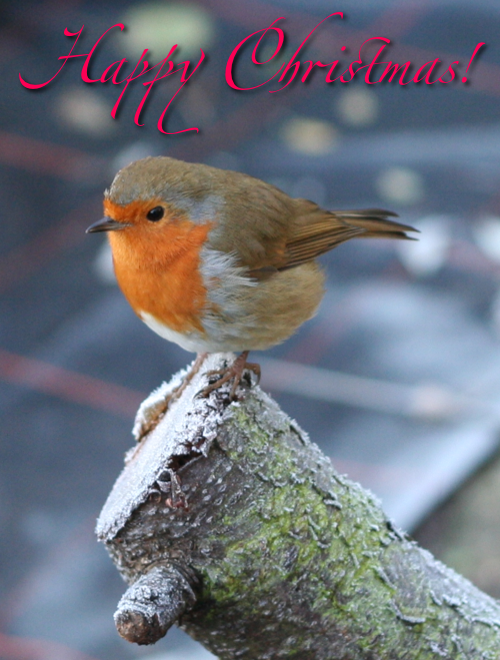
Harry’s advent calendar of birds, day 24: Robin

No surprise in the final bird on the advent calendar. Or at least, no surprise for my British readers; robins probably appear on more Christmas cards here than Jesus.

In fact, the robin is so deeply linked to Christmas that it’s slightly surprising to remember other countries don’t have the same association. Some of them have the excuse that they don’t actually have any robins — and no, Americans, your so called ‘robins’ don’t count — but the same applies to other European countries.

It’s not completely clear where the connection came from. It’s relatively recent, as folklore goes; at most back to the eighteenth century, and it became really well established in the nineteenth, as Christmas cards became popular. One suggestion, according to Birds Britannica, is that Robin was a nickname for Victorian postmen, who had red uniforms; so the birds often appeared on Christmas cards carrying envelopes in their beaks. Or perhaps it’s because they sing through the winter.

Christmas aside, they are very popular birds; they are famously tame around people, hanging around gardeners looking for worms. Apparently they actually evolved this behaviour in association with wild boar, which they would follow through the forest in much the same manner. I guess there are worse things to be than a substitute boar.

Happy Christmas, one and all.

Categories
Me

The 5th annual Christmas stuffing post

As usual, I’ve made a base of sausagemeat, onion, celery and breadcrumbs, and split it into two batches.

To one I added dried apricots and dried barberries which I reconstituted in champagne (but only because there was half a bottle of flat champagne in the kitchen). Then a pinch of mixed spice.

The second stuffing had pistachios, lots of flat-leaved parsley & a bit of thyme, some chopped green olives, garlic, lemon zest and lemon juice.

Incidentally, my computer problems are back and so the final entry to my advent calendar will have to wait until when and if I get it running again… hopefully at least before midnight.

Categories
Nature

Harry’s advent calendar of birds, day 23: Partridge

I’ve been baking a ham, wrapping presents, and listening to cheesy Christmas music today, so let’s plough on with the Christmas clichés.

I’ll skip the seven swans a-swimming, the six geese a-laying, four colly-birds, three french hens and two turtle doves; but here’s a partridge:

It’s not in a pear tree because, apart from anything else, it would be very unusual to see a partridge in any kind of tree.

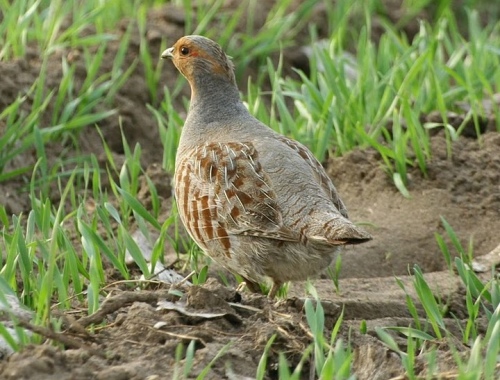
The partridge above is the Grey Partridge, Perdix perdix, which is native to the UK, as well as much of the rest of Europe. So that’s probably the partridge in the song, although according to Wikipedia the song came from France, so perhaps it was about the Red-legged Partridge — which also came from France. The song dates to 1780 in English, and the first breeding record of RLP is 1770, so they could even have been introduced together… though probably not.

People have all sorts of reasons for introducing birds to countries where they aren’t native, but not surprisingly, species which are good for hunting and eating are one popular choice.

The Red-legged Partridge is still known to hunters in the UK as the ‘French Partridge’, and even after 200 years we still think of it as an introduced species. But it’s not the only introduced game animal; the pheasant, the rabbit and the fallow deer are all so well established as to seem like native species, but the (originally Asian) pheasant was brought by the Romans, and the Normans brought us fallow deer and rabbits.

Here’s some good stuff from Wikipedia about variant versions of the song:

France

In the west of France the piece is known as a song, “La foi de la loi,” and is sung “avec solennite,” the sequence being: a good stuffing without bones, two breasts of veal, three joints of beef, four pigs’ trotters, five legs of mutton, six partridges with cabbage, seven spitted rabbits, eight plates of salad, nine dishes for a chapter of canons, ten full casks, eleven beautiful full-breasted maidens, and twelve musketeers with their swords.

Scotland

In Scotland, early in the 19th century, the recitation began: “The king sent his lady on the first Yule day, | A popingo-aye [parrot]; | Wha learns my carol and carries it away?” The succeeding gifts were three partridges, three plovers, a goose that was grey, three starlings, three goldspinks, a bull that was brown, three ducks a-merry laying, three swans a-merry swimming, an Arabian baboon, three hinds a-merry hunting, three maids a-merry dancing, three stalks o’ merry corn.

That French version sounds like a recipe for one hell of a Christmas party.

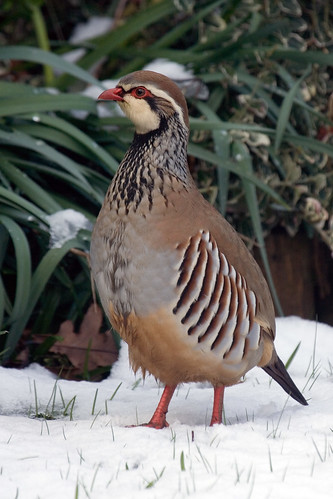
» Photo Credits: Grey Partridge (Perdix perdix) is © Tomasz Kulakowski and used under the CC by-nd licence. Partridge in Snow 2 is © Keith Marshall and used under the CC by-nc-sa licence.

Categories
Me

Mmmm, cured pork products

This is what I have been doing today (well, that and wrapping presents):

The ham is from Sillfield Farm, but I steamed and glazed it myself. I’m pretty pleased with how it turned out, although I know it’s not the most flattering photograph.

Categories
Nature

Harry’s advent calendar of birds, day 22: Spotted Nightjar

I’m going out on the razz this evening and I have things to do; presents to wrap, cats to give pills to, ummm… that might be it. But anyway, here’s a quick one, a lovely picture of a Spotted Nightjar and chick which I found on Flickr:

Cryptic camouflage designed to help birds hide can be just as beautiful as flamboyant plumage used to attract mates.

» Photo Credit: There are two nightjars is © Brent Barrett, and used under the CC by-nc-nd licence.