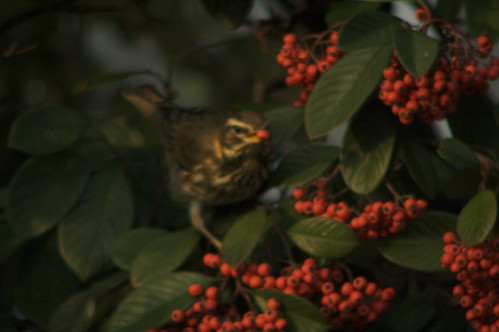
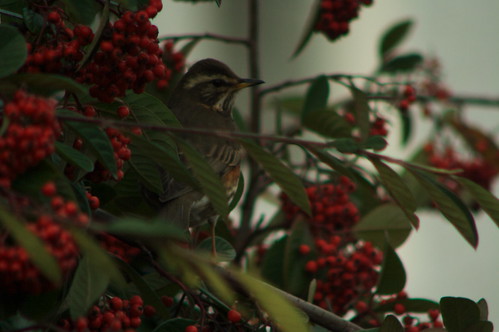
I was reading in the garden today and heard a distinctive chirp: there was a female house sparrow on the bird feeder. Once, this would have been normal, but British house sparrow numbers have plummeted in the past few years; the sparrow population of London declined 75% between 1999 and 2004. It was the first one I’ve seen here for years.
No-one quite knows why they disappeared. Loss of nest sites because of changing roofing materials? Loss of hedging? Less waste ground? Inevitably some ‘bird lovers’ blame sparrowhawks and magpies, or cats or squirrels; equally inevitably some people have tried to blame it on mobile phone masts. It seems difficult to account for the suddenness and scale of the decline by any obvious change in the environment, and it’s tempting to suggest disease; but honestly we don’t know.

Food Fight!, originally uploaded by ScottCatskill.
There’s a particular poignancy because Londoners have long identified with the house sparrow as the ‘cockney sparra’. In Victorian London, when the air was murk and anything left in one place for too long was gradually covered in a layer of flaky soot, and city gardeners had to choose their flowers from species which could survive the pollution, there weren’t many birds found in the heart of the city. But the sparrows were there, nesting in the gutters and tiled roofs and any little nook in the brickwork which would offer them enough space to build a nest out of sweet papers and cigarette butts. The very character of them—drab, scruffy, gregarious, chirpy, impudent, noisy, tuneless, and given to squabbling and shagging in public—makes them seem like proper London birds.
Behind the most ancient part of Holborn, London, where certain gabled houses some centuries of age still stand looking on the public way, as if disconsolately looking for the Old Bourne that has long run dry, is a little nook composed of two irregular quadrangles, called Staple Inn. It is one of those nooks, the turning into which out of the clashing street, imparts to the relieved pedestrian the sensation of having put cotton in his ears, and velvet soles on his boots. It is one of those nooks where a few smoky sparrows twitter in smoky trees, as though they called to one another, ‘Let us play at country,’ and where a few feet of garden-mould and a few yards of gravel enable them to do that refreshing violence to their tiny understandings.
—from Dickens’s The Mystery of Edwin Drood
The idea that the house sparrow is a cockney bird is admittedly parochial. Sparrows are found nearly everywhere there are people. And they are only found where there are people; they have become so closely tied to human habitation that no-one knows quite what habitat the ancestral sparrows preferred, or what part of the world they lived in. I like to think that sparrows started hanging out around people at about the moment some Mesopotamian farmer built the first granary, and they’ve been with us ever since, hopping around our barns and farmyards, our parks, markets and pavement cafés; nesting in our thatch, under our tiles, and in our lamp-posts.

Little bandit,……, originally uploaded by Hans Viveen.
I also feel a certain kinship in the fact that house sparrows, like the other species that have hitched a ride with humanity—rats, pigeons, cockroaches—have been successful because, like us, they are generalists. They are adaptable. They may not be exquisitely adapted to efficiently exploit a particular evolutionary niche, but provide them with a new environment like a city, and they find a way to thrive while other species are left stuck in their evolutionary rut.
When the sparrows disappeared from this bit of London, I didn’t consciously notice them go. But when I’m staying somewhere that does have them—if I’m woken in the morning by their chirping, if they try to steal the crumbs from my morning croissant—there is a sense of order restored. Deep down, I feel that a house without sparrows is lacking something important. I know that people in the Americas and Australia, for whom the house sparrow is an invasive, non-native species, may not feel the same way. But to me, the sparrows are our companions, our familiars, our symbionts.
I just hope that today’s was the first of many.