Categories
Culture Other

The Italian Job by Gianluca Vialli

The subtitle of this book is “A journey to the heart of two footballing cultures”, and Gianluca Vialli, having grown up and played most of his career in Italy before ending it playing and then managing in England, is well placed to make the comparison (as indeed is his co-writer Gabriele Marcotti, the UK correspondent for Corriere dello Sport). He also interviewed many of the major figures in both countries, including managers, referees and former players.

The comparison is interesting and I suspect most of his diagnoses are right: for example, that the English are not so much tactically inept as completely uninterested, that we don’t treat it as a serious profession, that the specifically working class identity of football in Britain is a key part of why it has developed differently here, and that an unjustified sense of the superiority of English football has kept us from learning useful lessons from all those countries that win World Cups more often than we do.

If that makes it sound like he portrays the English as the village idiots of European football, well, it does feel like that at times. He finds enough negative things to say about Italian football culture, but it’s pretty clear which country he thinks produces better footballers. It’s not just the football itself, though; he has interesting things to say about the differences in the media, the fans, and the attitude to managers.

There is a perhaps inevitable tendency to lapse into presenting national stereotypes as though they were explanations; not just from Vialli, either, but from many of his interviewees. I think Vialli is generally careful to go beyond stereotypes to find more specific explanations, but there’s still a certain amount of ‘Latins are like x and northern Europeans are like y’ being bandied around. Here’s an example of the kind of thing I found questionable:

These are the kind of mental acrobatics many of us go through in Italy – quite the opposite of England. But then the English are off to war, blindly trusting their leader, while the Italians aren’t quite so sure…

‘Look, it’s in the blood of the English. It’s the almost military attitude with which they approach everything,’ says Wenger. ‘They do as they’re told, they follow orders, they do not question authority and they never give up, not even when they are three goals down and there are two minutes to go. I don’t think it’s a coincidence. Every time there is a war, the English almost always win. The Italians on the other hand…

There was no need for Wenger to finish the sentence. I knew where he was going with it. And, admittedly, he has a point. As a nation, we are far less warlike than the English – not to mention the Germans – so our record in war is not quite as good as our record in football. The football-as-war analogy is popular in some coaching circles but in my opinion it is flawed. Football is a collaborative effort, it’s the synthesis of the individual and the collective: it’s not about blindly following orders.

I’m not going to argue with Wenger and Vialli’s practial experience of what it’s like to manage an English football team, but as it happens I’ve recently been reading The Utility of Force: The Art of War in the Modern World by Rupert Smith, which makes it clear that the British Army believes strongly in a devolved command structure, where soldiers lower down the command structure are given an objective but then have the responsibility of making their own decisions about the details of putting it into practice, and the flexibility to respond to events. Which means their training has to give them the kind of tactical and contextual knowledge that allows them to make those decisions. If you ever hear the Army talk about themselves, the key word they like to use is ‘professional’. In other words, the British Army’s approach to war is more like the Italian approach to football.

Which doesn’t tell us much about the chances of England winning the World Cup in my lifetime but might say something about the helpfulness of national stereotypes.
Categories
Culture Me

Books books books

I’ve posted a few thoughts on the books I read in Crete (a couple of novels by Kazantzakis, some Marquez, Seferis, books on the Battle of Crete and resistance, Aristophanes), which can be found via my ‘What I’ve been reading’ page.

Categories
Culture

The Autumn of the Patriarch by Gabriel Garcia Marquez

This is marvellous. I haven’t read any Marquez for a bit, and I’d forgotten just how good he is. It describes the decline and death of the dictator of an invented Caribbean country, with each chapter as one long, run-on sentence. It’s beautifully written, dark and absurd and I guess you would call it surreal, although if you’ve ever read much about the courts of real dictators, the incidents start seeming less far-fetched.

For example, at one point he discovers that all the modern buildings he’s seen from his presidential limo are just facades, put up to fool him into thinking that progress is being made. Well, when Mao was travelling through an area, people used to plant the rice paddies near the train tracks at super-high densities so it would look like his great plans for improving rice production were working. The rice duly died, of course.

The whole atmosphere of the court—paranoid, corrupt, hedonistic, violent, capricious, self-deceptive—and the relationship between the dictator and those trying to anticipate his wishes seems convincing to me. It would be a pity if the surreal touches led people to think the book is unrecognisably exaggerated from reality.

Categories
Culture

Crete by Antony Beevor

The story of the German invasion of Crete during WW2 and, to a lesser extent, the resistance thereafter.

This is really a book of cockups all round; the Germans had already taken the Greek mainland and planned a completely airborne invasion of Crete using paratroops and gliders which was, as it turned out, wildly ambitious, not least because a man floating down on a parachute is an easy target for someone on the ground. Moreover, thanks to Bletchley Park, the Allied commander had access to information derived directly from German radio traffic.

Nonetheless, thanks to bad planning (for example, the Allies had been in the island for many months, but they still didn’t have a robust communications network in place), lack of initiative, and most crucially, the Allied CO’s misunderstanding of the intelligence he was being given, the Germans managed to take Crete, although with enormous losses, and the Brits, Aussies and New Zealanders had to make a scrambled retreat across the island. Helped by the terrifying ferocity of the Cretans, who had several centuries of experience fighting guerrilla wars against the Ottoman Empire, and since becoming part of Greece in 1918, had kept in practice with hunting and blood-feuds.

And of course with the Allies gone, the Germans then had a brutal crack-down on the Cretans. After the invasion the British helped set up a resistance network on the island, and eventually as the tide of the war turned, Crete was won back.

The overriding thing I was left with from the book was Crete once again getting caught up in the violent arguments of big countries that really had nothing to do with them.

The book feels a bit British-centric, but other than that it seemed to give a good account of what happened, and Beevor writes well.

Categories
Culture

Freedom and Death by Nikos Kazantzakis

Based on this and Zorba, Kazantzakis was a bit like D.H. Lawrence: the first highly educated member of a working family, and suffering a crisis of masculinity as a result. But with Cretan shepherds instead of Nottinghamshire miners.

This book in particular, which is about a rebellion against the Turks, exhibits a glamorous, nostalgic view of the macho culture of Crete; manly men who sweat and fight and drink and feud and hold to the kind of code of honour that largely involves killing people at the smallest perceived slight. And who despise book-learning.

I don’t want to be unfair; the book is more nuanced than that account might suggest, and I don’t think Kazantzakis is whole-heartedly endorsing the palikari warrior culture he portrays. But considering the way his characters behave, he manages to seem a lot more admiring of them than I would be.

It’s also worth pointing out that the main Turkish character in the book is just as much of a palikari as any of the Greeks, so it’s not completely one-sided in that respect.

Anyway, leaving nationalism, gender politics and Kazantzakis’s internal class struggle aside for a minute, I enjoyed it. It’s a big dramatic novel full of striking characters and action, and if it edges into melodrama and stereotype, well, it’s that kind of book.

Categories
Culture

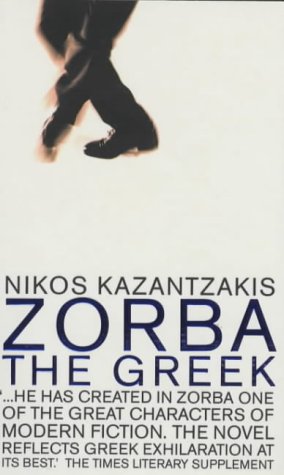
Zorba the Greek by Nikos Kazantzakis

This is rather less heavily drenched in the smell of male sweat than Freedom and Death, but it has rather similar themes of the relationship between education, thought, action and masculinity. Again I’m reminded of D.H. Lawrence, and the Buddhism in this one brought Herman Hesse to mind; you could draw a parallel with Steppenwolf, for example.

The narrator is an intellectual, working on a book about Buddha, who buys a lignite mine, and develops a friendship with the man he has employed to run it—Zorba. There’s a very clear dynamic set up between the narrator’s intellectualism on the one hand and Zorba’s spontaneity and openness on the other. The bookish man learns all sorts of lessons from the enthusiasm for life of the man of action, as well as his untutored philosophy.

It would be very easy to make into the most awful kind of Hollywood movie* because of the rather obvious nature of that relationship, but the novel is better than the summary would suggest. Mainly because Kazantzakis writes good characters, dramatic situations and generally has the storytelling virtues that one associates with the great C19th novelists. And the details are interesting and unexpected enough to lift it above the obvious.

*I haven’t seen the movie version, so this isn’t a comment on that one way or the other.