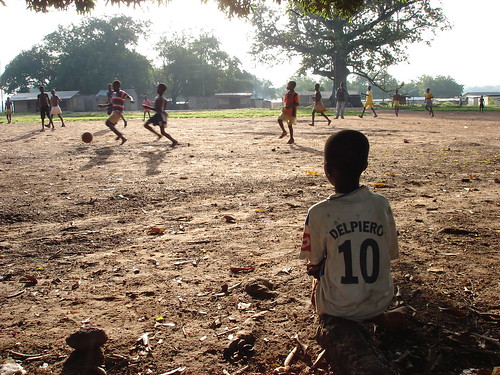
One of the minor pleasures of international sport is the way that sports change and adapt as they travel around the world. So professional soccer starts with one character and one meaning a century ago in grimy industrial British cities like Manchester, Liverpool and Glasgow, and mutates into something different in Buenos Aires, Budapest, Milan, Dakar, and even Los Angeles. And no one place can claim that their version is somehow the real thing. A sport is just a set of rules, an abstract framework; there are as many ways to play a game of football as there are to write a sonnet.
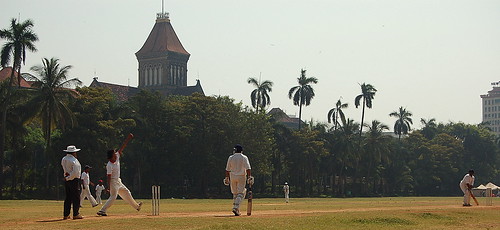
For the English, there’s one vision of an archetypal game of cricket. It takes place somewhere lush and green; preferably a village green in the country, with an oak tree, a pub and some fluffy white clouds. But cricket is also a game of dusty back streets in Karachi and sun-baked pitches in Guyana.
The first games of cricket in India, perhaps played by members of the East India Company or the British Army, must have seemed impossibly out-of-place, a bloody-minded attempt to maintain a facade of Englishness; like Kim Philby sitting in his Moscow apartment eating Cooper’s Oxford Marmalade and watching Test cricket on videotape. But at some stage, to use the colonial jargon, cricket went native, and cricket is as authentically Indian as kedgeree is authentically English.
But I want to talk about the adoption of rugby union by the people of the South Pacific. The image of rugby has improved since the game turned professional in 1995, but not long ago, even at international level, it seemed to be a game of fat blokes grinding out low-scoring wins in about three feet of mud. And at club level, an opportunity for middle class men to go on the kind of tours that involved a lot of beer and songs with vulgar gestures. Grey skies, mud, and self-satisfied amateurism.

Against that kind of background, I remember the first time I saw a touring team from Samoa on TV; I thought at first that some of them were wearing some kind of tight black Lycra shorts under their kit. It was a shock to realise that their entire thighs were densely covered in traditional tattoos. The tattoos aren’t the most spectacular thing they brought with them from traditional Pacific culture, though; that would be the pre-match challenge. The most famous is the Haka, performed by the New Zealand rugby team before a match, but Samoa, Tonga and Fiji all have their own versions. There are lots of examples on YouTube, but the most atmospheric is this one, with the New Zealand Haka facing up to the Tongan Sipi Tau:
I don’t actually know how the sport came to be taken up so enthusiastically in the Pacific. Given rugby’s boarding school origins, it’s tempting to think it was purposefully introduced there by missionaries as part of the kind of muscular Christianity that believes in cold baths and lots of manly sport as the best way to prevent ‘filthiness’. But the Pacific islanders have made it so much their own that you could believe it happened the other way round: that missionaries took the bible to Polynesia and came back having discovered an exotic, warlike local sport called, as best as they could pronounce it, ‘rugby’. The way polo was brought back from the Himalayas by the British, and turned into a game for stockbrokers.
The reason I’m posting a paean to Pacific rugby now is that the Rugby World Cup is currently on, and the island teams have looked good. With professionalism, they can now make a living playing for clubs in Europe, and they’ve added greater fitness, discipline and experience to their game. Last week, Fiji beat Wales in a brilliant match to reach the quarterfinals for the first time. That might not seem much of an achievement, considering I’ve just been rhapsodising about their passion for the game, but sport generally favours countries which are large and rich, and Fiji, with a little under a million people, is neither.

And Fiji is a colossus compared to Tonga and Samoa, which have a combined population of about 300 000. There are 57 cities in the USA which have a population of over 300 000; despite that fact, the US rugby team has been beaten by both countries at this tournament. Yes, I know, rugby must be about the 15th most popular team sport in the US; but still, you have to enjoy this parallel world where the puny Americans are crushed by the mighty Tonga.
» Football Ghana was uploaded to Flickr by sarahebsgaard; Cricket at The Oval Maidan is by .Hessam. The rugby kits are from an illustration Football Colours of some of our Public Schools from the Boy’s Own Paper, used under a by-sa Creative Commons licence. The Flickr account of Frederic of www.rugby-pioneers.com is a mine of great vintage rugby material. Check out that link to his blog, as well. THE Beach, taken in Samoa, was uploaded to Flickr by Tagaloa.


