Categories
Culture

An African in Greenland by Tété-Michel Kpomassie

An African in Greenland is an autobiographical book; as a teenager in Togo, Tété-Michel Kpomassie read a book about Greenland and decided to go there. It took him eight years, working a variety of jobs, to make his way up through West Africa and Europe before eventually arranging a trip to Greenland, where he stayed for about two years (in, if I’ve got my sums right, 1965).

The book’s title implies that there is some kind of different perspective that Kpomassie is going to bring because he’s African, and I have to admit that it was part of the appeal for me when I bought the book. It’s such an immediately striking juxtaposition, this young man from Togo living among the Inuit and eating seal blubber: just the title is like a pitch for a cheesy Hollywood comedy.
In fact, it’s not obvious that his Africanness makes that much difference to the book, after the first couple of chapters that take place in Africa, and in retrospect it’s hard to say what I was expecting, really. There are a couple of occasions where he compares local beliefs (about the travels of the human soul in dreams, for example) with those he grew up with; and his Africanness does make him an instant celebrity in Greenland: the first black person most of them had seen, and several inches taller than most of the locals.

It is, though, an interesting and enjoyable book about Greenland: ice-fishing and dog-sledding and eating of revolting-sounding bits of raw viscera and lumps of animal fat. Whale lung! Boiled sea gull! Yummy. And as with Halldór Laxness in Iceland, endless cups of coffee.

Although actually, I think it’s to his credit that he clearly made a point of eating everything that was put in front of him, and doesn’t spend a lot of time in the book dwelling on the off-putting nature of the food. Perhaps it’s nicer than it sounds; perhaps he just wanted to downplay the potential freak-show aspect of this kind of travel book. He has a fairly clear-eyed view of the harshness of life for many of the people he meets and the social problems he encounters, but he doesn’t dwell on it excessively. Perhaps even more surprising for someone who had travelled for eight years to get there to fulfil a childhood dream, he doesn’t romanticise the country either: not too much of the noble savage stuff.

Here’s a longish passage about life during the time of the midnight sun, with 24 hour daylight:

The oddest thing was that we couldn’t get to sleep any more. To fill in the time I stayed at the school, where I took notes, sometimes until three in the morning. Kield Pedersen, the Danish headmaster, kindly gave me access to the Medelelser of his establishment — many bulky volumes which contained the findings of every piece of research done in Greenland since the days of Hans Egede.

Outside, small orange or red tents sprang up, erected by children whom the endless daylight kept from sleeping. At three in the morning you could still see them playing outside. Sometimes they went on like this for two whole days without going to bed. Eventually they dropped with fatigue, and then might sleep for two days at a stretch. It was the teachers, not the parents, who complained, because most of the time their classes were half empty.

Sleep eluded the adults, too. Everyone was restless. They had hardly set foot indoors before they were longing to go out again, to tramp on and on, to run from hill to hill. They rambled around incessantly, in search of who knows what. All through the spring they’d go wandering like this, building cooking fires in the mountains with three stones for an oven, gathering parnet berries, resting no matter where when tiredness overtook them. both with humans and animals, spring here was the season of tireless frenzies of love. Groups of boys and girls ran laughing and shouting until early morning, and there was the noise of rutting huskies fighting, the deep growls of the males mingling with the bitches’ piercing yelps. The birds sang and the eiders quacked in the creeks.

The landscape seemed excluded from this general harmony, and it changed from day to day. All the filth of Christianshåb was suddenly exposed by the sun’s return and the thaw. Snow melted n the slopes, the street became a river of mud, and innumerable streams riddled the ash-grey earth and brought to light piles of of old bottles and cans, dog shit, household waste, and rotten potatoes. All the garbage which cold and snow had preserved — now swollen with melted water, rotting fast and buzzing with clouds of flies, real flies, come out to haunt us like a bad conscience. Outside the doors and under the foundations, the houses were repulsively filthy. the borrowed coat of spotless white had covered so much offal! A sickening stench hung everywhere. the dogs, some of them now moulting, slunk squalidly about the village. You really wondered whether you were still living in the same land that had once been so clean and white.

An African in Greenland is my book from Togo for the Read The World challenge. Oh, I nearly forgot: it was translated from the French by James Kirkup.

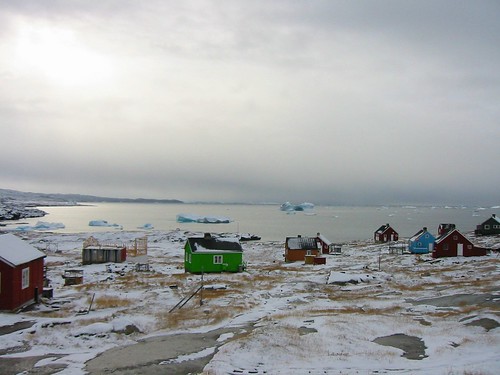
» The photo, Oqaatsut/Rodebay, Greenland, is © kaet44 and used under a CC attribution licence. Rodebay is one of the villages where Kpomassie spent a winter in Greenland.

Categories
Daily Links

Links

Categories
Other

Charlie boy apparently wants to destroy the monarchy

The Times hints at the gory details:

The Prince of Wales, who celebrated his 60th birthday on Friday, has told confidants he would like his role to “evolve” so that his knowledge and experience are not wasted once he inherits the crown, Jonathan Dimbleby, his friend and biographer, reveals today.

Translation: he wants to have his cake and eat it.

Look, it’s not that fucking complicated. Take all the enormous and unearned benefits of being born into the Royal Family and keep your mouth shut, or abdicate and campaign on your pet issues as a private citizen.

His charity work is generally unexceptionable, and he sells excellent biscuits, beer and sausages and gives the profit to his charity, so those things help me try to feel positive about him; but when he sticks his nose into politics it drives me completely nuts. If the official duties, the charity work, running the Duchy of Cornwall, the painting, the gardening and the polo aren’t enough to keep him busy, he’ll just have to take up knitting.

Democracy: it’s really not that difficult to understand.

Categories
Other

Self-evident

I always thought the US Declaration of Independence had a lovely bit of intellectual sleight of hand. It’s phrased almost as an exercise in logical deduction (various bits bolded for emphasis):

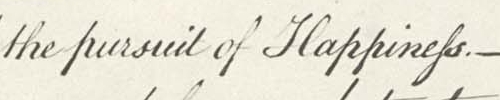
We hold these truths to be self-evident, that all men are created equal, that they are endowed by their Creator with certain unalienable Rights, that among these are Life, Liberty and the pursuit of Happiness. — That to secure these rights, Governments are instituted among Men, deriving their just powers from the consent of the governed, — That whenever any Form of Government becomes destructive of these ends, it is the Right of the People to alter or to abolish it, and to institute new Government … [rhubarb rhubarb] … The history of the present King of Great Britain is a history of repeated injuries and usurpations, all having in direct object the establishment of an absolute Tyranny over these States. To prove this, let Facts be submitted to a candid world.

[long list of ‘facts’ snipped here]

We, therefore, the Representatives of the united States of America, in General Congress, Assembled, appealing to the Supreme Judge of the world for the rectitude of our intentions, do, in the Name, and by Authority of the good People of these Colonies, solemnly publish and declare, That these united Colonies are, and of Right ought to be Free and Independent States….

Quite apart from the awkwardness of reconciling this document with slavery, the phrase I’d particularly  pick out is ‘self-evident’. Jefferson, of all people, must have known perfectly well that over the course of history, it has certainly not been felt to be self-evident that all men are created equal. Or indeed that they are endowed with inalienable rights; or that governments are instituted to secure those rights; or that they derive their powers from the consent of the governed; or that when a government fails in that respect, that it is the right of the people to alter or to abolish it.

From Plato to George III, there were an awful lot of people who would have disputed those ideas; it is clearly begging the question to treat them as axiomatic.

As it happens, history has been kind to Jefferson: his revolution went well, and the country he and his cronies set up has become the most powerful on earth. The victory of the democratic way of thinking has been so thorough that it is possible to read the Declaration of Independence and take it at face value, as though it actually was a statement of self-evident truth instead of a piece of political rhetoric. Perhaps that’s for the best: if you believe, as I certainly do, that the principles laid out in the preamble to the declaration are a Good Thing, then it probably helps to have people treat them as an item of faith. But my pedantic soul revolts against it. I’m with Jeremy Bentham on this one:

Natural rights is simple nonsense: natural and imprescriptible rights, rhetorical nonsense — nonsense upon stilts.

Those rights — life, liberty, the pursuit of happiness, free speech, freedom of religion, fair trials, take your pick — are not given to us by the universe; they are human constructs, things people have chosen and demanded for themselves. All the more reason to defend them.

You may be wondering why I’ve suddenly started going on about C18th political philosophy: well, it’s because I was struck by same process going on right now with gay marriage. There is an attempt by supporters of gay marriage to frame the question as one of simple natural justice: that this is a straightforward case of equal rights* and that the answer is, in fact, self-evident.

Now I’m a supporter of gay marriage, because I think that, all else being equal, we should avoid excluding a large chunk of the population from a social institution which has a central role in the culture; because the evidence generally suggests that having people in committed, long-term relationships is a societal good, and surely having a load of people keen to marry strengthens marriage rather than weakening it; and because it just seems like a way of making people happier with no obvious downside. But any claim that it is obviously a simple question of fairness seems a bit disingenuous.

I mean: has their ever been any society anywhere which has granted full legal marriage rights to homosexual couples on exactly the same basis as heterosexual marriage? I’m no anthropologist, and there may be examples I just don’t know about, but it seems fair to say that most people through history have not thought it was obvious that homosexual relationships are the same thing as heterosexual ones. The people who argue that ‘marriage is defined as between a man and a woman’ have a point: the introduction of gay marriage does redefine marriage in a fairly major way. There’s nothing unique about that; marriage has naturally been redefined over time as society has changed. But if you’re introducing a social change which is almost unprecedented in the whole of human history, it’s hard to deny that it’s a radical agenda.

I’m not suggesting that supporters of gay marriage should present it as a radical agenda; not if they want to get it into law. On the contrary, I think they are exactly right to frame it as a question of equal rights, and tap into the American rhetorical tradition that goes back via the civil rights movement all the way to Jefferson and the Declaration of Independence. But like the Declaration of Independence, there’s a hint of a rhetorical rabbit being pulled out of a hat, as a rather controversial and radical conclusion is presented as though it was a self-evident truth.

*and indeed equal rites

Categories
Nature

Kissing’s never out of fashion when the bloom is on the gorse

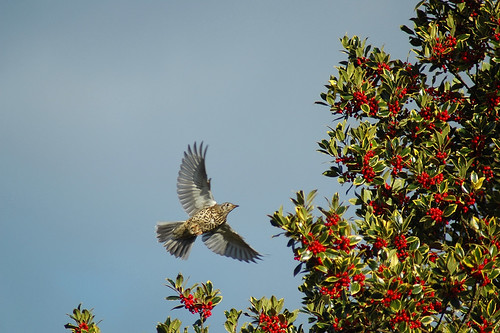
Surprise sighting of the day in the local park: mistletoe. I mean it’s not that surprising — mistletoe is a native British plant and quite common in some parts of the country — but I don’t think I’ve ever seen it growing in London.

I’d like to think that the seeds were spread there by a mistle thrush which had been feeding on someone’s discarded Christmas decorations.

» Yes, I do know that’s not mistletoe in the picture. holly & mistle thrush  is © Sandy Morrison and used under a CC by-nc-nd licence.

Categories
Daily Links

Links