Categories
Culture

Anil’s Ghost by Michael Ondaatje

The Anil of Anil’s Ghost is a forensic anthropologist; she was born in Sri Lanka but having left to study and work, she is now returning after 15 years away to investigate allegations of political murders. Ondaatje was eleven when he left Sri Lanka, so Anil’s insider/outsider status is presumably a reflection of his own experience. His decision to write this book is perhaps his equivalent of Anil’s need to return to Sri Lanka.
Ondaatje is really a very good writer. His books seem to have a dream-like quality, not so much because of what happens but the way that it is presented to us. Part of it is the way that the focus shifts around, not just between the main characters but an assortment of others who are only loosely connected to the central plot; and shifting backwards and forwards in time as well.

Also, if you were someone who just read books for the plot you might feel that it had its priorities oddly skewed: an ‘important’ event will go past rather rapidly, and then the book will dwell lovingly on a scene which has no particular narrative importance, but is atmospheric or striking or thematically apt.* It’s a kind of structuring which would seem very natural in a long poem but is a bit less common in novels.

As much as I liked the book, it was somewhat depressing. Perhaps a novel about ethnic conflict and political atrocities should be depressing, but still. Obviously I knew there was a long-running conflict in Sri Lanka, and of course it has been in the news recently as the war (or that phase of the war) drew to a bloody end; but I was blissfully ignorant of any of the details, and for me, Sri Lanka was largely associated with cricket. And it’s much more pleasant to associate a country with flamboyant opening batsmen than with heads on spikes. The book doesn’t actually wallow in the atrocities as much as it could do — they are evoked sparingly rather than described at length — but they are quite disturbing enough without that kind of pornographic attention to detail.

I had already counted a different book by Ondaatje — In the Skin of a Lion — as my book from Sri Lanka for the Read The World challenge, but that book is all set in Canada, so it seemed appropriate to read a book with a bit more Sri Lanka in it.

* I would hate to have to justify that sentence with close reference to the text, but thankfully I’m a blogger not a scholar.

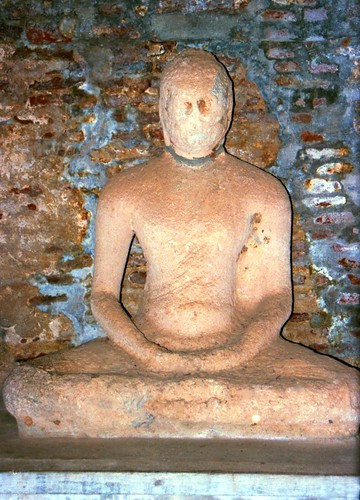
» The picture, ‘Old Buddha, Sri Lanka‘ is © Rahul Barraez D’Lucca and used under a CC attribution licence.
Categories
Nature

Butterfly update

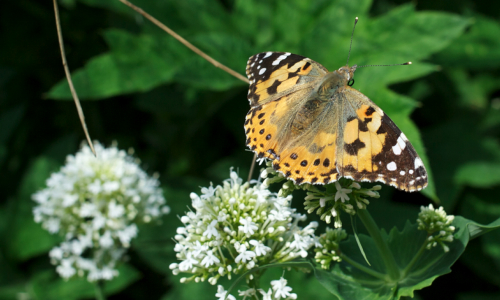
Butterfly Conservation are holding an organised Painted Lady count this Saturday when they’re asking people to count passing butterflies for two hours and post their sightings online. It’s an exciting aspect of the internet that it allows this kind of rapidly organised exercise in citizen science.

Anyway, I thought I’d do a little preliminary count of my own at lunchtime and just counted PLs in the half hour between 12.30 and 1.00. The result: 36. Slightly over one a minute.

What’s interesting is that on the one hand, that’s a staggering number, when you extrapolate out over the whole country: butterflies going past at the rate of one a minute for days at a time over the whole of England (the whole of Northern Europe, possibly). And yet if you weren’t paying attention, it would be possible to be out in the garden and not even notice that this huge natural phenomenon was going on.

Categories
Daily Links

Links

Categories
Nature

Ladies, stags and owls

Last week — last Thursday, I think? — I was walking along the road and saw a butterfly go past which I thought was maybe a Painted Lady. Not actually my first of the year, because I’d only recently returned from Provence where I saw *thousands* of ’em, but still quite pleasing because they’re a migrant species resident in North Africa, and while they are not actually a rarity in Britain — some turn up every year — they’re not especially common either.

Then the next day there were a few in the garden, and mentions of them started popping up on the blogs and Twitter feeds of the handful of British natural history bloggers and twitterers I follow. And so I started thinking maybe this was going to be one of those years, when all the conditions come together and they are suddenly all over the place. Something that became very clear when I saw this tweet from @SallyCourt on Sunday:

An incredible sight at Strumpshaw Fen today with hundreds, probably thousands of Painted Ladies flying west. Also Swallowtails + H Dragonfly

In fact over the past week we’ve been in the middle of a massive movement of painted ladies across the whole country. Apparently it’s because they had good weather for thistles in Morocco over the winter. It probably isn’t a coincidence that I saw quite so many of them in Provence; I didn’t think that much of it at the time, since they’re a more common species in the Mediterranean, but there were an awful lot there. Maybe some of them were the same ones that are now fluttering across England.

img_6598

It hasn’t been particularly obvious that they’ve been migrating in my garden; there are a few flowers they like and so I’ve been seeing them fluttering back and forth, in no apparent hurry to get anywhere. But while it might appear to be the same three butterflies going round and round in circles, I guess it has probably been a whole sequence of new ones.

Today, after a couple of days of rain when I guess all the butterflies have been sensibly laying low, I saw one fly past outside the window, so I went along to the local park. And sure enough, there they were. Not in their thousands, but a regular stream of them passing through, looking much more determined, flying more or less straight by, heading about NNW. One every few minutes rather than one every few seconds, but once you knew what you were looking for, it was still quite striking.

Here’s an intriguing snippet about painted ladies from my butterfly guide:

Reported occasionally from Iceland, which has no indigenous butterflies.

I bet a few will make it to Iceland this year.

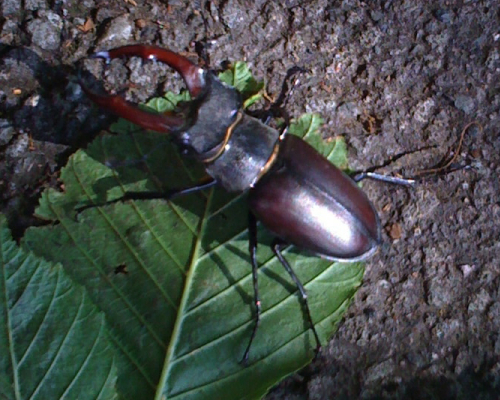
So that was good. My other good local sighting was this (apologies for the rubbishy iPhone photo):

img_0193

That’s a Stag Beetle. There are many species of stag beetle worldwide, so to be exact it’s Lucanus cervus, but in the UK it’s just Stag Beetle because we only have the one species with proper antlers. There is also, to be pedantic, the lesser stag beetle, but that’s much less interesting.

South London isn’t exactly a wildlife stronghold for many species, but stag beetles are increasingly rare nationally and doing pretty well around here, so it’s good to see one. It’s also good to see them because they are just fabulous little beasties.

While I’m on insects, a few things from Provence. We saw lots of butterflies, most of then just too hard (or too much work) to identify: blues, fritillaries, either Pale or Berger’s Clouded Yellow and so on. But also Swallowtail, Scarce Swallowtail, Red Admiral, Brimstone, Orange Tip. And this, the Southern White Admiral; another iPhone picture but it has come out looking surprisingly good. Most of the time they didn’t actually look that blue, but the light was obviously catching it just right.

southern-white

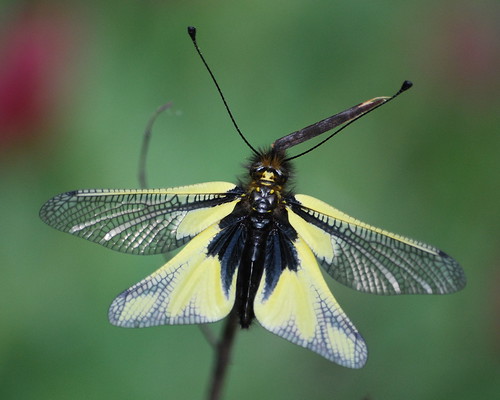
As well as butterflies, there were a few other things; lots of burnet moths flying around, which are always nice, and the Narrow-bordered Bee Hawkmoth I mentioned earlier. Those big black ants which are one of my earliest memories of southern Europe. And one critter that was a real puzzle. Take a look at this:

Now maybe you know what that is, but it confused the hell out of me. It looks most like a dragonfly, sort of, and it flies rather like a dragonfly, but the head isn’t right and look at those antennae! They were almost enough to make me think it was some kind of weird clearwing moth or even weirder butterfly — but it just doesn’t look right for either.

Thankfully for the sake of my sanity, my mother’s superior Google skills came to the rescue when we got back: it is an owlfly. A what? I’d never heard of them. They are related, Wikipedia informs me, to the lacewings and antlions, something which is not at all apparent when you see them sitting with their wings spread like dragonflies, but which makes more sense when you occasionally see one with its wings folded.

» All the pictures except the last were taken by me. The last is Libelloides coccajus, uploaded to Flickr by and © Le pot-ager (Philippe Vannier).

Categories
Daily Links

Links

  • Why the UK is completely fucked. One of the better articles I've read about the economic meltdown; I'd like to believe that its conclusions are too melodramatic, but it has a horrible ring of truth.
    (del.icio.us tags: economy UK )
Categories
Culture

Echoes from the Dead Zone by Yiannis Papadakis

Yiannis Papadakis is a Greek Cypriot anthropologist, and Echoes from the Dead Zone is based on his fieldwork in Turkey and on both sides of the Green Line in Cyprus. he investigates the different attitudes of people on each side of the conflict, and in the process has to confront all his own prejudices from growing up on the Greek side.

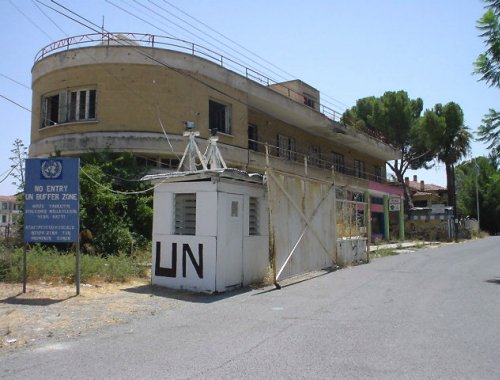
Papadakis only managed to spend a month in the so-called Turkish Republic of Northern Cyprus and was accompanied by government minders the whole time, although as well as that he spent a few months in Turkey itself and a year in the village of Pyla/Pile which is within the UN-controlled ‘Dead Zone’.

cyprus

I came to it vaguely expecting it to be a basically two-sided conflict, Greeks vs. Turks, but of course it’s much messier than that; there are tensions between the Greek Cypriots and Greeks from Greece, and between Turkish Cypriots and Turks from Turkey. There are tensions on both sides of the divide between those who see themselves as Cypriot first and Greek or Turkish second, and those who look to the motherland, who see themselves as Greeks or Turks who happen to live in Cyprus.

And the different groups have quite different views of history; not just the relevant modern history, the half-century or so that takes in Cyprus winning independence from the British, the Turkish invasion and so on, but also the longer history of classical Greece and Byzantium and the Ottoman empire.

I think it’s probably inevitable, as a British reader, that it reminded me above all of Northern Ireland; but I guess all these local religio-culturo-ethnic conflicts are fundamentally rather similar: deeply intractable and ultimately pointless.

Weather forecasts in Cyprus did not just tell the weather, I now noted. They expressed positions on the Cyprus Problem. ‘The Flag’, the Turkish Cypriot TV channel, broadcast a daily news bulletin in Greek for the enlightenment of Greek Cypriots. During the weather forecast, they gave temperatures only in towns in the north, where no Greek Cypriots lived. The towns were called by their Turkish names. On the Greek Cypriot side, RIK, the state TV station, used a map of Cyprus without a dividing line, but only mentioned the temperatures in the south. other Greek Cypriot channels, right-wing private ones, regarded this as unpatriotic. they also showed temperatures in the north to make the point that those areas too belonged to Greek Cypriots.

Maps in Cyprus, as elsewhere, were a political instrument. I remembered the map of Greece — not of Cyprus — at school. In order for Cyprus to appear in the map of Greece, it was cut and placed in a box next to Crete. I only became aware of this when I first saw Turkish Cypriot maps. No need to cut and paste to include Cyprus in the map of Turkey. Greek Cypriot maps showing Cyprus in the world at large always extended westwards, positioning Cyprus in a European context. The never showed Cyprus in the Middle East or Africa. The problem with the ‘Cyprus in Europe’ maps was that bits of Africa, the Middle East, and — sadly — Turkey were visible. One such map by the Greek Cypriot Public Information Office presented such undesirable bits as blank. The biggest challenge was to make a map of Cyprus that included Greece but not Turkey. The map shown as background during the news on The Word, the Church channel, managed best, with Turkey obscured by mist, as if weather conditions had rendered it invisible.

Echoes from the Dead Zone is my book from Cyprus for the Read The World challenge.

» The photo, crossing the “green line”, is © danceinthesky and used under a CC by-nc-sa licence.