'A fascinating new study on the types of people who stalk or harass the British Royal Family has just been published online by the journal Psychological Medicine.
A group of forensic psychologists examined, by hand, twenty thousand files held by SO14, the Metropolitan Police Service's Royalty Protection unit, to study people who had made inappropriate approaches or communications with the British royals.
This is the classification of harassers and stalkers by motivation'
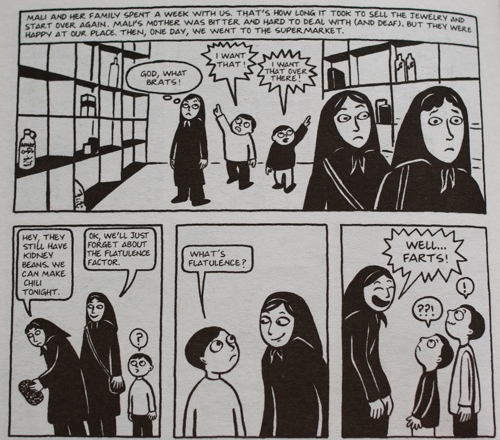
Persepolis is an autobiographical graphic novel* about growing up in Iran. I think it might be the first graphic novel I’ve read — certainly the first critically acclaimed one. So I’ve sort of been wondering what it does or doesn’t gain from being drawn as well as written… and haven’t really reached a conclusion.
So first things first: it certainly does work. It’s a vivid portrayal of day-to-day experience, initially under the Shah but mainly after the Islamic revolution, and including a period of living away from her family in Europe. Politics and religion are inescapable and a constant presence, but it is full of the intimate details of everyday life: the music, the clothes, family, flirtation, and all the little ways that they try to accommodate or avoid the regime. The narrative is unsurprisingly full of tragic events, but it is also funny and honest.
But what the format brings to it; well, this book has a kind of directness. The pictures are very simple, cartoonish rather than any attempt at visual realism, and the quantity of text is relatively limited compared to what you would have in a prose memoir. So the overall effect is a very direct, stripped-down quality. I guess you might call it a naive style. Of course, that’s a quality of this book in particular rather than due to the graphic format.
Anyway, well worth reading.
* i.e. it’s an autobiography in comic strip form. I suppose by the logic of the terminology, that makes it a graphic autobiography. But that sounds confusing as well. *shrug*
Well, firstly because the explanation as laid out here and here seems fairly plausible to me.
But mainly because I just don’t think that Amazon are that stupid. They sell an enormous amount of material which is liable to offend *somebody*: they sell books about being a gay parent and books about curing homosexuality through God. They sell books by young-earth creationists and books by angry atheists. They sell box sets of hardcore porn DVDs. They sell books by holocaust deniers.
The last thing they want is to be seen as endorsing any of those things. It is completely in their interest to be perceived as a non-judgemental buyer and seller of goods; the people who will sell anything, as long as its legal. The moment they are seen as exercising some kind of editorial control on the basis of a moral or political agenda, they lay themselves open to having to defend every product they sell.
They cannot be seen to be taking sides. And I think they know that.
Yeah, I know, not exactly topical. But David Mitchell wrote a good article about it in the Guardian today and it seemed like a suitable moment to add my halfpennyworth.
It seems to me that the phone calls to Andrew Sachs were a special case. It bothered a lot of people who are not easily offended. I know that the outrage was orchestrated by the Daily Mail, but even so, I don’t think they would have been able to generate so many complaints if it hadn’t touched a nerve with a lot of people.
Leaving a message on someone’s answering machine making a joke about having slept with their granddaughter is just a dick thing to do. It would be a mean-spirited and distasteful thing to do even if you didn’t broadcast the message on national radio. It is in a sense as much bad manners as it is bad taste. And it was aimed directly at an individual who had done nothing to provoke or deserve it. If someone did it who wasn’t on the radio, just because they thought it was funny, it would be understood as harassment.
As you can tell, I think Jonathan Ross and Russell Brand crossed a line. I didn’t complain myself, but I can understand why people did, and an apology and some kind of disciplinary action was appropriate.
But that doesn’t mean that I support some kind of generalised campaign against bad taste at the BBC. An example: in the weeks after this happened, in the general climate of BBC self-flagellation, Frank Skinner made a little current affairs programme investigating the issue of bad language on television and particularly in comedy. To me, that’s a completely separate issue. I don’t care about bad language; sure, keep it off Blue Peter, but in an appropriate slot in the schedules I just don’t care. There is literally no amount of swearing you could fit into half an hour of television that I would find offensive. I might find it boring and unnecessary, but I am not going to be offended by it.
Or take the incontinent old women in Little Britain:
Now people might or might not find that kind of thing funny. They might well find it distasteful, in which case they can choose not watch it. They might even feel that there’s a serious social issue about the portrayal of the elderly, or the issue of incontinence, and that the show is actively harmful for that reason. But even if you find it offensive, it’s something which is performed by actors, which you have chosen to watch and which you can turn off. It is not the same as the BBC ringing your house and personally offending you, which is what they did to Andrew Sachs and the reason why so many people were angry.
It would be a tragedy for British popular culture if the BBC only ever made programmes which were completely inoffensive. The message I would want the BBC to take away from Sachsgate is not ‘don’t produce any material that might possibly offend people’. It’s ‘don’t call up individual members of the public and go out of your way to offend them personally’. Its the difference between a stand-up who makes fun of religion in a comedy club, and one who marches into a church on a Sunday morning and delivers the same material to the congregation halfway through the service.
'The Elements of Style does not deserve the enormous esteem in which it is held by American college graduates. Its advice ranges from limp platitudes to inconsistent nonsense. Its enormous influence has not improved American students' grasp of English grammar; it has significantly degraded it.'
Interesting article about how internet censorship works in China. The article is now 3 years old, which is a long time on the internet, but it's worth reading.