Categories
Culture

Island Boy by Tom Davis

…or to give him his full title: Sir Tom Davis, Pa Tuterangi Ariki, KBE. The ‘Pa Tuterangi Ariki’ bit was a title he got by marriage; the knighthood was all his own. Davis was the Prime Minister of the Cook Islands from 1978-87, and Island Boy is his autobiography. He was undoubtedly an impressive individual — he studied medicine in New Zealand, then took the job of Medical Officer of the Cook Islands, where he modernised a decrepit colonial medical service; then he sailed his young family in a small yacht from the Cook Islands to Boston to study public health; did some medical work in Alaska; then he took various research jobs in the US, including research on physiological adaptions to extreme conditions for the army and the nascent space program; raced sports cars; then returned to the Cook Islands to enter politics as a free market ideologue, eventually becoming Prime Minister.
So there’s lots of good material. However, although Davis wrote perfectly well, he was not a dazzling prose stylist, or a man with a gift for anecdote, and he clearly had no intention of sharing anything very personal; he mentions two marriages, a divorce and several children during the book but gives absolutely no details at all. So what you get is a straightforward, by the numbers autobiography which is often interesting but also often a bit of a chore. I don’t think he was terribly introspective, to be honest. His obituary, which I found while trying to learn more about his title, says (among more flattering stuff):

A driven and ambitious man, he was sometimes seen by his peers as arrogant and conceited.

And that does ring true. He is certainly really quite dismissive of most of his political colleagues and opponents.

I ordered Island Boy as my book from the Cook Islands for the Read The World challenge, before realising that the Cook Islands wasn’t actually on my list of countries, which is based on UN membership. But the list isn’t that rigid, and having bought it I may as well count it.

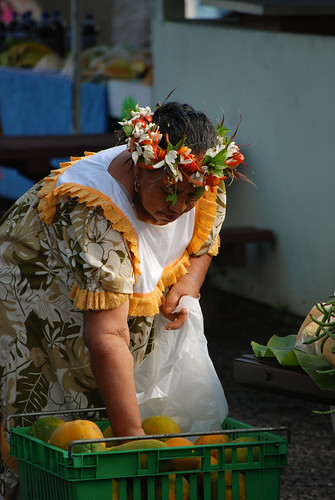
» The picture, Avarua Market, is © Daniele Sartori and used under a CC by-nc licence.
Categories
Daily Links

Links

Categories
Daily Links

Links

Categories
Me

Speaking as a dumbed-down chav…

I am endlessly fascinated by the people who are, by their own account, in a constant state of simmering rage at having to overhear other people’s uncouth language. This comment was in response to an article in the Sunday Times:*

Dave Russell wrote:

Couldn’t agree more abouyt the dumbing down of the nation. Just listen to a conversation between a group of people under the age of 25. It seems to be cool to speak like a complete thicko these days, no longer something to be ashamed of. The one thing that really grates on my nerves is to hear people using the child-like term ‘train station’ instead of ‘railway station’- the mark of the true dumbed-down chav. The other thing is how some apparently intelligent people think its cool to continually use swear words in public-in bars, buses and trains etc-even at the ‘Train Station!’ Most of the this dumbed down class wouldn’t understabnd a single Monty Python sketch-they simple don’t have the educational background.

OK, this is the usual stuff: the suffering of psychic violence when exposed to casual speech, the fear of the demotic. But the idea that the mark of a ‘true dumbed-down chav’ is that they say ‘train station’? That’s genius.

*admittedly, it’s a Jeremy Clarkson article, but even so.

Categories
Culture

‘Pop Life’ and ‘John Baldessari’ at Tate Modern

Two superficially very different exhibitions at Tate Modern at the moment. One is Pop Life: Art in a Material World; to quote the blurb:

Andy Warhol claimed “Good business is the best art.” Tate Modern brings together artists from the 1980s onwards who have embraced commerce and the mass media to build their own ‘brands’. Pop Life includes Andy Warhol, Damien Hirst, Jeff Koons, Takashi Murakami and more.

Which is flashy, exhibitionist, loud — several rooms have music playing — and vulgar. I don’t mean to be snobby; much of it is intentionally vulgar. Not least Jeff Koons’ kitschy hardcore porn imagery.

The other is John Baldessari: Pure Beauty [which doesn’t have much of a website just yet… they may just be running a bit late]. The tone of which is much more Serious and Arty. Not that it’s humourless, there’s plenty of dry wit on show; but it’s all very restrained and low-key. Series of small photographs, made with an eye on content rather than beauty. Stills from black and white films with sections blanked out. Rather formally-constructed photocollages. The later work gets larger in scale, more complex and I think more human, in the sense that his collages refer more directly to emotions and issues and almost form proto-narratives; but it’s still very tightly controlled and visually restrained.

So stylistically, they’re quite different. It’s a distinctly different experience going round them: the Baldessari is much less likely to give you a headache, for a start. To some extent, though, I think it’s as much a difference of personality as of kind. Not everyone enjoys celebrity and celebrities, and money and noise and going to Studio 54 with Grace Jones — or whatever the equivalent was for Damien Hirst in the 90s. But if you were an art critic from Mars, or a few hundred years in the future, the similarities might seem more significant than the differences.

Though having said that, the artists brought together in the Pop Life show are themselves a slightly mixed bunch, so perhaps I should resist making any more sweeping generalisations anyway. I mean, Tracey Emin, Keith Haring and Jeff Koons don’t necessarily have a great deal in common beyond a talent for self-promotion. Perhaps the Tate thought it would be a bit blunt to just call the show ‘Masters of Hype’.

Incidentally, having been at school at the time when Keith Haring merch — bags, pencil cases, whatever — was all the rage, it seems odd to find him in the Tate. It’s like finding a room dedicated to seriously analysing the artistic importance of Hello Kitty. Or Thundercats.

Categories
Culture

‘Moctezuma — Aztec Ruler’ at the British Museum

So, I went to see Moctezuma at the BM this week. And yes, if you’re wondering, Moctezuma II (or even more correctly, according to Wikipedia, Motecuhzoma Xocoyotzin) is the man I always thought was called Montezuma: the ruler of the Aztec empire when Hernán Cortés and his conquistadors conquered Mexico. Except that apparently they weren’t ‘Aztec’ either; they referred to themselves as ‘Mexica’.

knife_xray

It’s hard to believe it has been seven years since the Royal Academy’s mega-exhibition about the Aztecs; this show is nowhere near as large or spectacular as that one. And it’s more narrowly focussed on a particular geographical and historical moment; the city of Tenochtitlan and the fall of the Aztec empire. Which does at least mean that it’s easier to take in the information, even if most of the exhibits are a bit less jaw-dropping. And it means that they can supplement the Aztec material with stuff from the Spanish perspective: colonial paintings and so on.

It’s certainly worth going to, although I wouldn’t say it was the most exciting exhibition I’ve been to recently. One thing I found interesting was what you might call the ‘deathcult problem’. The Mexica civilisation was kind of revolting. The sacred courtyard at the centre of Tenochtitlan was built around a temple where they ritually sacrificed their captured enemies. It also featured a skull rack where they could display the skulls afterwards. That’s the kind of design feature that would seem a bit OTT in a Hollywood representation of Mordor. And so it’s a curatorial problem: do you emphasise the gore? downplay it? make any kind of ethical comment?

Generally this exhibition chose to downplay it — not to disguise it, but not to place too much specific emphasis on it either. I guess I think that’s fair enough; better that than salaciously revelling in it, or stigmatising a whole civilisation as somehow subhuman. And presumably they can rely on their visitors to realise for themselves that ripping the hearts out of the living chests of their enemies is a Bad Thing. And yet somehow the studiedly non-judgmental tone of the blurbs and the audioguide, which seemed to treat ritual human sacrifice as just another intriguing cultural quirk like using thorny oyster shell for decoration, left me a little queasy.

Not that the Spanish were exactly saintly themselves; they killed a large chunk of the population of Tenochtitlan in a moment of panic, just for starters. But at least the killing was a by-product of a ruthless lust for gold and power, rather than the central organising principle of their society. Going round all the skull-covered Aztec stuff feels a bit like being at an exhibition of Nazi regalia. Though having said that, an exhibition of religious art from C16th Spain would probably have a bit of a death cult quality to it, with all that graphic martyrdom all over the place. So to sum up: people are a bit creepy.

Also on at the BM at the moment is a very nice little free exhibition of dogū — that is, prehistoric clay figurines from Japan. I didn’t know anything about dogū, so I found it interesting. And they are striking objects.

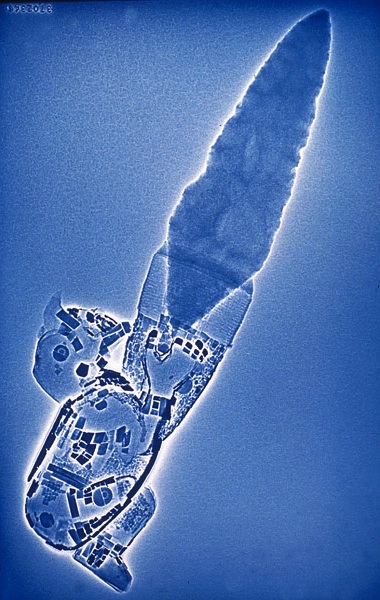
» The image is an x-ray of a knife with a mosaic handle and a chalcedony blade. They reckon it’s a sacrificial knife but that it isn’t robust enough to have actually been used, so it’s probably ceremonial.