I made plans to go birding yesterday in the expectation it would be sunny again; in the event it was grey, overcast and drizzly.
But I did see one swallow.
I made plans to go birding yesterday in the expectation it would be sunny again; in the event it was grey, overcast and drizzly.
But I did see one swallow.
I went along to this with little knowledge and few preconceptions and on the whole was pleasantly surprised. I’ve said before I particularly like the Northern Renaissance for its more medieval aesthetic compared to the Italians. That’s actually less true of Gossaert; a lot of his figures have that contorted quality that I associate with, say, Michelangelo; of being posed in rather uncomfortable-looking positions with pronounced foreshortening. They also have a kind of fleshiness which relates to the Italians but also seems to make him a precursor of painters like Rubens and Jacob Jordaens.

The portraits stood out for me; which, come to think of it, is often the case in these exhibitions. I guess that’s partially because of their human interest — they are the most gossipy kind of painting — and partially because the relatively constrained format strips away many of the things modern audience find off-putting about older paintings. I think there are various reasons why religious paintings and history paintings are not to modern taste, some of it to do with the subject matter, but also the style. Whereas a straightforward head-and-shoulders portrait, the subject looking out of the canvas, is probably the single genre of painting which carries through most directly from the Renaissance to now.
So there was certainly stuff to enjoy — not least some fantastic Dürer engravings and woodcuts which were in there for context — but I can see why Gossaert’s not as well known as some of his contemporaries. He was clearly a wonderful painter, but he just lacks the extra something to make him stand out. And the ways in which he is different from his contemporaries probably make him less to modern taste rather than more. Certainly less to my taste.
Well, not actual summer, obviously. But it has been a week of glorious spring sunshine here, and I’ve been out and about enjoying it and doing some birding.
On Monday I failed yet again to see Lesser-spotted Woodpecker in Richmond Park *shakes fist in general direction of south-west London*, but that was more than made up for by two birds. One was a woodcock — a sign that winter hasn’t quite left us yet, because they certainly don’t breed in Richmond. It was the classic brief view of it appearing from the leaf litter, flying a short distance and disappearing again, but it was a lifer for me so yay.

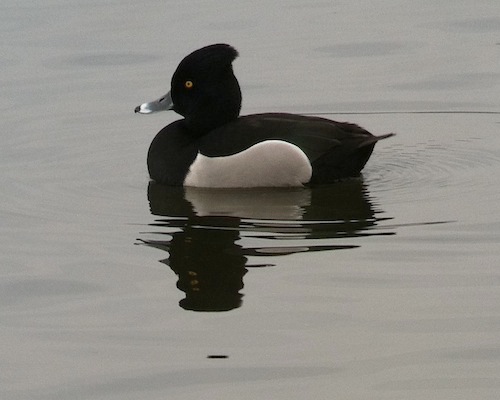
The other was the duck I used to illustrate my last post. I took the picture because it was an obviously odd-looking Tufted Duck, presumably a hybrid but I wasn’t sure quite what; turns out to be Tufted Duck × Ring-necked Duck. Which is cool, because Ring-necked Duck is an American species and a bit of a rarity in Europe, while Tufted is a European species and occasional visitor to North America… but like an anatine Romeo and Juliet, one pair obviously overcame the obstacles. If, that is, the parents were wild birds. I saw a black swan yesterday, and I’m quite certain that it didn’t fly here all the way from Australia. Not to mention the Mandarin Ducks, Egyptian Geese and Ring-necked Parakeets that breed in Richmond Park.
Still, it was an interesting bird. And the first time in a while, incidentally, that I regretted not having a paper field guide with me as well as the iPhone one, but fortunately the photos I took were good enough to let me work it out later.
And yesterday I had a good day up in the Lee Valley. I kind of hoped I might see a migrating Osprey, which didn’t work out. But I saw about eight species of duck, including Goldeneye, had a good view of a Water Rail, and the Chiffchaffs and Cetti’s Warblers were singing. And I saw my first Sand Martin of the year (that’s Bank Swallow if you’re American), and the best bird was a Pink-footed Goose in among the greylags.
And lastly, on Wednesday I went for a walk with a friend on the South Downs, and the skylarks and meadow pipits were singing, which was nice, but the most surprising thing was to suddenly hear a distinctive groonk groonk — raven!
I still think of ravens as birds of the really wild places; Welsh mountain tops, Scottish moors. Which they were, when I started birding twenty years ago. But actually they’re one of the most adaptable species in the world, living everywhere from deserts to the high Arctic. The fact that, when I was a child, you didn’t see them circling high over rolling farmland in southern England: that was a historical accident. It was the result of them being wiped out by gamekeepers and farmers. And now they are protected, they are coming back; like the buzzards, the peregrines, the sparrowhawks. And they are a joy to see.
I got some very nice new binoculars at Christmas, so various people have asked to try them; and it appears that if you give a pair of binoculars to someone who doesn’t use them much, the first thing they do is point them at the furthest object they can find. Or they ask ‘How far can you see with those things?’
Which is actually rather a bad way of testing them. Because if the visibility isn’t perfect — if there is any dust, or heat haze, or mist, or if it’s just a bit gloomy — you rapidly run up against the limitations of physics. It doesn’t matter how brilliant the lenses are, they aren’t going to magically make fog disappear.
The best way to get a sense of how good they are is to look at something close. You can appreciate the sharpness and brightness of the image much better if you look at a bird from thirty feet and can see every feather than if try to look at something half a mile away.
If I was more spiritually inclined, I’d be tempted to make a metaphor out of that — it’s not about seeing further than the other guy, it’s about seeing the things which are close to you more clearly — but I’m not, so I won’t.
» The photo was taken with my phone camera and the new binoculars. It doesn’t have much relevance other than that. I just like to have a picture to break up the rather austere design of the blog.
Looking through one of those advertising-funded local newsletter things, I saw there was an ad for classes in the martial art of ‘sebek-kha’. Which I’d never heard of.
So I checked google and learned that it is an ancient Egyptian martial art, said to be founded by founded by Heru-Ur (Heracles), passed down over thousands of years by a secretive lineage of Egyptian priests, and now known only to a select few. Known only to one chap running classes in a church hall in Herne Hill, to be exact.
The whole thing has cheered me up immensely.
Interesting one, this. Lee Jackson of victorianlondon.org decided to use some of his archive of digitised Victoriana to raise a bit of money to help support the site and put this for sale as a Kindle book for the minimum price of 86p. So I thought I’d give it a try.
Rook was apparently a Victorian journalist and this book claims to be a true account of his conversations with a young Lambeth criminal called Alf — a ‘hooligan’ when that word was new. It is what you might expect from a journalist writing about a colourful lowlife for a popular audience; that sensationalism makes it a genuine page-turner, but it comes with the usual scepticism about writers who seem more interested in a good story than accuracy. It seems pretty safe to say that it’s not actually ‘true’; it’s harder to judge whether it’s a realistic portrayal of that way of life.
However, read as a novel, it’s entertaining stuff. Alf is a classic anti-hero, charismatic and largely amoral, displayed for the prurient pleasure of the reader. It must have been fairly racy stuff in 1899; sex is only really hinted at with references to the number of Alf’s romantic entanglements, but there’s a plentiful supply of violence, crime, colourful slang and a general lively seediness.
It’s also fun for me personally that it’s all south London: the action all takes place in Clapham, Vauxhall, Elephant and Castle, Peckham Rye. The centre of this particular universe is Lambeth Walk, which was then a street market and is presented as a place where all human life is present — his descriptions of it read like a tourist visiting a middle eastern souk. The road called Lambeth Walk is still there, but the market is gone, and judging by Google street view, what is left is a very quiet and undistinguished local street. You can still see the Victorian buildings along one side, but thanks to some combination of the Luftwaffe and Lambeth planning department, the other side of the road is all large housing developments and so the feel of the street is quite gone.
It’s odd to think about how some of these places have changed. I was surprised to learn once that earlier in the C19th the roughest, most dangerous ghetto in London, where the police would only go in groups, was… Seven Dials. Which is now part of the overflow of Covent Garden, mainly consisting of quirky little fashion outlets, cafes and the like.
Anyway, at this point I’m just rambling. So I will stop.
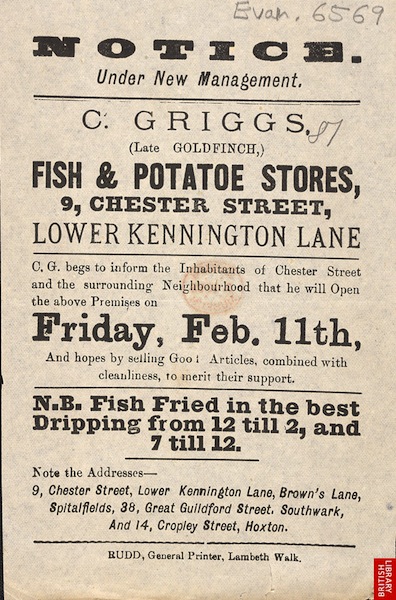
» The image, from the British Library, is only loosely relevant, but I chose it in honour of a greengrocer I used to see from the 37 bus somewhere between Brixton and Clapham. It had a nice, swirly hand-painted sign saying ‘Mr Cheap Potatoe’. It used to cheer me up every time I saw it; sadly it doesn’t exist any more.