Categories
Culture Other

The Thames path, Westminster to Putney

I talked about the juxtaposition of the C19th Gothic of Tower Bridge and the genuine medievalness of the Tower of London: not, in my opinion, one of the great planning decisions in the history of London. Well, at Westminster, you meet with a similar case. The Palace of Westminster (i.e. the Houses of Parliament), started in 1840, sits over the road from Westminster Abbey, started six hundred years earlier in 1245, and does its best to insinuate that it’s been there all along.

The fact that this revival of a five-hundred-old style occurred in the throes of the Industrial Revolution is fascinating to me. And at a time when wealth was moving faster than ever from the hands of the landed gentry to industrialists and merchants, and when reform was broadening democracy and extending the franchise, the symbolism of choosing a parliament building in a style associated with feudalism and religion could keep the semioticians busy for weeks.
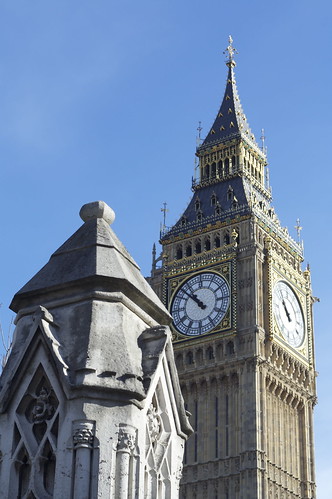
Big Ben

But symbolism aside, the finished result is far more successful than the Bridge/Tower combination. It helps that there’s a historical logic to it; it was after all built to replace the original medieval Palace of Westminster that burnt down in the 1830s, and it incorporates the medieval Westminster Hall. A lot of Victorian Gothic looks very Victorian indeed, because of the materials used or because a few Gothic motifs have been sprinkled on an essentially C19th building. And that’s no bad thing: much more interesting to reinvent a style for a new age than produce slavish reproductions. But in this case, given the location, I think it’s quite fitting that it does manage to look kind of ‘authentically’ medieval. Compared, for example, to the Buxton Memorial fountain marking the abolition of the slave trade:
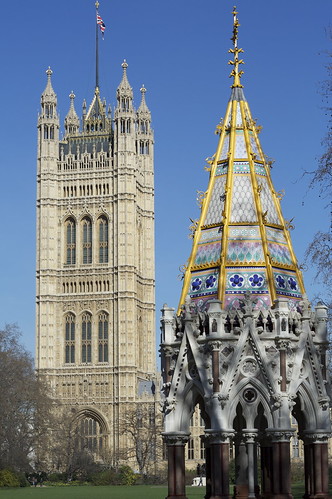
Buxton memorial fountain

And if it slightly overshadows Westminster Abbey: well, it’s an important building. Having Parliament in a vast, grandiose, sprawling palace while the Prime Minister’s residence is an anonymous terraced townhouse must be better than the other way round.

Heading off along the river, the next major landmark is what I still think of as ‘the Tate’ but is now ‘Tate Britain’, thanks to Nicholas Serota’s empire-building and his ruthless crackdown on definite articles. And on the opposite side of the river, the building a friend of mine used to refer to as Ming the Merciless’s palace.
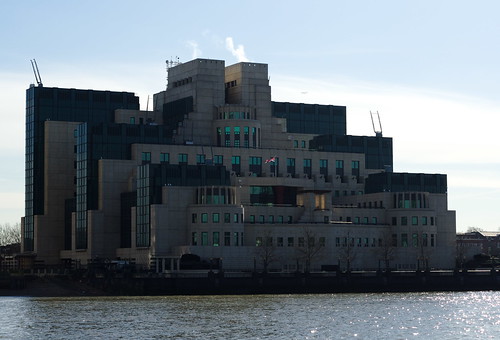
MI6 building

It is in fact the headquarters of the Secret Intelligence Service (MI6). I don’t know whether the architects were specifically asked for something that squats on the riverbank like a gigantic stony-faced toad, or if it just seemed appropriate. I remember reading once that it was supposed to look from air like the portcullis which is the symbol for the Palace of Westminster; thanks to Google Maps you can now see that it sort of slightly does.

The impact of it is somewhat diluted now by the presence just over the bridge of St George Wharf, the ugliest building in London. I remember quite liking St George Wharf when it was first built; during my lifetime, London (and indeed the UK) hasn’t always felt like a forward-looking, self-confident kind of place, and a boom in constructing big shiny new buildings was quite exciting in and of itself. But it just looks uglier every time I see it. I can’t think of a single nice thing to say about it. And St George Wharf itself is soon going to be overlooked by a 49-storey tower built by the same company. Yay. Vauxhall wasn’t exactly a site of outstanding architectural beauty before the developers got there, mind you.

Anyway, I crossed over Vauxhall Bridge because I wanted to do the next bit of the walk on the south side of the river; mainly because I wanted to go past London’s favourite white elephant, Battersea Power Station. I guess BPS isn’t very well known outside London except to Pink Floyd fans, but it’s an old friend to Londoners, particularly those who regularly take the train into Victoria from south London. It was designed by Giles Gilbert Scott, who also designed the Bankside Power Station which now houses Tate Modern. The building is protected because of its architectural importance, and since it stopped producing electricity in the 80s, a sequence of developers have supposedly been converting it to some other use (theme park, shopping centre, whatever). The cynical theory is that their plan is to let it deteriorate to the point where eventually the government lets them knock it down and stick up a load of apartment buildings.
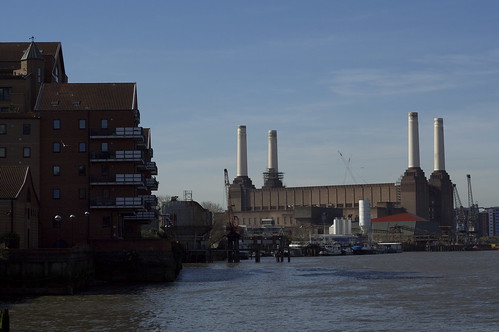
Battersea Power Station

It was first built as a long narrow building with a chimney at each end (picture), and I actually think it was a more attractive building like that; elegant and cathedral like. But it was expanded in the 50s with a second turbine hall alongside the first, giving it its current upside-down table/dead dog look. Still, even if it messed up the proportions, it also made it much more striking and memorable. And if an impressive-but-ugly building sticks around for long enough, it eventually becomes much-loved. People even have nice things to say about the Albert Memorial.

As it turns out, you can’t see the Power Station especially well from the Thames Path anyway; the path cuts inland to go around the Power Station site and the site is surrounded by hoardings that largely obscure it. You’d probably get a better overall view from the other side of the river. Still, it was quite interesting; it goes past the market at Nine Elms, where the wholesale fruit and flower markets moved when Covent Garden was converted to a tourist trap; some nice houseboats, including one which, in what I thought was a particularly stylish touch, had a lawn on the deck; a recycling processing plant; and then Battersea Park, which was really very nice on a sunny day. The park has all sorts of different areas, but where the path goes it’s laid out in little elaborately shaped flower beds surrounded by iron fencing and looks, to my eyes, like a very classic Victorian city park; oddly enough it made me think of Paris. It’s also the site of the London Peace Pagoda, a distinctly random but quite attractive feature added in the 80s.
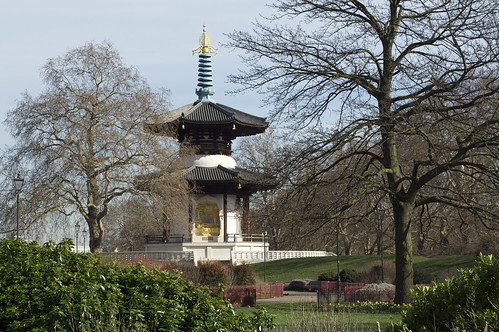
London Peace Pagoda

Then I went back over the river across the Albert Bridge. I think this might be the most attractive bridge in London. It’s nowhere near as striking as Tower Bridge, but it’s a lot prettier, with its decorative metalwork painted white and picked out in pale blue, pink and pistachio. It’s frothy and whimsical. The signs reading ‘All troops must break step when marching over this bridge’ only add to the sense of delicate lightness.

The walk then takes you through Chelsea, now of course one of the most expensive bits of London, but as recently as the late C19th it was louche and cheap enough to be where all the artists lived. The Hoxton of its time. Whistler did lots of paintings of Chelsea and Battersea, of course, and his is one of the many blue plaques that you pass on this section of the walk.

This is the last bit of the walk which takes you along the Thames Embankment. All the way from Blackfriars Bridge, in the City, to Battersea Bridge, there is a road that sweeps along the north bank of the Thames; it would give it a fine boulevardesque quality if it was a just a bit more pedestrian-friendly. In fact there’s too much traffic for it to really make a good place for a stroll; flâneurs should head for the South Bank or one of the parks. What’s not obvious is that it’s entirely built over a sewer; all the piss and shit of west London accumulates under there and is carried off downriver. It was one of the great civil engineering projects of C19th London, and put a stop not just to the regular cholera epidemics but the smell.

I can think of nothing interesting to say about Putney at all.

» These pictures and others can all be found in my Thames Path Flickr set. If you just want to see the ones from this section of the walk, they are tagged thamespath4. I’ve also posted some photos taken on the walk to my photoblog, Clouded Drab; they are tagged Thames Path.

Categories
Culture

‘Duchamp Man Ray Picabia’ at Tate Modern

The exhibition is subtitled ‘The Moment Art Changed Forever’ and the poster is illustrated with Duchamp’s Fountain, the famous work that just consists of a urinal signed with the name ‘R. Mutt’. In 2004 Fountain was voted the most influential artwork of the C20th, presumably for having sharply and clearly established the principle that art is whatever the artist says it is. So I can see why the Tate is emphasising it; but in fact those kind of ready-mades make up a fairly small proportion of the show; which is probably just as well because they are pretty one-dimensional. Sure, it was a gesture worth making, and Duchamp did it well, with a good choice of object and title and so on; but I wouldn’t want to see a whole exhibition of them.

Other stuff in the show includes paintings and sculptures themed around the body, sex, machines and movement, including familiar pieces like Duchamp’s Nude Descending A Staircase and The Bride Stripped Bare by her Bachelors, Even (The Large Glass) which is in the Tate anyway; there are paintings as well as photographs by Man Ray. Picabia was the artist whose work I knew least about beforehand; lots of the Duchamp and Man Ray has been in previous exhibitions about Dada and Surrealism. Picabia was also probably the least interesting, but some of his paintings were quite fun.

Daughter Born without Mother by Picabia

I can’t say I was wildly excited by the show, but if it’s the kind of thing you like it’s certainly worth checking out. The most covetable objects are mainly Man Ray photographs and Rayographs (made by placing objects on photographic paper and briefly exposing it to light), though there were some small, very abstract late paintings by Picabia, just a few dots of colour in thick paint on a plain coloured background which I would also quite like on my wall.

On thing I would say is: don’t waste your money on the audioguide. The commentary has a kind of coy, knowing, vaguely patronising tone, as though the narrator was trying to seduce a slightly dim 12-year-old; so that was deeply irritating. It was also short of insights that reached beyond the blindingly obvious. If I’m standing in front of a painting, I don’t need the guide to carefully tell me what the painting looks like; I want some kind of extra information that I can’t see for myself. You can actually hear some of the audio tour on the exhibition website (this page, for example) if you’re curious.

On top of the tour itself, the controllers were also a problem; instead of the standard audioguides with a big keypad, the Tate has got some little touchscreen devices. Which would be fine in principle, except that the touchscreen is erratically responsive, you have to carry around a stylus, and the user interface is badly designed. This is a machine which people are expected to just pick up, use for about an hour and hand back; there’s no time for a learning curve. So make the controls large, use standard icons for play/pause etc, and if necessary label the buttons with text. I spent a couple of minutes trying to figure it out and nearly crumbled and went and asked for help. Even when it was working, some design decisions were just bad; for example, when you pressed the ‘Go’ button to start a recording, the screen changed and the play/pause appeared on exactly the same part of the screen, with the result that many times, I accidentally pressed the screen twice and found I had paused the audio by mistake. And just when I was coming to the end of the exhibition, it crashed and I lost the tour altogether.

» The painting is Daughter Born without Mother by Picabia, from the exhibition website.

Categories
Culture Other

Stalin: The Court of the Red Tsar by Simon Sebag Montefiore

Stalin: The Court of the Red Tsar is a biography of Stalin, focussed on his domestic life and the tightly-knit group of people around him: his own family, and politicians, bodyguards, and their families.

As a piece of history, it’s very impressive. It’s clearly the result of a huge amount of research by Montefiore: he seems to have personally interviewed just about every living relative of the major figures, quite apart from the endless reading of archives and memoirs that must have been involved. As a casual reader I found it slightly hard going at times. I didn’t do it any favours by largely reading it in bed at night, but even allowing for that, I found it hard to keep track of all the people involved. I found I was having difficulty remembering which was which even of the most important figures, like Molotov, Mikoyan and Malenkov.

I don’t know if that’s an inevitable result of a book with quite so many people in it — it’s not a subject I’ve read about before, and all the unfamiliar Russian names didn’t help — or if it’s my fault for reading it while drowsy, or if there’s more Montefiore could have done to fix the various people in my mind. I didn’t find I got much sense of their various personalities that would have helped me keep them separate. Still, what I did get was a strong sense of Stalin himself, and his trajectory from a charming (though ruthless) young man living an almost campus lifestyle at the Kremlin, surrounded by the young families of his colleagues, to a sickly, garrulous old despot wandering nomadically from dacha to dacha and living in a vortex of terror and awe.

But even a sense of what Stalin was like to live and work with doesn’t get you much closer to understanding his motivations and the motivations of people around him. Was it just about power or did he believe to the end that he was acting in the interests of Russia and the party? The inner clique around Stalin clearly knew at some level that all the denunciations and show trials were arbitrary and could attach to anyone: they saw the process happen over and over again. And when colleagues they had known for years confessed to ludicrously unlikely accusations, they surely can’t have believed it. But the things they said and wrote suggest that at the same time they sort of did believe it, and remained theoretically committed to the ideology to the end. It made me inclined to reread 1984, because the concept of ‘doublethink’ is so startlingly apt.

In some ways the Stalinist purges are even more incomprehensible than the Holocaust. The Holocaust at least has a kind of simple central narrative: an attempt to exterminate the Jews. It fits into a thousand year history of European anti-Semitism as well as a broader human history of racism and genocide. The purges don’t offer any kind of similarly clear story: at different times they focussed on different things. It might be a whole social class, a profession, an ethnicity, or it might start with one or two individuals that Stalin was suspicious of and spread out through their colleagues and families to take in hundreds of people. Targets included kulaks, engineers, doctors, army officers, Poles, Jews, ethnic Germans, Chechens, Estonians, Latvians, Ukrainians, Koreans: in fact any ethnic minority that could provide a possible focus for dissent. The total number of deaths, including not just those executed but those who died in slave labour camps or famine, is disputed; but 20 million is apparently a plausible ballpark figure.

At one stage Stalin was setting two quotas for the different regions: the number to be shot and the number to be arrested. These numbers were in the tens or hundreds of thousands, but the regions were soon writing back and requesting that their quotas be extended — out of ideological zeal? In an attempt to demonstrate their loyalty? Or just because these things have a momentum of their own?

It’s a staggering story and despite the slight reservations I expressed earlier, this is a very impressive book.

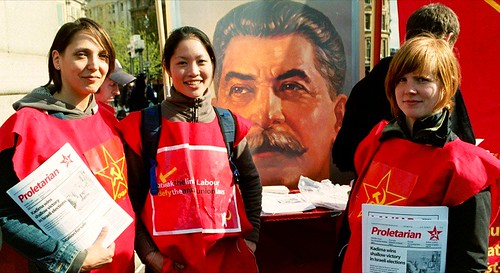
» The photo, Posing for communisim, was posted to Flickr by famous boxer and is used under a by-nc-nd licence. It was taken at the 2006 May Day protest in London and shows members of the Communist Party of Great Britain (Marxist-Leninist). The CPGB-ML website has a link to the Stalin Society, “formed in 1991 to defend Stalin and his work on the basis of fact and to refute capitalist, revisionist, opportunist and Trotskyist propaganda directed against him.” Which just goes to show… well, I don’t know what, really.

Categories
Culture

book meme

Ooh, I’ve been meme-tagged by Sherry Chandler.

Look up page 123 in the nearest book, look for the fifth sentence, then post the three sentences that follow that fifth sentence on page 123.

Well, the actual closest book is Brewer’s Dictionary of Phrase and Fable. Yay. So I’m going to ignore mere physical proximity and pick the first book which caught my eye after reading the meme, because it’s on a bookshelf directly behind the computer: Judith Thurman’s A Life of Colette.

Poverty plays a central role in the fall of Luce, as it did in the lives of so many provincial girls who sold themselves to the rich old lechers of Paris. Poverty also played a central role in Colette’s version of her marriage to Willy, and it’s very wishfully that she provides her heroine with a dowry from her dead mother—a hundred thousand francs prudently invested with the notary in Montigny. It is telling, too, that Claudine is shocked when Luce declares with smug vindictiveness that she would rather see her mother starve than send her any money.

Which is mildly more interesting than Brewer’s definition of ‘blank cartridge’, but not particularly gripping out of context. So let’s cheat even further, and pick another book from the shelf: the autobiography of Benvenuto Cellini.

After the necromancer had completed his ceremonies he took off his robes and gathered up a great pile of books that he had brought with him; then we all left the circle, pressing tightly together – especially the boy, who had got in the middle and was clutching the necromancer by his robe and me by the cloak. While we were walking towards our homes in the Banchi, he kept crying out that two of the demons he had seen in the Colosseum were leaping along in front of us, on the roof-tops and along the ground.

The necromancer said that he had often entered magic circles but that he had never before witnessed anything on such a scale, and he tried to persuade me to join him in consecrating a book to the devil.

Good old Benvenuto. I knew he wouldn’t let me down.

Categories
Culture Other

Boy jumping

A crop out of the centre of a photo I shot on the South Bank the other day when I went to see the Rodchenko at the Hayward.

boy jumping

See also Phillippe Halsman and Jacques-Henri Lartigue. And of course Flickr.

Categories
Culture

Housekeeping by Marilynne Robinson

I bought Housekeeping because of an article at the end of last year where Bryan Appleyard made some suggestions of great artists working today. One of his two greatest living novelists was Marilynne Robinson; I don’t always find myself in sympathy with Appleyard, but with a recommendation like that it seemed worth a punt.

detail of Hiroshige’s ‘Two men by a gate in the mountains’

It is a remarkable novel. It’s a first-person story of a girl growing up in a bleak town somewhere in the north-western US in a household that gradually dissolves around her. It’s humane and atmospheric and deeply sad.

Most of all, it’s beautifully written: full of striking images and unexpected, often bleakly humorous details. And elusive and gradual and minor-key.

Is she one of the two greatest living novelists IN THE WORLD? Umm, I don’t know. But I’m willing to consider the possibility that she might be.

» the picture is a detail from Hiroshige’s Two men by a gate in the mountains, found on Wikimedia.