Categories
Culture

New stuff coming soon

I’m being an absolute dynamo of behind the scenes activity, wrestling with HTML, php and CSS for your reading pleasure. Sort of. Anyway, in the absence of any other new posts, have a video of Seu Jorge:

If you haven’t seen The Life Aquatic with Steve Zissou, you should. It’s a very good film.

Categories
Culture Nature Other

40 Days and 40 Nights by Matthew Chapman

Full title: 40 Days and 40 Nights: Darwin, Intelligent Design, God, OxyContin®, and Other Oddities on Trial in Pennsylvania. In other words, it’s about the trial in Dover, Pennsylvania where the school board tried to put Intelligent Design into the biology classes and were found to be in breach of the constitutional separation of church and state.

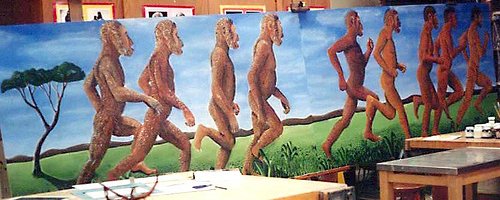
evolution mural from Dover High School

I’m not quite sure why I felt the need to read a second book about this; the blurbs promised a more entertaining read, and it’s certainly livelier and bitchier than Monkey Girl, but didn’t tell me anything new. And despite what Hollywood would have you believe, trials are not inherently charged with drama. Especially this trial, which, with eleven plaintiffs and a bucketload of lawyers and expert witnesses, lacked a personal dramatic focus.

Chapman largely concentrates on personality and anecdote and glides past a lot of the technical evidence; understandably, I guess, but I would have liked more to get my teeth into.

» The photo above, which I found rather unexpectedly on Flickr, is of a mural painted by a student at Dover High School which helped kick off the whole controversy when one of the school board took offence at it and took it on himself to take it away one weekend and burn it. It’s used under a by-nc-sa CC licence.

Categories
Culture Other

‘Sacred’ at the British Library

I went yesterday to see Sacred at the British Library. I nearly missed it; the exhibition closes at the weekend. I’m glad I didn’t, as it was extraordinary.

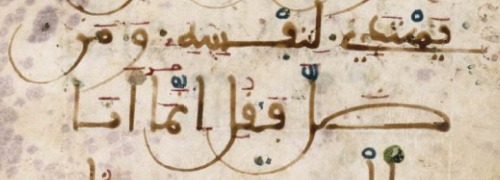
Maghribi script

It’s an exhibition of sacred texts from Islam, Christianity and Judaism, and the selection is seriously impressive. For example, the show includes the Lindisfarne Gospels and a bit of a Dead Sea Scroll as just two exhibits among many. They also have one of the two oldest Christian bibles, from the C4th, an C8th Qur’an, the first printed Mishnah, Henry VIII’s psalter, copies of the Qur’an made for various sultans, a Tyndale New Testament and so on. They haven’t even bothered to include a copy of the Gutenberg Bible, presumably because they have one of those on display in their permanent exhibition anyway.

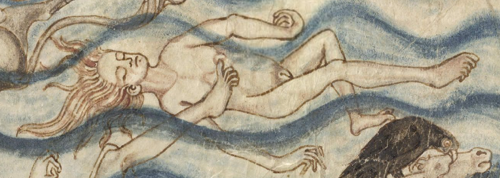
The Holkham Picture Book

Staggeringly, with a very few exceptions like the Dead Sea Scroll, all these books were part of their own collection. It’s odd to think of all these books, culturally interconnected but originally separated by many centuries and thousands of miles, having made their way, by who knows what means, from monasteries and mosques in Syria, Armenia, Ethiopia, India; and all ending up in a basement in North London.

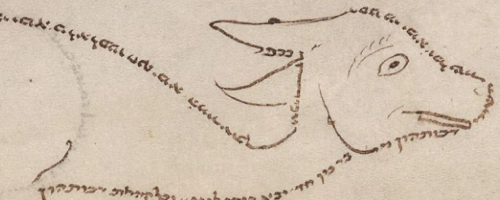
Micrographia

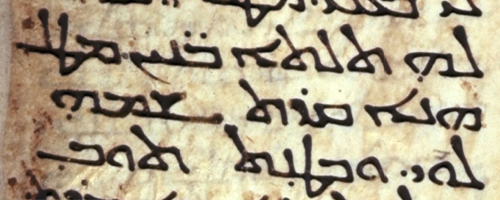
Whatever my disagreements with religion, I do feel a reverential instinct towards ancient artefacts and books, so I had no difficulty feeling a sense of the sacred. And many of them are extraordinary objects in their own right. I have a new-found passion for Syriac script.

Syriac writing

There are zoomable high-resolution images of 67 of the texts available on the website, so those of you who can’t make it London this week can take a look. That’s where all the images illustrating this post came from. I have to say, generally, kudos to the British Library; all the exhibitions I’ve seen there have been excellent (and free).

» Pictures, from the top: 1) An example of Maghribi script from a C13th Spanish Qur’an. 2) One of the people drowned in the Flood in the C14th Holkham Bible Picture Book. 3) Micrographic decoration (i.e. made up of tiny writing) from The Duke of Sussex’s German Pentateuch, c. 1300. 4) The bible in Syriac, dated by the scribe to 463/4 AD.

Categories
Culture Other

Amusing advertisement

I saw this in the cinema the other day when I went to see Helvetica, and I thought it was worth sharing:

Categories
Culture

Helvetica, the movie

I went to see Helvetica today. It is, as the name suggests, a documentary about the typeface, which is 50 years old this year.

Helvetica sample

I enjoyed it. My usual feeling with factual-type documentaries like this (as opposed to narrative-type documentaries like, say, Spellbound) is that they are very slow; that given the same amount of information in written form, you could take it in about ten times quicker. There was something of that in Helvetica, but it’s a visual subject, so it’s well-suited to film. It’s always good to see people talking enthusiastically about their particular area of expertise, and between them the interviewees and the film-makers did a good job of communicating what’s special about Helvetica and placing it in its historical context. It is undoubtedly a remarkably good typeface although the more I saw it over and over again on screen, the more it started looking a bit dated. Not so dated as to be unusable; it’s surely good enough to be a permanent part of the repertoire for hundreds of years. Just a bit tired.

I think you’d need some degree of interest in graphic design to enjoy the film, but you probably don’t need to be a die-hard type geek. My biggest complaint is actually with the cinema; they had the sound too loud and gave me a headache.

Categories
Culture Other

‘We The People’ at the Globe

I finally visited the Globe theatre for the first time this week. That’s not because I’ve been avoiding it—every time I walked past on the way to Tate Modern, I thought ‘I really must go to the Globe some time’— but I never got round to it.

Since the whole point is that it’s a reconstruction of an Elizabethan theatre, it might have made more sense to see a play from the period, but in fact I saw We The People by Eric Schlosser.

Ben Franklin and an air stewardess

N.B. Picture may not be representative of actual play.

Dealing with the play first: it was a dramatic reconstruction of the process of writing the U.S. constitution, based on primary sources. Schlosser, who wrote Fast Food Nation and Reefer Madness, is primarily a journalist/non-fiction writer, and this is a very straight presentation of history on the stage. He does his best to bring out the personalities of the men involved and find human interest and humour to leaven the mix a bit, but to be honest, a committee of lawyers and politicians discussing constitutional law doesn’t make for dynamic theatre. It was interesting and somewhat entertaining, but it all felt a lot like being in school.

I heard Schlosser on the radio talking about the play and saying that one of the things that interested him was that Americans tend to treat the constitution as a semi-sacred document (my paraphrase) and that he wanted to bring out its history as a document written by human beings, a product of compromise and a particular historical moment. Which is a worthwhile project, and I think he was successful, although for me the constitution never had those associations particularly.

With the subject of nation-building in the air at the moment, it’s worth being reminded that the process in our own countries’ histories was slow and erratic. A lot has changed in the meantime which might provide a framework and some help, but still, we can’t be surprised if countries like Iraq, Bosnia and even Russia take many years to even achieve stability, let alone all the features of a mature democracy. There’s no guarantee that they will ever achieve those things.

One touch worth noting: at various breaks in the action, a couple of musicians, dressed, like the rest of the cast, in C18th clothing, and played and sang West African music. One was playing a many-stringed instrument that I think was probably a kora, and the other some kind of stringed instrument played with a bow. Schlosser explains:

It’s a reminder of those who were not invited to the room. Slavery was crucial to the economy of the United States, but slaves had no voice whatsoever in society. In the play the music offers them a means to be heard. And it’s wonderful music.

I like the idea, although I’m not sure how well it worked theatrically. I’m not sure how many of the audience made the connection. And in a rather literal play, it seemed a bit out of place. Considering they were supposed to represent the voiceless, it’s an unfortunate irony that the musicians’ names aren’t listed on the website. They were named in the programme, but I don’t have it with me; one was Senegalese and the other was Gambian.

As for the theatre: it’s a striking building and has a plausibly authentic feel, although I believe it’s reconstructed on the basis of fairly thin evidence. I think probably the most interesting difference from a conventional theatre isn’t that it’s in the round—I’ve been to quite a few productions staged like that over the years anyway—it’s the natural lighting. Stage lighting provides a natural focus on the actors and away from the audience, and it helps the audience concentrate. In daylight, the actors don’t have that advantage. I don’t think this particular play made especially good use of the theatre, in fact; the actors moved among the audience standing in the pit sometimes, but most of the play consisted of men talking to each other and was naturally static; it could as easily have been staged in a proscenium arch theatre. Frankly it could almost have been a radio play. I’d be interested to see something more dramatic there sometime. Shakespeare, perhaps.

Oh, and if you visit and you have a seat, get a cushion. They rent them in the theatre. The seats are wooden benches, and it’s tough on the buttocks. They also rent out seat backs for some lumbar support, which is what I had, but I didn’t think it was very comfortable.

» The picture of Benjamin Franklin and an air stewardess is a section of a photo by Matt Wright and is used under—and therefore available under—a by-nc-sa Creative Commons licence.