It’s not that I want the football commentators to try and sell every game as a classic even when it clearly isn’t. I appreciate their willingness to be honest about their product. But having bloody Lawro gloomily commenting about how bad the game is every 30 seconds for the whole bloody match really doesn’t add to its value as a piece of entertainment. It’s like watching football with Eeyore sitting on your shoulder.
Category: Culture
The subtitle of this book is “A journey to the heart of two footballing cultures”, and Gianluca Vialli, having grown up and played most of his career in Italy before ending it playing and then managing in England, is well placed to make the comparison (as indeed is his co-writer Gabriele Marcotti, the UK correspondent for Corriere dello Sport). He also interviewed many of the major figures in both countries, including managers, referees and former players.
The comparison is interesting and I suspect most of his diagnoses are right: for example, that the English are not so much tactically inept as completely uninterested, that we don’t treat it as a serious profession, that the specifically working class identity of football in Britain is a key part of why it has developed differently here, and that an unjustified sense of the superiority of English football has kept us from learning useful lessons from all those countries that win World Cups more often than we do.
If that makes it sound like he portrays the English as the village idiots of European football, well, it does feel like that at times. He finds enough negative things to say about Italian football culture, but it’s pretty clear which country he thinks produces better footballers. It’s not just the football itself, though; he has interesting things to say about the differences in the media, the fans, and the attitude to managers.
There is a perhaps inevitable tendency to lapse into presenting national stereotypes as though they were explanations; not just from Vialli, either, but from many of his interviewees. I think Vialli is generally careful to go beyond stereotypes to find more specific explanations, but there’s still a certain amount of ‘Latins are like x and northern Europeans are like y’ being bandied around. Here’s an example of the kind of thing I found questionable:
These are the kind of mental acrobatics many of us go through in Italy – quite the opposite of England. But then the English are off to war, blindly trusting their leader, while the Italians aren’t quite so sure…
‘Look, it’s in the blood of the English. It’s the almost military attitude with which they approach everything,’ says Wenger. ‘They do as they’re told, they follow orders, they do not question authority and they never give up, not even when they are three goals down and there are two minutes to go. I don’t think it’s a coincidence. Every time there is a war, the English almost always win. The Italians on the other hand…
There was no need for Wenger to finish the sentence. I knew where he was going with it. And, admittedly, he has a point. As a nation, we are far less warlike than the English – not to mention the Germans – so our record in war is not quite as good as our record in football. The football-as-war analogy is popular in some coaching circles but in my opinion it is flawed. Football is a collaborative effort, it’s the synthesis of the individual and the collective: it’s not about blindly following orders.
I’m not going to argue with Wenger and Vialli’s practial experience of what it’s like to manage an English football team, but as it happens I’ve recently been reading The Utility of Force: The Art of War in the Modern World by Rupert Smith, which makes it clear that the British Army believes strongly in a devolved command structure, where soldiers lower down the command structure are given an objective but then have the responsibility of making their own decisions about the details of putting it into practice, and the flexibility to respond to events. Which means their training has to give them the kind of tactical and contextual knowledge that allows them to make those decisions. If you ever hear the Army talk about themselves, the key word they like to use is ‘professional’. In other words, the British Army’s approach to war is more like the Italian approach to football.
Which doesn’t tell us much about the chances of England winning the World Cup in my lifetime but might say something about the helpfulness of national stereotypes.
I do think it’s funny that the British, so temperamentally disinclined towards conspiracy theories that they even assume that referees are incompetent rather than corrupt, seem ready to believe in a shadowy international conspiracy to fix the result of the Eurovision Song Contest.
EDIT: and after posting that I read that Richard Younger-Ross, the Lib Dem MP for Teignbridge, has tabled an early day motion calling for the voting system to be changed, with the support of three other MPs. Thus proving there’s no subject so trivial that a pathetic, desperate MP won’t wrap it around himself if he thinks it’ll get him ten seconds of media attention.

The Cassette Generator, via things magazine, which/who I was surprised to realise I hadn’t already added to my blogroll.
Categories
Poetry and ‘truth’
It’s Poetry Thursday, and I don’t feel like writing a poem after napowrimo. Instead, some thoughts about poetry and ‘truth’. It always used to annoy the hell out of me when I heard people suggest that poetry—or more generally literature, or art—was somehow a search for truth, or that the success of a piece of art could be measured in terms of its truth.
That’s because most poetry isn’t ‘true’ in the normal sense of the word. I know this is shockingly reductive and literal-minded of me, but there wasn’t actually a woman called Arachne who had a weaving competition with the goddess Athena and was turned into a spider. So using the ‘truth’ criterion, Ovid’s Metamorphoses must be a failure as art. And it’s not just Greek myths; a large proportion of poems, even the naturalistic ones, describe things that didn’t actually happen, or didn’t happen exactly the way the poem says they did.
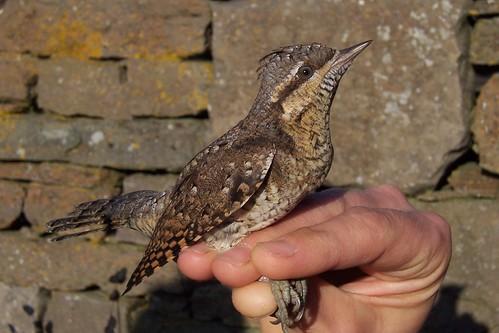
Wryneck 2, originally uploaded by Jen the wren.
Yes, I know; that most basic kind of ‘truth’ isn’t what people mean. And obviously it’s reasonable that they should apply the word in some kind of specialized sense to mean something slightly different; but it’s very hard to get anyone to pin down exactly what they do mean. It never seemed very productive, explaining what poetry is by invoking a common word to mean something vaguely and indefinably other than what it normally means.
It was frustration at that kind of waffly, hand-wavy traditional approach to the questions of what literature is, and how it works, that lead me to take a course in critical theory when I was at university, in the hope that one of those philosophers or theorists would have come up with a more rigorous and precise language for discussing literature. Instead I just encountered a whole different set of irritatingly bad arguments which I was equally impatient with.
But recently, and somewhat reluctantly, I’ve become more sympathetic to the idea of poetic ‘truth’. And that’s because sometimes, when I’m trying to write a poem, I’ll come up with, let’s say, an ending for a poem; and it’s the best I’ve got, and it works as a way of ending the poem, and I may settle on it, but it just niggles away at me because in some indefinable way it’s not right. Not that there’s anything technically wrong with it, but in some way it’s just not [something]. And the best word I can come up with to end that sentence is ‘true’.
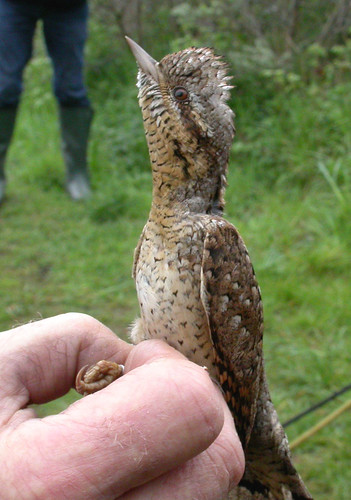
Wryneck, Sheringham (Norfolk), 1-May-04, originally uploaded by Dave Appleton.
So what do I mean when I say that? Well, that’s the difficulty. I spent some time thinking about it while I was looking for wrynecks on Crete, and came up with all sorts of shades of meaning for ‘true’; ways that something can be ‘true’ without being an accurate account of a specific thing that happened. It can be true to the way the universe works, or how the poet sees the universe, or to the kind of universe the writer wants to project in the poem; or say something true via a metaphor, or accurately convey what the poet wants it to convey. And to get into even murkier waters, it can be morally true or emotionally true, although I’m not sure those concepts are much more informative than ‘poetic truth’ was in the first place. And, to quote myself, it can be ‘true, not like an axiom, but like a bell’; soundly constructed so that all the parts work together as a greater whole. And all these overlapping kinds of truth seem relevant without any of them being the answer.
All of which seems frustratingly inadequate. Perhaps the problem is that one word is being made to do too much work; that we need not one alternative word but several. Or perhaps the traditional tools of philosophy are inadequate, and if we are ever going to gain a deeper understanding of how poetry works it will be from a deeper understanding of how the brain works, and not from worrying away at definitions of truth. And perhaps my time would be more productively spent reading and writing poetry anyway.
I’ve posted a few thoughts on the books I read in Crete (a couple of novels by Kazantzakis, some Marquez, Seferis, books on the Battle of Crete and resistance, Aristophanes), which can be found via my ‘What I’ve been reading’ page.