I thought it would be fun to make a whole set, with different record labels. I’ve added Trojan, Upsetter, Chess, Apple and Sun:
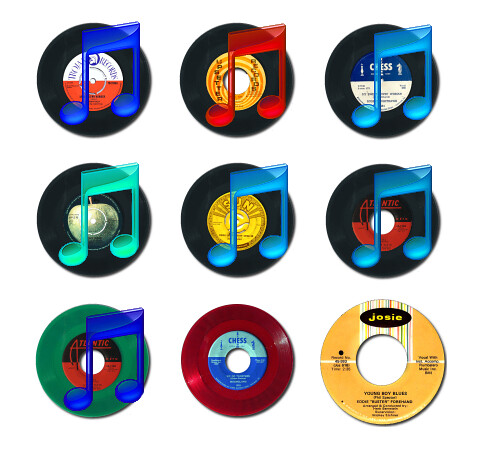
You can get a zip of them as .icns files here.
I thought it would be fun to make a whole set, with different record labels. I’ve added Trojan, Upsetter, Chess, Apple and Sun:
You can get a zip of them as .icns files here.
I can’t remember how I found this, but LibraryThing is a site where you can keep (and share) a record of the books you own. You can rate, review and tag them, find other people with the same books, get recommendations, discuss books and all that kind of webby goodness.
I just started an account to try it out and added a few books that came to hand, and quickly found it was strangly addictive. Initially I thought I might just use it to keep a record of books I was reading at the moment, but then I went and imported a list of books which I’ve bought from Amazon or told them I own, so that blew that plan. And then I added a few other favourites and books I thought were interesting. Pretty quickly, my library reached 95 titles. At this point I really have to make a decision whever I intend to do this seriously. If you add more than 200 titles, you have to pay a subscription ($10/year or $25 for life), and I’d reach that extremely quickly if I started trying to catalogue every book I own. Or even a decent selection.
I’m still not entirely sure what the point is, but as I say, I found it surprisingly addictive. And brilliantly simple to use, particularly if you have the book (and so the ISBN number) to hand.
From Robert Graves’ Goodbye to All That:
24 June, 1915, Versailles. This afternoon we had a cricket match, officers v. sergeants, in an enclosure between some houses out of observation from the enemy. Our front line is three-quarters of a mile away. I made top score, 24; the bat was a bit of a rafter, the ball a piece of rag tied with string; and the wicket a parrot-cage with the clean, dry corpse of a parrot inside. Machine gun fire broke up the match.
I read the Graves at school, but I’d forgotten that little gem. I found it in A Social History of English Cricket by Derek Birley, a book which I’m finding more entertaining than the slightly dry title would suggest. It would also make an excellent choice for the list of books to explain England, since all the social changes of the past 250 years have been reflected in the development of cricket. The class system is especially well represented. Although it does contain an awful lot of cricket anecdotes which might be a bit impenetrable to our notional foreigner.
Thinking about Englishness lead me to re-read My Five Cambridge Friends by Yuri Modin, who was the KGB handler of the Cambridge Five. It really is the most extraordinary story. Having started with an Englishman playing cricket behind the lines in WWI, let’s end with another posh chap maintaining his Englishness in difficult circumstances:
I know that Philby didn’t much care for the character in The Human Factor who is supposed to be modelled on him, a whining fool who ekes out his days in a Moscow hovel. His own circumstances were totally different, what with his huge apartment, his magnificent view, the copies of The Times, Le Monde and the Herald Tribune to which he had subscribed, the videotapes of cricket test matches and the pots of Cooper’s Oxford marmalade sent from London.
We really are caricatures of ourselves sometimes.
Well I’ve still been thinking, on and off, about that list of ten books to explain the UK. Which is an interesting exercise.
I quickly decided to eliminate Wales, Scotland and Northern Ireland. Not that I have anything against the Celtic Fringe, but it was complicated enough dealing with Englishness. There’s no difficulty in finding ten books all of which have some characteristically English quality to them; it’s getting some kind of balance to them as a list. For example Brideshead Revisited, Crome Yellow, Love in a Cold Climate, Summer Lightning, The Complete Saki and The Importance of Being Ernest are all in their way very English*, but they don’t exactly represent a very broad range of Englishnesses. And then there are cases like Gerard Manley Hopkins. He’s possibly my favourite poet, but as a Jesuit priest and radical poetic innovator I can hardly claim him as representative or typical.
I’m probably over-analysing again.
One thing that becomes apparent is that I don’t read enough contemporary fiction. I mean, over the years I have read quite a lot of it, but not a lot of books from the past few decades seem to be springing to mind at the moment.
I find myself drawn to books by and about English people but set abroad – A Passage to India, My Family and Other Animals, Our Man In Havana, Into The Heart of Borneo. Perhaps because the Englishness of the characters is set into relief. The flipside would be books about England written by foreigners: Voltaire, Conrad, Henry James, T. S. Eliot, even Bill Bryson.
I’m still thinking.
* yes, I do know that Wilde was Irish
If poems were not easily reproduced — if, as with paintings, owning a copy of a poem was obviously a poor alternative to owning the original — how much would an original Armitage sell for? A Larkin? An Eliot? A Marvell?
Flickr set of the week this week is Good Decorating by MikeLove. This are “examples of good decorating from the Practical Encyclopedia of Good Decorating and Home Improvement (1970)”.

