Flickr set of the week is Namibia 2006 by rutherfordfamily. And not just because ‘rutherfordfamily’ is in fact my brother (hi Dom).

Some zebras

An oryx

Guineafowl

another zebra
Lots more good stuff where those came from.
Flickr set of the week is Namibia 2006 by rutherfordfamily. And not just because ‘rutherfordfamily’ is in fact my brother (hi Dom).
Some zebras
An oryx
Guineafowl
another zebra
Lots more good stuff where those came from.
With the Amish in the news, I was thinking how odd it is that they have such a generally positive image. These people are religious extremists who define themselves by ignorance and dogma, who oppose art and science, who treat women as second-class citizens, and won’t even talk to their own family members if they have lost their faith.
They’re a non-violent version of the Taleban; and while I appreciate that the ‘non-violent’ part of that phrase is very important, I’m not sure it makes up for everything else. And yet somehow they are widely admired. Because they’re quaint? Because people are vaguely glad that someone else is living according to an obsessively strict and arbitrary moral code, even though they wouldn’t want to live to it themselves?
Who Do You Think You Are? is a BBC series where they trace the family history of celebrities. There was a particularly good episode tonight with David Tennant (Doctor Who, among other acting credits). Good both because he’s an articulate, personable man and because they had some good material to work with; one branch of the family were cotters on Mull who were forced to move to Glasgow by the Clearances, and another branch were deeply involved with Protestant sectarianism in Ulster.
Two points spring to mind. One is that the appeal of the program is very much what I was saying about biography: sometimes history seems more vivid when you narrow the focus. You don’t really learn anything new about the Clearances by seeing David Tennant on the site of the town where his ancestors lived and where now there are only some stone walls standing amid the bracken, but it does help you understand the individual human cost.
The other point is that every time I see film of the west coast and islands of Scotland, it looks unutterably beautiful. If there’s a more photogenic place on earth, I don’t know where it is. I really should get up there some time, to see the phalaropes and corncrakes and sea eagles as well as the scenery.
I do enjoy reading biographies. Not just to learn more about people I have a special interest in, but as a more entertaining way of reading about history.
There can be something a bit stifling about the careful thoroughness of the conscientious historian trying to lay out all the strands of a complicated subject. The joy of a biography is that it just picks out one strand. The subject’s life offers a route through a period. And even though it’s often a rather erratic and contingent route, it forms a natural narrative.
And because these narratives are immune to certain kinds of criticism, they can be full of the kinds of unexpected twists, bizarre coincidences, heavy-handed irony and acts of heroism or villainy that might seem vulgar in mere fiction. I mean who could make up a character like T. E. Lawrence? Or Emma Hamilton?
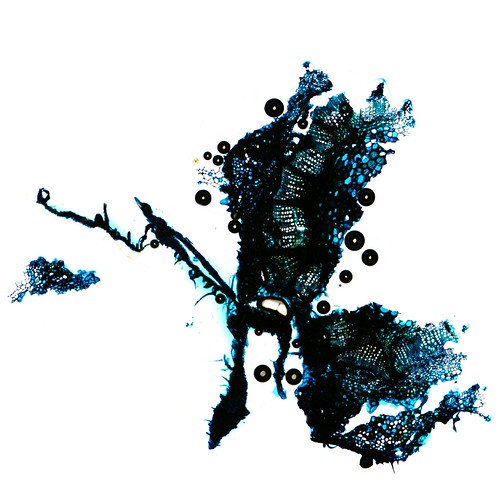
Sorry, I forgot yesterday, so Flickr set of the week is a day late, but worth waiting for. It’s the remarkable Digital Dendrology by phyredesign.
“I’m fascinated by how things are structured in nature. This year, I have begun taking samples from the branches I collect, and preparing slides for viewing under a microscope. After identifying the type of tree to which the branch belongs, I use a digital camera attachment on my microscope to photograph the samples. Piecing together over fifty photographs for each sample, each final image is a 100x magnification of a glimpse of life not seen by the human eye alone. They become abstract structures reminiscent of any number of things.”
White Mulberry:

Unidentified: