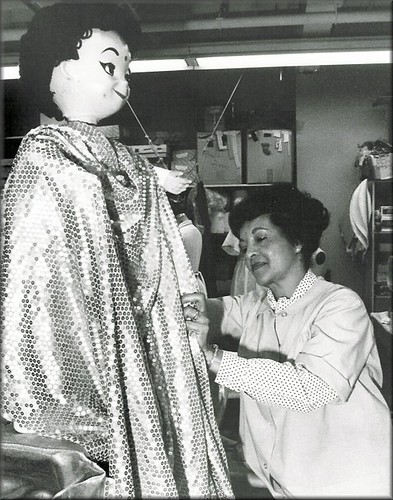
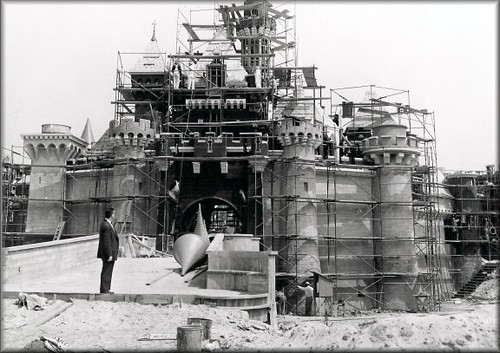
Flickr set of the week is Old Disneyland by Tom Simpson: “Pictures from its construction and first few years of operation.”
Categories
Flickr set of the week is Old Disneyland by Tom Simpson: “Pictures from its construction and first few years of operation.”

The Cassette Generator, via things magazine, which/who I was surprised to realise I hadn’t already added to my blogroll.
It’s Poetry Thursday, and I don’t feel like writing a poem after napowrimo. Instead, some thoughts about poetry and ‘truth’. It always used to annoy the hell out of me when I heard people suggest that poetry—or more generally literature, or art—was somehow a search for truth, or that the success of a piece of art could be measured in terms of its truth.
That’s because most poetry isn’t ‘true’ in the normal sense of the word. I know this is shockingly reductive and literal-minded of me, but there wasn’t actually a woman called Arachne who had a weaving competition with the goddess Athena and was turned into a spider. So using the ‘truth’ criterion, Ovid’s Metamorphoses must be a failure as art. And it’s not just Greek myths; a large proportion of poems, even the naturalistic ones, describe things that didn’t actually happen, or didn’t happen exactly the way the poem says they did.
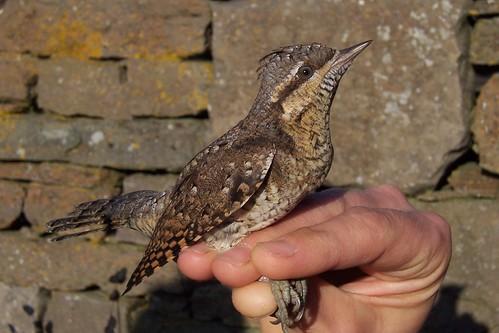
Wryneck 2, originally uploaded by Jen the wren.
Yes, I know; that most basic kind of ‘truth’ isn’t what people mean. And obviously it’s reasonable that they should apply the word in some kind of specialized sense to mean something slightly different; but it’s very hard to get anyone to pin down exactly what they do mean. It never seemed very productive, explaining what poetry is by invoking a common word to mean something vaguely and indefinably other than what it normally means.
It was frustration at that kind of waffly, hand-wavy traditional approach to the questions of what literature is, and how it works, that lead me to take a course in critical theory when I was at university, in the hope that one of those philosophers or theorists would have come up with a more rigorous and precise language for discussing literature. Instead I just encountered a whole different set of irritatingly bad arguments which I was equally impatient with.
But recently, and somewhat reluctantly, I’ve become more sympathetic to the idea of poetic ‘truth’. And that’s because sometimes, when I’m trying to write a poem, I’ll come up with, let’s say, an ending for a poem; and it’s the best I’ve got, and it works as a way of ending the poem, and I may settle on it, but it just niggles away at me because in some indefinable way it’s not right. Not that there’s anything technically wrong with it, but in some way it’s just not [something]. And the best word I can come up with to end that sentence is ‘true’.
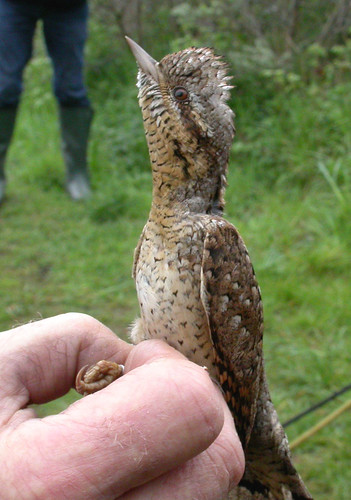
Wryneck, Sheringham (Norfolk), 1-May-04, originally uploaded by Dave Appleton.
So what do I mean when I say that? Well, that’s the difficulty. I spent some time thinking about it while I was looking for wrynecks on Crete, and came up with all sorts of shades of meaning for ‘true’; ways that something can be ‘true’ without being an accurate account of a specific thing that happened. It can be true to the way the universe works, or how the poet sees the universe, or to the kind of universe the writer wants to project in the poem; or say something true via a metaphor, or accurately convey what the poet wants it to convey. And to get into even murkier waters, it can be morally true or emotionally true, although I’m not sure those concepts are much more informative than ‘poetic truth’ was in the first place. And, to quote myself, it can be ‘true, not like an axiom, but like a bell’; soundly constructed so that all the parts work together as a greater whole. And all these overlapping kinds of truth seem relevant without any of them being the answer.
All of which seems frustratingly inadequate. Perhaps the problem is that one word is being made to do too much work; that we need not one alternative word but several. Or perhaps the traditional tools of philosophy are inadequate, and if we are ever going to gain a deeper understanding of how poetry works it will be from a deeper understanding of how the brain works, and not from worrying away at definitions of truth. And perhaps my time would be more productively spent reading and writing poetry anyway.