Categories
Culture

The Kite Runner by Khaled Hosseini

The Kite Runner was really the obvious choice from Afghanistan for the Read The World challenge, since my mother had a copy already. I have to admit I was sceptical about it; the very fact it became so popular at a time when Afghanistan was in the news made me wonder whether its success was based more on topicality than merit. Also the UK edition has a very wishy-washy cover with a sepia-tinged photograph of a small boy on it, and while covers are often misleading, they do at least tell you something about what the publishers think is the market for the book.

And so I rather expected The Kite Runner to be a bit like the book I read for Iran, also written by a refugee who has lived for many years away their home country: nostalgic and rather insubstantial. In fact, it is much darker than I was expecting.

It tells the story of the narrator Amir’s childhood in Kabul, particularly focussing on his relationship with his father and his friendship with the servant boy Hassan; then his life with his father as a refugee in California in the 80s after the Soviet invasion, and a trip back to Taliban-controlled Afghanistan to do a favour for someone. Some of the darkness comes from the brutality of the past 30 years of Afghan history, but Amir’s personal story is one of betrayal and guilt even in his childhood in the relatively peaceful pre-Soviet days.

Generally I thought it was successful: the childhood stuff is gripping and moving; the portrayal of the refugee experience, and the contrast with their life in Afghanistan, is very effective; and the vision of an absolutely shattered Afghanistan under the Taliban is also pretty good. I found the book to be a genuine page-turner; I was reading until 2am a couple of times. Just to be clear, I don’t think it’s a literary masterpiece. But it is a well-written novel that tells a good story.

Hosseini isn’t afraid to pile on the emotive material, and most of the time he manages that without tipping over into corny or melodramatic, but towards the end of the book he did trigger my own personal cynic a couple of times. There’s a confrontation with a member of the Taliban in Afghanistan where the coincidences got a bit too Hollywood for me, and I never quite got pulled back into the book again in the same way after that. I also think he fluffed the last few pages.

So having been thoroughly gripped by the book initially, I was a bit disappointed at the end; even so I would recommend it.

» the photo of boys flying a kite in Kabul is AFG_20071109_169.jpg, posted to Flickr by AndyHiggins.

Categories
Culture

Told by Starlight in Chad by Joseph Brahim Seid

Told by Starlight in Chad is a collection of stories by Chadian writer Joseph Brahim Seid, translated from French by Karen Haire Hoenig. I’ve tagged this post with ‘short stories’ but they aren’t really short stories in the literary tradition: they are fables or folk tales in the oral tradition. I’m not sure whether they are all traditional stories or new ones, or how true they are to the way the stories might be ‘told by starlight’.

In some ways the material seems very familiar — wicked stepmothers, magic purses, and beautiful princesses — although the stories feature hyenas and gazelles rather than foxes and rabbits. Sometimes the stories end with a moral or an explanation of the ‘and that’s why we do so-and-so’ type, and sometimes they are, as far as I can tell, just stories.

Just to give you an idea of the style, here’s the opening to a story called Bidi-Camoun, Tchourouma’s Horse.

A very long time ago, in the days when miracles and wonders were still common among us, a little prince was born in the kingdom of Lake Fitri. Tchourouma was his name; noone knew the reason why. His father loved him dearly and his mother adored him. At a very young age, they had given him as a gift Bidi-Camoun, a splendid chestnut horse. When Tchourouma had barely reached his fifteenth year, his gentle mother died, snatched away by a cruel disease in her chest, which neither the skill of the fakihs, the fetish doctors nor the Bulala witchdoctors could cure. In memory of his beloved wife, the Sultan retained a great deal of affection for the child. He took him lion hunting and on walks around the lake which is the sanctuary of the ancestral spirits and the safeguard of the kingdom. Devoured with envy by the King’s great fondness for his son, the women of the harem devised plots to kill the child….

All quite interesting and quite enjoyable, though I can’t say I was completely grabbed by it. Told by Starlight in Chad is my book from Chad for the Read The World challenge.

» The picture of rock art in Chad, “Round head” paintings, is © Franck Zecchin and used under a by-nc-sa licence.

Categories
Culture

Main Street by Sinclair Lewis

I made a vaguely dismissive comment about Sinclair Lewis in the comments to the Halldór Laxness post, questioning whether he deserved a Nobel Prize. But not long afterwards, in reference to the Wall Street vs. Main Street theme that has been running in US elections, a journalist mentioned the novel Main Street by Sinclair Lewis. Hang on a minute, I thought, that doesn’t sound right… and about 30 seconds of research revealed that I hadn’t been thinking of Sinclair Lewis at all. I was thinking of Wyndham Lewis. A really quite different writer.

So I read Main Street. And actually, it was surprising how often it seemed relevant to the kind of culture war rhetoric that has been coming up on the campaign trail. Especially for a book published in 1920. There was even an argument about whether or not it’s patriotic to pay taxes.

The book is about Carol, a liberal, bookish girl who is non-specifically ‘artistic’; she marries a country doctor and moves with him to his home town of Gopher Prairie, Minnesota, which is part of what Sarah Palin would call ‘the real America’. She goes there with vague but idealistic hopes of improving the town, with beauty or culture or architecture, which founder in the face of the gossipy, judgemental, conservative, hypocritical, prejudiced, narrow-minded, coarse, prudish and generally unsympathetic locals.

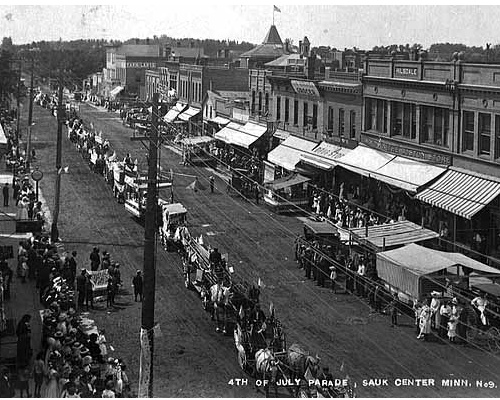
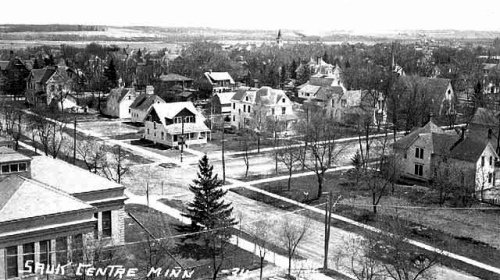
It is a fiercely satirical portrayal of small-town America which confirms all the worst fears of an arugula-eating, latte-drinking liberal like myself*. Lewis came from a small town himself (Sauk Centre, Minnesota), so he was writing from experience, although it does seem possible that he had a few biases of his own.

This is Carol’s first Gopher Prairie party:

Sam Clark had been talking to Carol about motor cars, but he felt his duties as host. While he droned, his brows popped up and down. He interrupted himself, “Must stir ’em up.” He worried at his wife, “Don’t you think I better stir ’em up?” He shouldered into the center of the room, and cried:

“Let’s have some stunts, folks.”

“Yes, let’s!” shrieked Juanita Haydock.

“Say, Dave, give us that stunt about the Norwegian catching a hen.”

“You bet; that’s a slick stunt; do that, Dave!” cheered Chet Dashaway.

Mr. Dave Dyer obliged.

All the guests moved their lips in anticipation of being called on for their own stunts.

“Ella, come on and recite ‘Old Sweetheart of Mine,’ for us,” demanded Sam.

Miss Ella Stowbody, the spinster daughter of the Ionic bank, scratched her dry palms and blushed.

“Oh, you don’t want to hear that old thing again.”

“Sure we do! You bet!” asserted Sam.

“My voice is in terrible shape tonight.”

“Tut! Come on!”

Sam loudly explained to Carol, “Ella is our shark at elocuting. She’s had professional training. She studied singing and oratory and dramatic art and shorthand for a year, in Milwaukee.”

Miss Stowbody was reciting. As encore to “An Old Sweetheart of Mine,” she gave a peculiarly optimistic poem regarding the value of smiles.

There were four other stunts: one Jewish, one Irish, one juvenile, and Nat Hicks’s parody of Mark Antony’s funeral oration.

During the winter Carol was to hear Dave Dyer’s hen-catching impersonation seven times, “An Old Sweetheart of Mine” nine times, the Jewish story and the funeral oration twice; but now she was ardent and, because she did so want to be happy and simple-hearted, she was as disappointed as the others when the stunts were finished, and the party instantly sank back into coma.

The scathing portrayal of Gopher Prairie is pretty relentless, but the book is more than just 400 pages of mocking the rubes. Carol is hardly perfect herself: she’s just a touch too highly-strung and prickly. And her husband may be more interested in motor cars and land deals than Yeats, but he is shown to be a hard-working, resourceful and skilful doctor. 

Mainly, though, I thought it was an enjoyable read: I really got caught up in it as a story, which isn’t true of everything I read these days. The details, both social and physical, are well observed; it’s funny; it has just enough of the soap opera about it to keep me turning the pages. Good stuff.

*Actually, that’s not true, I can’t see the point of latte. But I don’t suppose my organic, single estate coffee grown on a Guatemalan co-operative wins me any Real America points either. And not being American can’t help, of course.

» The pictures of Sauk Centre are from the enormous collection you can find at the Minnesota Historical Society website.

The reason I quoted such a long passage is that it’s out of copyright, so I could just copy and paste it from the Electronic Text Center at the University of Virginia LIbrary.

Categories
Culture

The Hostage by Zayd Mutee‘ Dammaj

This Yemeni novel, in what I assume is a coincidental parallel to Orwell, was written in 1984 but set in 1948; it’s about a boy who has been taken hostage by the Imam to ensure his father’s political obedience and is sent to work as a duwaydar in the Governor’s palace. A duwaydar was a personal servant, a pre-pubescent boy who filled the role that would once have been given to a eunuch: being able to work in the women’s areas of the palace without any risk to their chastity.

However, the women of the palace do in fact seek out the boys in search of sexual gratification; this is a novel about loss of innocence, about people who are trapped (the women as well as the hostage), about a somewhat toxic intersection of emotional, sexual and power relationships. It is also, I think, a political novel in its portrayal of the Imams’ rule as decadent and arbitrary. And in the background political events are rumbling, although they only appear as echoes within the tightly circumscribed world of the novel.

I find it quite difficult to pick passages to quote for these posts — something which more or less stands alone and gives some idea of what the book is like. But anyway. Here, our hero has just smoked his first cigarette.

It left me floating in a daze, and all I could remember next morning was that my friend hadn’t stayed therewith me, because two women, neither of them Zahra, had taken him and sat on the palace steps, kissing him and squeezing further pleasures out of him. When he came back, I remember, he slammed the door violently behind him, then sank down to sleep more deeply than I’d ever seen him sleep before.

How difficult it was to wake up in this city, so different from the fortress in the mountains, with its fresh, invigorating air! In the city, you always seemed to wake with the feeling that you’d been beaten black and blue, with your body swollen like a drum or the stump of a palm tree and your eyes drooping. From the very beginning there was a lingering feeling of nausea and depression, and you didn’t usually feel the least desire for breakfast or coffee. All you wanted was cool water, and that was only to be found, if at all, in the soldiers’ jugs.

The Hostage is my book from Yemen for the Read The World challenge.

» Note on the author’s name: there doesn’t seem to be a consensus on how to transcribe Arabic words, and I’ve seen it written in various different ways [Zayd or Zaid, Muttee, Mutee or Muti]. Zayd Mutee‘ Dammaj is the spelling used in this edition; the author’s page in the Library of Congress catalogue is under Zayd Muṭīʻ Dammāj.

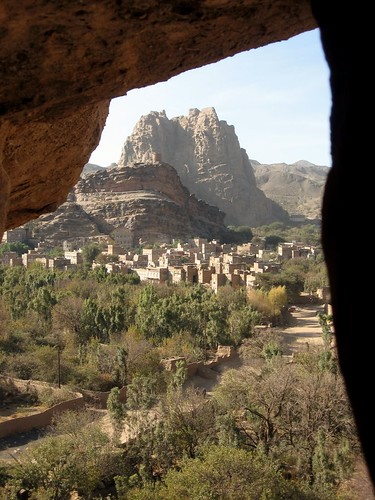
The picture is ‘the view of the village from a vindow of the Imam’s palace in Wadi Dhar’ and is © Franco Pecchio but used under a CC attribution licence.

Categories
Culture

Waiting for the Wild Beasts to Vote by Ahmadou Kourouma

Waiting for the Wild Beasts to Vote is the life story of President Koyaga, the dictator of the (fictional) République du Golfe, as told to him by his court storyteller Bingo.

Bingo is in some ways the ultimate unreliable narrator, portraying Koyaga as a heroic, semi-mythical figure protected by powerful magic, but he is accompanied by an apprentice whose role is to speak truth to power. The result is a portrayal of post-colonial African politics which is brutal, and darkly comic.

It has the sprawling rhythms of oral storytelling, with its repetitions and parallelism, which makes it difficult to pick an excerpt which does it justice and is short enough for me to type out. But this will do: it’s a part of an account of Koyaga’s triumphal march across the country after surviving a coup.

At the entrance to a far-off village, the hunters take the initiative of offering you — since you are a sinbo, a donsoba (a master hunter) —  the shoulder of a slaughtered bubale. At the next village there are shoulders, haunches, heads. At the village after that, there is a stinking mound of animal carcasses of every species: deer, monkeys, even elephants. Above the pile, the canopy of trees is black with vultures. In the sky, carrion birds attack each other with terrifying cries. Packs of hyenas, lycaons, lions follow and threaten.

The order is given that hunters should no longer offer you the shoulders of game killed by the hunters that week, need not gratify the master hunter who is their guest as their code of brotherhood demands.

In another village, to set itself apart, the sacrificial  priest does not stop at two chickens and a goat, he offers four chickens, two goats and an ox to the manes of the ancestors. The sacrificial priests in neighbouring villages follow suit, they outdo him, they go too far. Soon there are twenty oxen and as many goats and forty chickens. The sacrifice becomes interminable, it is a veritable hecatomb. A call goes out for a limit to be set on the number of sacrificial victims.

Waiting for the Wild Beasts to Vote is my book from Côte d’Ivoire for the Read The World challenge.

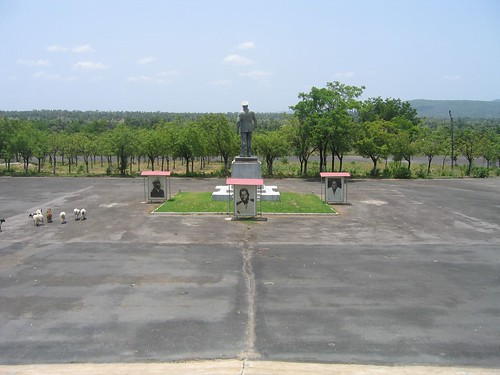
» The picture, Sarakawa Crash Site, Togo, is © Julius Cruickshank and used under a CC attribution licence. Julius explains:

“A huge monument built in the middle of nowhere to celebrate a plane crash that the dictator of Togo survived in the seventies. The photos at the base of the statue (donated by the people of North Korea) are Eyadéma’s generals that died. 

The only other visitors were the goats on the left…”

Categories
Culture

Yemen: Travels in Dictionary Land by Tim Mackintosh-Smith

I was originally considering Yemen: Travels in Dictionary Land* as my book from Yemen for the Read The World challenge, but I’ve tracked down a novel by an actual Yemeni writer which is available in English⁑, so I’ll read that at some stage. I still wanted to read Travels in Dictionary Land, though, because I very much enjoyed Mackintosh-Smith’s two books† following in the footsteps of the medieval Arab traveller Ibn Battutah.

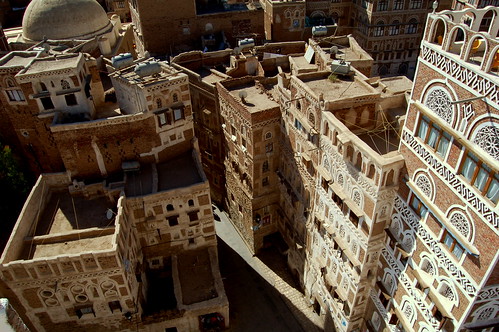
Sana'a old city, Yemen

I’m not quite sure how long Mackintosh-Smith had lived in Yemen when this book was published 10 years ago, but he still lives there; he is clearly deeply engaged with Arab culture, history and language generally and Yemen in particular — in fact, living in San’a and chewing qat, I think in the terminology of the Empire they would have said he has gone native — and the book mixes what you might call straight travel writing with historical context and snippets of literature and mythology.

I think it’s easiest to just quote a couple of passages.

Very occasionally they [scorpions] are found in bunches of qat. Once, a baby one walked out of my bundle and across my lap, and disappeared among the leavings in the the middle of the room. I have never seen qat-chewers move faster. Another creature that sometimes pops up in qat is the fukhakh, the hisser — the Yemeni name for the chameleon. Its blood taken externally is a cure for baldness, but its breath makes your teeth fall out.. The gecko too is often killed, as it eats the remains of food from around your mouth as you sleep, pisses and gives you spots. Despite this I have been attached to several that have grown up in my house as they are clever flycatchers and converse, like the Hottentots, in clicks.

Or, in a bar in Aden:

Then the band broke into a sort of Egyptian glam-rock number and, unexpectedly, the floor filled with young men dressed in Paisley pattern shirts and pleated trousers. The number of pleats seemed to reflect their prowess at dancing. One particularly energetic youth — a twenty-pleater — shone out: his pelvis was articulated in extraordinary places, and spurts of sweat shot from his forehead. These were the mutamaykalin, the Michaelesques — the fans of Michael Jackson.

So, generally speaking, enjoyable stuff. Some of the political/history passages are less gripping than the travel anecdotes, but at least I now know a lot more about Yemen.

* sold under the title Yemen: The Unknown Arabia in the US.
The Hostage, by Zayd Mutee‘ Dammaj.
Travels with a Tangerine and The Hall of a Thousand Columns.

» The photo of Sana’a old town in Yemen is © eesti and used under a CC by-nc-nd licence.