I’m having serious computer problems—like not being able to turn it on—so posting is liable to be sporadic. Just fyi.
EDIT: I’ve seized the opportunity while my computer is running of posting a new picture at Clouded Drab.
I’m having serious computer problems—like not being able to turn it on—so posting is liable to be sporadic. Just fyi.
EDIT: I’ve seized the opportunity while my computer is running of posting a new picture at Clouded Drab.
I was picking a few herbs to put in a stew earlier and realised I’d picked parsley, sage, rosemary and thyme.
Yes, I do know that the song is a traditional one, but it’s completely associated with S&G in my head. Despite the fact that they pronounce Scarborough with an ‘o’ on the end.
The stew was nice, either way. I sweated down some shallots, half an onion, a stick of celery, a tomato, a couple of cloves of garlic and a green chilli in olive oil and butter with some of the herbs. In a separate pan I fried off some smoked pancetta, then some free-range rare breed pork sausages then some mushrooms. I combined it all in a casserole and deglazed the frying pan into the casserole with a bit of water; then added a rinsed-off tin of borlotti beans, some fresh chicken stock and some more herbs, brought it to the boil and put it in the oven at 160C for about an hour and ten minutes, the last ten minutes with the lid off.
Sausage casserole isn’t a dish that has very positive associations for me. It reminds me of student cooking, and students are, after all, cheap and don’t know what they’re doing. And, at least in my day, we all seemed to drown everything in tinned tomatoes.
But you learn as you get better at cooking is that for most of these dishes which seem naff or old-fashioned, it’s not the fault of the concept, it’s the execution. Use good ingredients, treat them well, and the result can be delicious.
The recipe that really brought this home for me was meatloaf. I remember on the sitcom Roseanne, she was always cooking meatloaf for her family, and that was exactly the image I had of it: blue-collar utility food. Convenient, cheap and easy; one step up from a TV dinner. And then, in a book of Italian cooking, I found a recipe for something called polpettone; a rich, mouth-watering concoction of beef, chopped salami, cheese, onion, peppers, herbs, garlic, but a meatloaf by any other name. And as American as it seems now, it seems plausible that meatloaf actually is polpettone, taken across by Italian immigrants and naturalised, just as the equally American barbecue ribs are Chinese. That meatloaf is in fact as American as apple pie.
Aside from displaying the various facets of my food snobbery, I do have a broader point: there is no excuse for boring food. The whole craft of cooking is to make food interesting. Most ingredients are fairly dull on their own: it’s the cook’s job to enhance the flavour that’s there and add more favours as necessary. Things like sausage casserole, fish pie, beef stew, and meatloaf aren’t inherently bland: they’re only bland if they’re made that way.
Hot news of the day: I’m an uncle. My sister-in-law had a baby girl yesterday. So send positive mind rays in the general direction of Cheltenham, please.
The word ‘nuncle’ is, as I expect you know, a variation of ‘uncle’ formed by mishearing ‘mine uncle’ as ‘my nuncle’. The same with ‘Ned’ as a variation on ‘Edward’. ‘Adder’ and ‘apron’ went in the other direction: it was originally ‘a nadder’ and ‘a napron’. Similarly, while I’m on the subject, ‘pea’ is formed by misinterpreting ‘pease’ as a plural, and the same with ‘cherry’, which also originally ended in an s, as it does in the French cerise.

I vaguely thought that ‘nuncle’ was widespread in Shakespeare, but I did a search online and it turns out that only one character uses it: the Fool in King Lear, who uses it fourteen times. So I don’t know whether it was a genuine misunderstanding or just a whimsical usage. Almost baby-talk. Or informal/affectionate: in which case the fact that the Fool uses that kind of language in addressing the King is an indication of his special freedom. I suppose I could consult the OED and see if it tells me.
Looking for nuncles in Lear reminded me of what an incredible piece of writing that storm scene is, with the interplay between the mad Lear, Edgar pretending to be mad, and the Fool whose job is to act mad. Language is stretched almost to meaninglessness, and there’s an edge to it, a nastiness, that helps counterbalance the ladlesful of pathos. I find the overt artificiality fascinating as well; having the three ‘mad’ characters on stage together, and of course the blinded Gloucester who doesn’t know that one of them is his son. Obviously throughout his career Shakespeare made liberal use of coincidences and unlikely plots, but some of the late plays, like Lear, seem to move away from realism in a much more profound way. As a comparison, in Twelfth Night, when people keep getting confused between Viola and Sebastian, the unlikeliness of the situation is part of the joke. I’m not sure it even makes sense to look at Lear in those terms. it’s clearly true that the plot of King Lear is unlikely, but it seems ridiculous to say so. It’s somehow not the point.
KING LEAR:
Why, thou wert better in thy grave than to answer with thy uncovered body this extremity of the skies. Is man no more than this? Consider him well. Thou owest the worm no silk, the beast no hide, the sheep no wool, the cat no perfume. Ha! Here’s three on’s are sophisticated! Thou art the thing itself: unaccommodated man is no more but such a poor bare, forked animal as thou art. Off, off, you lendings! Come unbutton here.
[Tearing off his clothes.]Fool:
Prithee, nuncle, be contented; ’tis a naughty night to swim in. Now a little fire in a wild field were like an old lecher’s heart; a small spark, all the rest on’s body cold. Look, here comes a walking fire.
{Enter GLOUCESTER, with a torch.}EDGAR:
This is the foul fiend Flibbertigibbet: he begins at curfew, and walks till the first cock; he gives the web and the pin, squints the eye, and makes the hare-lip; mildews the white wheat, and hurts the poor creature of earth.
S. Withold footed thrice the old;
He met the night-mare, and her nine-fold;
Bid her alight,
And her troth plight,
And, aroint thee, witch, aroint thee!
It wasn’t a time with a very sensitive approach to mental health issues; people used to go to visit Bedlam for the entertainment value of seeing the madmen. And indeed there’s a scene in Webster’s The Duchess of Malfi where a bunch of actors basically come on stage to act mad for the amusement of the audience in the same freak show manner; the contrast with the portrayal of madness in Lear is striking.
Shakespeare really was a very good writer. I’m always tempted to be sceptical about his status, towering untouchably over English literature; my bloody-minded reaction to the cult of Shakespeare which treats him as though he never wrote a bad line, let alone a bad play. We’re less reverential about art these days—less reverential about everything—but still, the big names have a halo around them, as though entry into the canon equated to canonisation. I’m torn between feeling that serious, unironic celebration of the power of art is a Good Thing and a sense that once something gets tainted with sacredness it is defanged.
Anyway, I seem to have rambled from my new niece, via cherries, to ART. I shall stop before I wander any further off-topic. Hopefully responding to the birth of a daughter by quoting King Lear isn’t too much of a bad omen :)
» The photo Cherry was posted to Flickr by moogs and is used under a Creative Commons by-nc licence.
This is a Hungarian novel from 1937. I don’t really know much about it; I found it while I was sorting books into some new bookshelves. It’s the kind of thing I can imagine myself buying, but I don’t actually remember doing so. But it had lots of glowing blurbs on the back, including one from litblogging’s favourite Anglo-Hungarian (Hungaro-Briton?) so I thought I’d give it a go.
And I enjoyed it. It feels very much of its time. Not in a bad way; in fact there was a pleasant sense of recognition that ah, this is one of those European inter-war novels. Kazantzakis, Lawrence and Hesse spring to mind. The characters don’t actually spend that much of the book having earnest conversations about death and sex and love, but you feel they might start at any minute. It’s fundamentally serious and rather highly-strung: which is probably a fair reflection of Europe between the wars politically as well as artistically.
Which makes it sound like it might be rather hard work, but it’s not; it’s quite short, it moves along at a fair clip, and it’s full of striking imagery. While I wouldn’t necessarily want to be stuck on a desert island with any of the characters, they’re an engaging bunch. And while I say it’s fundamentally serious, it’s also quite funny.
Anyway, I’m not going to attempt to offer any kind of thoughtful analysis of it, but if you’re looking for something to read, you could do a lot worse.
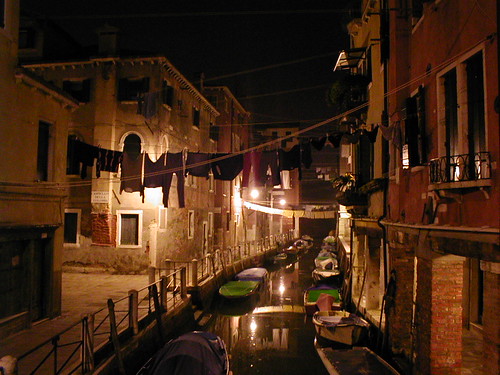
» That photo, Night in a venetian alley, was posted on Flickr by Damiel and is used under a Creative Commons by-nc-sa licence. It is loosely relevant to the novel but I mainly posted it because the blog seems a bit short of pictures at the moment.