Categories
Me Nature Other

Blogger Bio-blitz #2: Paleohora

blogger bioblitz

Paleohora is a little town on the south coast of the western end of Crete. It’s an expanding resort town with plenty of tavernas and cafes, but still small and quiet compared to the established resorts. Especially quiet in April, which is really before the tourist season starts in earnest. The town sits on a little headland with the ruins of (Venetian?) castle on the end. Immediately behind the town is the start of the mountains, all rocky scrubby stuff, and to one side there’s a little river valley with olive groves and trees and things, which goes down to form a little reed-lined pool. So there’s a range of habitats present and it’s well-placed to pick up migrant birds. This is a shot of the town looking back from the castle site; I haven’t got a picture of the castle because it’s just a few wall-bases and really not picturesque at all.
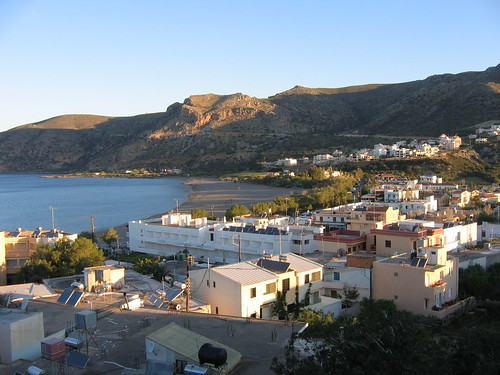
Paleohora

My best birds here were Common Quail—a species that is relatively common across Europe but very difficult to see—and, especially, European Roller, a great big blue thing I’ve wanted to see for years and is even a rarity for Crete. Oh, and a whole flock of eight Golden Orioles, spectacular yellow birds that are normally shy and reclusive, but which I had a good view of as the flew one by one across the olive groves. But I don’t have any bird pictures from here; I didn’t feel like carrying my telescope around. So here’s my bird list for April 22nd-25th with interspersed photos of the area just for local colour.

Squacco Heron
Purple Heron
Little Egret

Common Buzzard
Peregrine Falcon
Common Kestrel
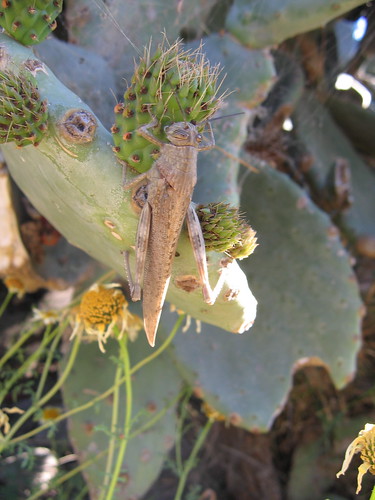
grasshopper on prickly pear
A big grasshopper/locust thing perched on a prickly pear. Prickly pear is an introduced species; from Mexico, I think? that’s fairly common in various places around the Med.

Common Quail

Common Sandpiper
Yellow-legged Gull

Collared Dove
Turtle Dove
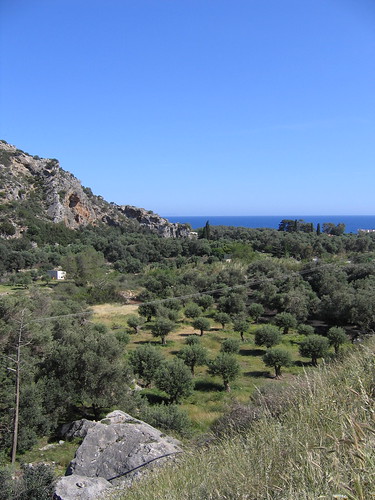
river valley
This is part of the river valley from up on the hill. You can see olive groves, obviously; the common tree tended to be some species of plane.

European Scops Owl (heard)

Common Swift

European Roller
European Bee-eater
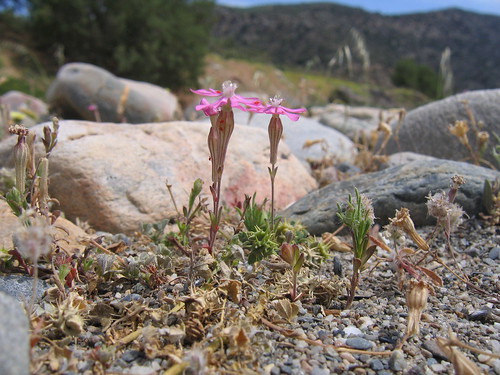
Silene
I’m pretty sure that’s some species of Silene, but I don’t know which one.

Crested Lark

Barn Swallow
Red-rumped Swallow
House Martin
Sand Martin

Tree Pipit
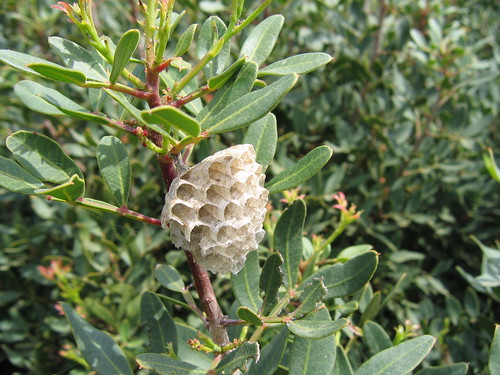
wasp nest
An empty wasp nest on what I think might be myrtle. Taken down on the beach.

Common Blackbird

Sardinian Warbler
Common Whitethroat
Blackcap
Garden Warbler
Wood Warbler
Cetti’s Warbler
Great Reed Warbler
Sedge Warbler
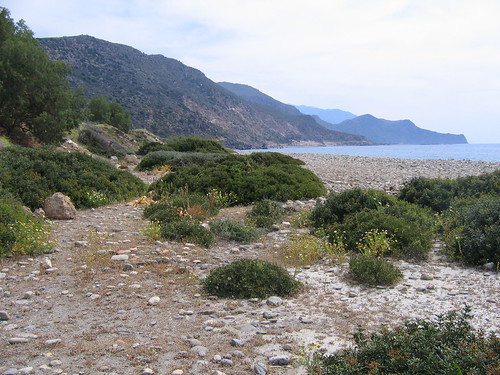
pebbly beach
A shot of the shingle beach. There’s a sandy beach on the other side of the headland, but it seemed less productive for birdwatching so I didn’t go there much.

Spotted Flycatcher
Whinchat
Common Redstart
Common Nightingale
Blue Rock-Thrush

Great Tit
Blue Tit

Woodchat Shrike

Hooded Crow

Golden Oriole
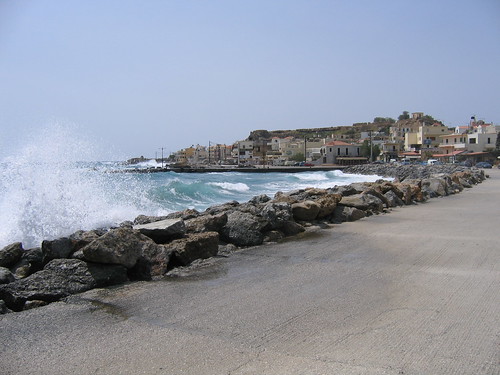
waves breaking on the rocks
Waves breaking on the rocks.

House Sparrow
Spanish Sparrow

European Goldfinch
European Greenfinch
Chaffinch
European Serin

That barn owl bio blitz button is derived from a photo on Flickr by Nick Lawes used under a by-nc-sa licence; the button is therefore available under the same licence. Not that there’s anything wrong with the Jennifer’s BBB buttons, but I wanted something to match my colour scheme.

Categories
Culture Me

Books books books

I’ve posted a few thoughts on the books I read in Crete (a couple of novels by Kazantzakis, some Marquez, Seferis, books on the Battle of Crete and resistance, Aristophanes), which can be found via my ‘What I’ve been reading’ page.

Categories
Daily Links

Links

Categories
Culture

The Autumn of the Patriarch by Gabriel Garcia Marquez

This is marvellous. I haven’t read any Marquez for a bit, and I’d forgotten just how good he is. It describes the decline and death of the dictator of an invented Caribbean country, with each chapter as one long, run-on sentence. It’s beautifully written, dark and absurd and I guess you would call it surreal, although if you’ve ever read much about the courts of real dictators, the incidents start seeming less far-fetched.

For example, at one point he discovers that all the modern buildings he’s seen from his presidential limo are just facades, put up to fool him into thinking that progress is being made. Well, when Mao was travelling through an area, people used to plant the rice paddies near the train tracks at super-high densities so it would look like his great plans for improving rice production were working. The rice duly died, of course.

The whole atmosphere of the court—paranoid, corrupt, hedonistic, violent, capricious, self-deceptive—and the relationship between the dictator and those trying to anticipate his wishes seems convincing to me. It would be a pity if the surreal touches led people to think the book is unrecognisably exaggerated from reality.

Categories
Culture

Crete by Antony Beevor

The story of the German invasion of Crete during WW2 and, to a lesser extent, the resistance thereafter.

This is really a book of cockups all round; the Germans had already taken the Greek mainland and planned a completely airborne invasion of Crete using paratroops and gliders which was, as it turned out, wildly ambitious, not least because a man floating down on a parachute is an easy target for someone on the ground. Moreover, thanks to Bletchley Park, the Allied commander had access to information derived directly from German radio traffic.

Nonetheless, thanks to bad planning (for example, the Allies had been in the island for many months, but they still didn’t have a robust communications network in place), lack of initiative, and most crucially, the Allied CO’s misunderstanding of the intelligence he was being given, the Germans managed to take Crete, although with enormous losses, and the Brits, Aussies and New Zealanders had to make a scrambled retreat across the island. Helped by the terrifying ferocity of the Cretans, who had several centuries of experience fighting guerrilla wars against the Ottoman Empire, and since becoming part of Greece in 1918, had kept in practice with hunting and blood-feuds.

And of course with the Allies gone, the Germans then had a brutal crack-down on the Cretans. After the invasion the British helped set up a resistance network on the island, and eventually as the tide of the war turned, Crete was won back.

The overriding thing I was left with from the book was Crete once again getting caught up in the violent arguments of big countries that really had nothing to do with them.

The book feels a bit British-centric, but other than that it seemed to give a good account of what happened, and Beevor writes well.

Categories
Culture

Freedom and Death by Nikos Kazantzakis

Based on this and Zorba, Kazantzakis was a bit like D.H. Lawrence: the first highly educated member of a working family, and suffering a crisis of masculinity as a result. But with Cretan shepherds instead of Nottinghamshire miners.

This book in particular, which is about a rebellion against the Turks, exhibits a glamorous, nostalgic view of the macho culture of Crete; manly men who sweat and fight and drink and feud and hold to the kind of code of honour that largely involves killing people at the smallest perceived slight. And who despise book-learning.

I don’t want to be unfair; the book is more nuanced than that account might suggest, and I don’t think Kazantzakis is whole-heartedly endorsing the palikari warrior culture he portrays. But considering the way his characters behave, he manages to seem a lot more admiring of them than I would be.

It’s also worth pointing out that the main Turkish character in the book is just as much of a palikari as any of the Greeks, so it’s not completely one-sided in that respect.

Anyway, leaving nationalism, gender politics and Kazantzakis’s internal class struggle aside for a minute, I enjoyed it. It’s a big dramatic novel full of striking characters and action, and if it edges into melodrama and stereotype, well, it’s that kind of book.