Categories
Culture

Impressionist and Modern Art at Christie’s

I went along to the viewing of a sale of Impressionist and modern art at Christie’s in London.

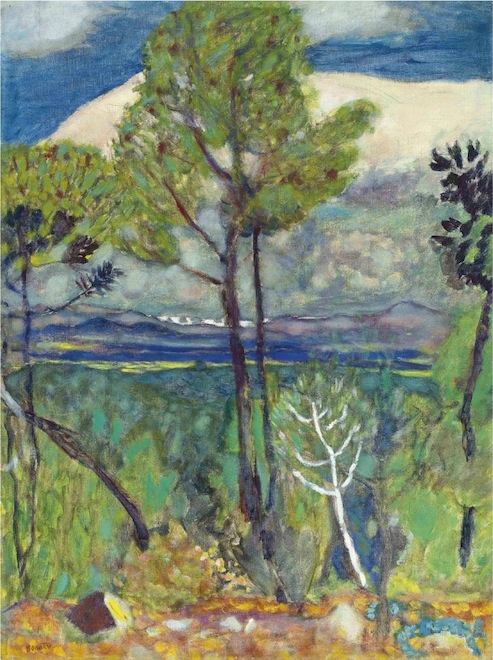
It’s always quite interesting going to see paintings at auction houses rather than the big public art galleries where I see most of my art. For a start, there’s the fact that everything has a price on it; of course they’re only estimates, but they give you a general sense of what’s hot and what isn’t.  The trends are somewhat predictable, of course; a large, stylistically distinctive painting by a Very Famous Artist goes for a lot more than a small, sketchy painting by a someone slightly less famous. The painting above,Les pins, bord de mer by Pierre Bonnard, is estimated at £150,000 – £250,000.* Which is quite a lot of money by most standards, but seems pretty modest compared to the £17,000,000 – £24,000,000 for some Monet waterlilies.

Actually, though, it’s not surprising that a large painting by Monet of his most iconic subjects is worth a fuck of a lot of money. If you’re a Russian oligarch and you put that on your wall, people are going to walk into the room and know you’ve spent shitloads of money on it.

In some ways it’s the lesser paintings which say more about the madness of art prices. Not even great artists produce masterpieces every time they pick up a brush, and there’s a plentiful supply of little sketchy paintings and ones which don’t quite work; paintings which look like they could have been done by any random weekend painter, but which go for hundreds of thousands of pounds.

A couple of other thoughts about the auction house experience. I quite like the fact that people feel free to talk, to have normal conversations at a fairly normal volume; and indeed to use their mobile phones. The sanctified hush of public art galleries, with everyone whispering to each other, can be a bit deadening.

And however artistically radical a painting may have been when it was new, seeing it surrounded by the sheen of money in an upmarket auctioneers really does strip away any last hint of anti-establishment.

* Update: it actually went for £337,250, fwiw.

Categories
Culture

The Maltese Baron… and I Lucian by Francis Ebejer

The Maltese Baron… and I Lucian is my book from Malta for the Read The World challenge. It’s a novel narrated by an old man called Lucian which begins with the return after decades of his childhood friend, the Baron. It is the story of their fractious relationship, and Lucian’s relationship with a woman called Katarina, cutting back and forth between the present and their youth.

It has quite a successful unreliable narrator thing going on — Lucian portrays himself as an upright, moral, dignified man in contrast to the Baron’s promiscuity and vulgarity, whereas we can see that he’s a pompous selfish prick, and that the Baron, despite a few flaws, is practically heroic in comparison.

Otherwise, though, it doesn’t have much going for it. The opening chapter has some prose which is so convoluted that it was practically incomprehensible, and I initially couldn’t tell whether this was supposed to be a way of characterising the narrator, some kind of advanced literary technique that I just wasn’t grokking, or just very badly written. In the end I decided it was a combination: Ebejer was trying to characterise Lucian as stuffy and self-important, but just wasn’t quite good enough to pull it off. The main narrative is more readable, most of the time, but it’s never any better than ordinary.

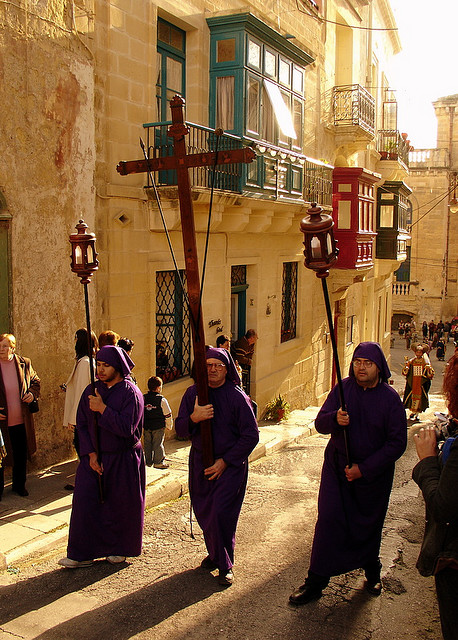
» Good Friday 2007 – Malta is © Antonio Caselli and used under a CC by-nc-sa licence.

Categories
Culture

The Devil That Danced on the Water by Aminatta Forna

Aminatta Forna’s father was a doctor, then activist and politician in Sierra Leone, rising to be Minister of Finance for a while before resigning in public protest at corruption in the government. But she was born in Scotland to a Scottish mother while her father was studying medicine there.

Unfortunately politics in Sierra Leone was a dangerous business. We learn at the very start of the book that, when she was ten, her father was arrested and she never saw him again, but exactly what happened to him emerges over the course of the book, so even though it is in fact a matter of historical record, I suppose the polite thing to do is to issue a MILD SPOILER ALERT before I go on to talk about it.
So, as I was saying, her father (along with fourteen other men) was arrested and charged on trumped-up charges of treason, inevitably found guilty, and hanged. They had supposedly been conspiring to blow up a government minister — an explosion at his house did take place but appears to have been staged for the purpose.

After that Forna moved to the UK permanently, but even before that she had moved frequently between Sierra Leone and the UK according to her father’s fluctuating political fortunes. That in itself would be an interesting subject for a memoir, of course, a mixed race girl with a childhood split between the UK and Africa in the 60s and 70s; but inevitably her father’s story dominates the book, and the second half is the story of her return to Sierra Leone decades later to learn as much as she can about the details of her father’s trial.

I’ve actually been putting off reading this book because it sounded a bit depressing. But once again it reinforces the basic truth: my enjoyment in books is much more dependent on the quality of the writing than the subject matter. I got pleasure from reading this book, despite everything, because it is very well written. The childhood stuff particularly; she’s good at capturing the limited understanding of a small child caught up in a complicated, adult situation.

I thought the second part, her return to Sierra Leone as an adult to investigate her father’s trial, was less interesting. Just because it’s incredibly predictable, really. It was a political show trial organised by a dictator, and it followed the familiar pattern: forced confessions, a jury stuffed with political partisans, a cowed judiciary, ‘witnesses’ motivated by self-interest or fear, the accused denied access to a lawyer. Of course I can understand why Forna felt driven to find answers, but whereas her account of her childhood is full of individual, unique details, the second part just feels weirdly like you’ve read it before. Still interesting, still worth reading, but not as engaging as the first part.

Anyway, here’s a  little extract, from a period when her father is in prison and she is living in London with her stepmother and her siblings.

I used to walk down a road, any road, and say to myself: If I can just hold my breath until I get to the end of this street Daddy will be released from prison. Or, if I was crossing a bridge and a train went underneath, I wished my father would be freed. Sometimes I’d stand there until train after train had gone by, eyes closed, amassing wishes. Three times over three years, as I cut the first slice of cake, I used my special birthday wish so I could have him back. I wished on the full moon and the new moon, and then any moon at all. At Christmas, if I found the silver sixpence Mum hid in the pudding, I wished for my father’s freedom. I wished for nothing else.

As time went on I increased my challenges: to reach the end of the road with my eyes closed without bumping into anyone or anything; to leap every other paving stone, dancing between them, promising myself that if I could make it ten yards, or twelve, or fifteen, I would somehow, miraculously earn his freedom. gradually I upped the ante: I’d work my bike up to speed then aim the front wheel at a pothole or a speed bump. If I don’t fall off, if I can stay in the saddle, then they’ll let him out of prison. Alone in the flat one afternoon I stood in the galley kitchen passing my hand as slowly as I dared across the ice-blue flame of the gas ring, once, twice, thrice, until the smell, like burnt bacon rinds, rose from the scorched ends of my fingernails.

[…]

There’s a good reason exile was once used as a punishment. It is life apart, life on hold, life in waiting. You may begin full of strength and hope, or just ignorance, but it is time, nothing more than the unending passage of time that wears down your resilience, like the drip of a tap that carves a groove in the granite below. Exile is a war of attrition on the soul, it’s a slow punishment, and it works.

The Devil That Danced on the Water is my book from Sierra Leone for the Read The World challenge. Incidentally, although this book is clearly about the politics of a particular country, the name of that country doesn’t appear on the cover once: there are four references to ‘Africa’ and none to Sierra Leone. I know that we have an unfortunate tendency to lump all of sub-Saharan Africa into one entity, but you might hope that the publisher would make some sort of effort even if no-one else does.
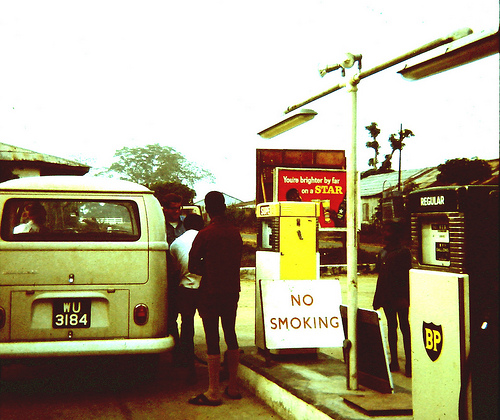
» BP Gas Station in West Africa, 1967 and Lansana Kamara (centre) at his store/pub in Kabala, Sierra Leone (West Africa), 1968 are both © John Atherton and used under a CC by-sa licence.

Categories
Culture

Flat Earth News by Nick Davies

This book apparently started as an attempt to get to the bottom of a particular news story which went around the world but turned out to be, broadly speaking, a load of cobblers: the Millennium Bug. Davies wanted to trace the process by which a story could start with such limited foundations and keep going round the world, gaining in momentum, and result in governments spending a fortune on what turned out to be a non-problem — as proved by countries like Italy, who didn’t bother to do anything about it and were just fine.

But the book ended up being a much broader condemnation of the news media’s systemic failure to do its their job properly: assuming you think its job is to tell us the truth about what is happening in the world.

Interestingly, the most common accusation — political bias in the interest of newspaper proprietors — actually comes fairly low on his list of worries. The Millennium Bug story is a good example from that point of view; it would take an exceptionally conspiratorial mindset to claim that it was whipped up because Rupert Murdoch had some kind of financial interest in it.

He suggests instead that the biggest single problem is more prosaic and more fundamental: that news organisations are understaffed. The logic of commercial efficiency has led to newspapers employing less people to produce the same amount of content: not just reducing the total number, but shedding particular categories like regional reporters and court reporters. Meanwhile the same process has happened at the local newspapers and wire services that were another source of stories to the national press. And something has to give. Forget real investigative journalism: simple fact-checking becomes a luxury.

And of course journalists don’t need to be malevolent or deceitful to produce bad journalism. They don’t need to actively choose to tell untruths; simply not caring whether something is true is bad enough.

So if the newspapers aren’t employing enough people to gather news properly, how do they find enough stuff to fill their pages? Well, the first source is wire services (the Press Association, AP, Reuters etc). At least those are real journalists, although they are overstretched themselves and only claim to offer accurate quotes rather than true fact-checking. But all the news outlets are getting their stories from the same wire services, so it doesn’t exactly produce variety. The whole system becomes one big echo-chamber.

And the other huge source of content is PR. A huge percentage of so-called ‘news’ is directly reproduced from someone’s press release. Isn’t that reassuring.

The book also gets into the world of government propaganda, including the truly staggering scale of CIA spending on media and propaganda during the Cold War (did you know the the CIA owned loads of foreign newspapers? I mean, seriously, what the fuck?) and the suggestion that the War on Terror has given them an opportunity to ramp up their activity again. It looks into the ‘Dark Arts’; i.e. illegal news-gathering activities by British newspapers, including but not limited to the phone-hacking which has been in the news lately. And there are some case studies of bad practice: the decline of the Sunday Times Insight team (key quote: ‘there are some journalists who would rather inhale vomit than work for Andrew Neil’), the failure of the Observer in the build up to the Iraq War (inexperienced editors seduced by their cosy relationship with Number 10 end up just parroting the government line), and the Daily Mail (for being the Daily Mail, basically, except that the racism of the paper is even more overt than I appreciated).

Anyway, it’s thought-provoking, interesting stuff. I’ve no idea how fair it is, but it all has the dismal ring of truth to me.

Categories
Culture

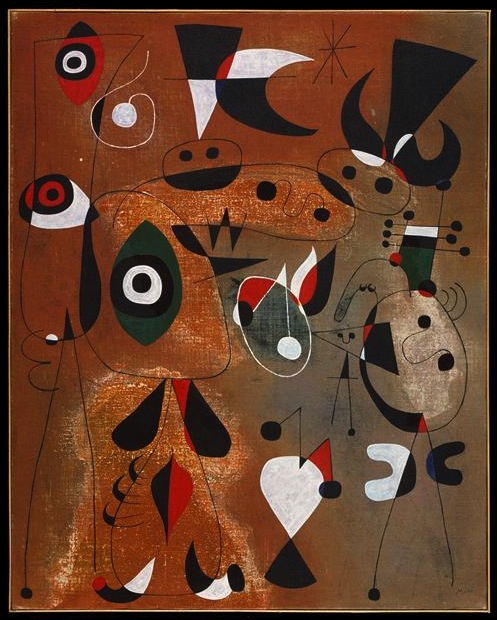
Miró at Tate Modern

Without knowing a lot about Joan Miró, I’ve always liked his work when I’ve seen it. It’s interesting the way that the work of one artist will speak to you and another won’t… so I’ve aways liked Miró, never liked Chagall.

Or at least I say the work ‘speaks to you’ but that’s not the right metaphor; I don’t think it’s because the paintings are making some sort of intellectual or emotional connection. Or at least I don’t think that’s primarily what it is; it’s more to do with a basic visual aesthetic. I tend to like controlled, precise, carefully composed paintings with strong clear colours: so I like Vermeer, but find it hard to like Rubens. It’s suppose it’s a graphic design sensibility, really.

Articulating it like that does make me feel a bit shallow; taking great painters and sorting them into sheep and goats according to the most superficial and basic elements of their visual style, well, it doesn’t exactly make me a sophisticated judge. But there you go. It’s not the only factor which decides which work I like, but it certainly makes a difference.

So I was predisposed to like this exhibition. Which I did. I thought it was fabulous. Mainly because I liked all paintings, of course; but also because I didn’t know much about Miró, so it was interesting to see the chronological development of work. There was also quite a lot of biographical context, much of it related to Spanish politics — Miró’s Catalan identity, the Spanish civil war, WWII and so on. So that was all quite interesting.

But mainly I just love the paintings. I want to own all of them and have them on my walls.

» Women, Birds, and a Star, 1949. Which is in the Met, although I got the image from RMN.

Categories
Culture

Ragamuffin by Tobias S. Buckell

Ragamuffin is my book from Grenada for the Read The World challenge. It’s a science fiction novel about a universe where humans share space with various other species and can travel from world to world via wormholes. Some of them come from a world which was settled by people from the Caribbean, hence the title and a certain amount of West Indian-inflected dialogue.

It was quite entertaining, I guess; I’m not really much of an SF fan. I read a lot at one stage because my brother used to read them, but since we don’t live in the same house anymore, I’ve largely stopped. I think the most interesting thing about SF is when it’s used to explore ideas: so for example, Iain M Banks’s Culture novels are in a sense a contribution to the Utopian tradition, and among other things, they raise the question of what human society would be like in a situation with limitless material wealth.

Ragamuffin is not really a novel of ideas in that way; it’s inventive enough, but it’s inventive within the standard tropes of science fiction. In a way this kind of space opera is really futuristic fantasy; swords and sorcery, with bionic implants taking the place of magical powers. I always thought it was interesting, incidentally, that two of the most popular works of C20th narrative, Lord of the Rings and Star Wars, have such a medieval shape to them. But maybe that’s too much of a detour for this post.

Anyway, sub-genres of SF aside, what really makes the difference between good novels and bad ones is not the genre, it’s always the quality of the writing. Which in this book was perfectly reasonable but nothing remarkable. Even though it’s not the kind of book I usually read, I picked it up thinking it might be a bit of treat to read some escapist fiction. But it never really grabbed me.

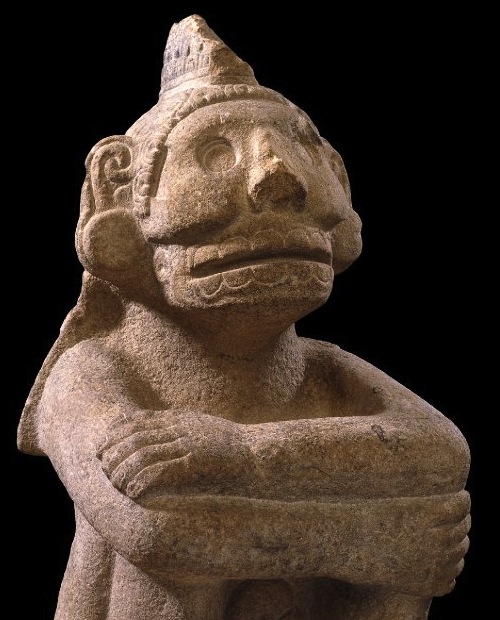
» The Aztec figurine of Mictlantecuhtli is from the British Museum. As well as the Caribbean theme in the novel, there’s an Aztec-inspired culture, weirdly enough.