Categories
Culture

Don’t Let’s Go to the Dogs Tonight by Alexandra Fuller

Don’t Let’s Go to the Dogs Tonight is an autobiography about growing up in Rhodesia/Zimbabwe. It’s about growing up in a war — Fuller was only eleven at the time of independence — and about the last throes of white colonialism and a dying way of life.

Her parents had been living in Kenya, but after Mau Mau they moved to Rhodesia, where Ian Douglas Smith had declared that there would never be majority rule, and fought to keep at least one part of Africa under white rule. Then after Rhodesia became Zimbabwe, and their farm was taken by the new government, they moved first to Malawi and then to Zambia. It reminded me of travelling in Zimbabwe nearly twenty years ago, and meeting these white people from South Africa and Zimbabwe and Zambia who seemed to have a shared identity as white Africans that had no real connection with national borders. It’s not just whites in Africa who often have an ethnic identity which doesn’t fully coincide with their nationality, of course.
You don’t have to have any sympathy with the ideal of white rule in Africa to find something melancholy in a story of people being left stranded by the tide of history, their way of life disappearing around them, and this is rather a sad book; as well as the war and the politics, the family suffer more personal losses, with several children dying young and the mother turning more and more to alcohol. But there’s a lot of humour and colour along with the gloom.

She writes well. She has a good ear for dialogue, an eye for the absurd, and her portrayal of her parents’ attitudes to race (and indeed her own childhood attitudes) is unsparing but nuanced. She doesn’t whitewash anything but she’s not interested in demonising her family either.

Here’s a little fairly randomly chosen extract:

We stop at the SPCA in Umtali and collect a host of huge dogs, and then we collect dogs abandoned by civil-war fleeing farmers. These dogs are found tied to trees or staring hopefully down flat driveways, waiting for their nonreturning owners. their owners have gone in the middle of the night to South Africa, Australia, Canada, England. We call it the chicken run. Or we say they gapped it. But they gapped it without their pets.

One day Dad says to Mum, ‘Either I go, or some of those bloody dogs have to go.’
‘But they don’t have anywhere to go.’

Dad is in a rage. He aims a kick at a cluster of dogs, who cheerfully return his gesture with jump-up licking let’s-playfulness.

Mum says, ‘See? How sweet.’
‘I mean it, Nicola.’

So the dogs stay with us until untimely death does them part.

The life expectancy of a dog  on our farm is not great. The dogs are killed by baboons, wild pigs, snakes, wire snares and each other. A few eat the poison blocks left out in the barns for rats. Or they eat cow shit on which dip for killing ticks has splattered and they dissolve in frothy-mouthed fits. They get tick fever and their hearts fail from the heat. More dogs come to take the place of those whose graves are wept-upon humps in the fields below the house.

We buy a 1967 mineproofed Land Rover, complete with siren, and call her Lucy. Lucy, for Luck.

‘Why do we have the bee-ba?’
‘To scare terrorists.’

But Mum and Dad don’t use the siren except to announce their arrival at parties.

I read Don’t Let’s Go to the Dogs Tonight as my book from Zimbabwe for the Read the World challenge. As it turns out, although Alexandra Fuller’s parents spent pretty much their whole lives in Africa and she was conceived in Rhodesia, she was born during about the only two year period when they were living in England… but I’m going to count it anyway.

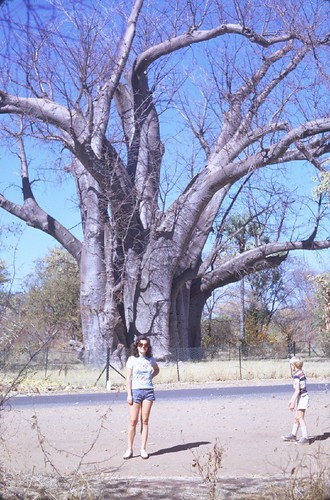
» The photo, ‘Ritsa and Baobab Tree, Rhodesia, 1973‘, has no direct connection to the book, except that it’s a picture I found on Flickr taken in the 70s in Rhodesia. It is © Robert Wallace and used under a CC by-nc-nd licence.
Categories
Culture

Persepolis by Marjane Satrapi

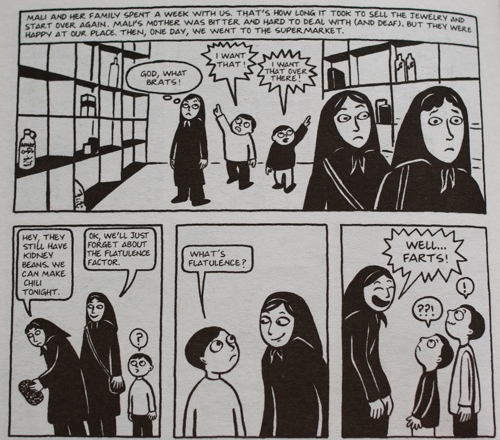
Persepolis is an autobiographical graphic novel* about growing up in Iran. I think it might be the first graphic novel I’ve read — certainly the first critically acclaimed one. So I’ve sort of been wondering what it does or doesn’t gain from being drawn as well as written… and haven’t really reached a conclusion.

So first things first: it certainly does work. It’s a vivid portrayal of day-to-day experience, initially under the Shah but mainly after the Islamic revolution, and including a period of living away from her family in Europe. Politics and religion are inescapable and a constant presence, but it is full of the intimate details of everyday life: the music, the clothes, family, flirtation, and all the little ways that they try to accommodate or avoid the regime. The narrative is unsurprisingly full of tragic events, but it is also funny and honest.

satrapi

But what the format brings to it; well, this book has a kind of directness. The pictures are very simple, cartoonish rather than any attempt at visual realism, and the quantity of text is relatively limited compared to what you would have in a prose memoir. So the overall effect is a very direct, stripped-down quality. I guess you might call it a naive style. Of course, that’s a quality of this book in particular rather than due to the graphic format.

Anyway, well worth reading.

* i.e. it’s an autobiography in comic strip form. I suppose by the logic of the terminology, that makes it a graphic autobiography. But that sounds confusing as well. *shrug*

Categories
Culture

Why I tend to believe that #amazonfail was a cock-up rather than anything more sinister

Well, firstly because the explanation as laid out here and here seems fairly plausible to me.

But mainly because I just don’t think that Amazon are that stupid. They sell an enormous amount of material which is liable to offend *somebody*: they sell books about being a gay parent and books about curing homosexuality through God. They sell books by young-earth creationists and books by angry atheists. They sell box sets of hardcore porn DVDs. They sell books by holocaust deniers.

The last thing they want is to be seen as endorsing any of those things. It is completely in their interest to be perceived as a non-judgemental buyer and seller of goods; the people who will sell anything, as long as its legal. The moment they are seen as exercising some kind of editorial control on the basis of a moral or political agenda, they lay themselves open to having to defend every product they sell.

They cannot be seen to be taking sides. And I think they know that.

Categories
Culture

The Ross/Brand incident and its aftermath

Yeah, I know, not exactly topical. But David Mitchell wrote a good article about it in the Guardian today and it seemed like a suitable moment to add my halfpennyworth.

It seems to me that the phone calls to Andrew Sachs were a special case. It bothered a lot of people who are not easily offended. I know that the outrage was orchestrated by the Daily Mail, but even so, I don’t think they would have been able to generate so many complaints if it hadn’t touched a nerve with a lot of people.

Leaving a message on someone’s answering machine making a joke about having slept with their granddaughter is just a dick thing to do. It would be a mean-spirited and distasteful thing to do even if you didn’t broadcast the message on national radio. It is in a sense as much bad manners as it is bad taste. And it was aimed directly at an individual who had done nothing to provoke or deserve it. If someone did it who wasn’t on the radio, just because they thought it was funny, it would be understood as harassment.

As you can tell, I think Jonathan Ross and Russell Brand crossed a line. I didn’t complain myself, but I can understand why people did, and an apology and some kind of disciplinary action was appropriate.

But that doesn’t mean that I support some kind of generalised campaign against bad taste at the BBC. An example: in the weeks after this happened, in the general climate of BBC self-flagellation, Frank Skinner made a little current affairs programme investigating the issue of bad language on television and particularly in comedy. To me, that’s a completely separate issue. I don’t care about bad language; sure, keep it off Blue Peter, but in an appropriate slot in the schedules I just don’t care. There is literally no amount of swearing you could fit into half an hour of television that I would find offensive. I might find it boring and unnecessary, but I am not going to be offended by it.

Or take the incontinent old women in Little Britain:

Now people might or might not find that kind of thing funny. They might well find it distasteful, in which case they can choose not watch it. They might even feel that there’s a serious social issue about the portrayal of the elderly, or the issue of incontinence, and that the show is actively harmful for that reason. But even if you find it offensive, it’s something which is performed by actors, which you have chosen to watch and which you can turn off. It is not the same as the BBC ringing your house and personally offending you, which is what they did to Andrew Sachs and the reason why so many people were angry.

It would be a tragedy for British popular culture if the BBC only ever made programmes which were completely inoffensive. The message I would want the BBC to take away from Sachsgate is not ‘don’t produce any material that might possibly offend people’. It’s ‘don’t call up individual members of the public and go out of your way to offend them personally’. Its the difference between a stand-up who makes fun of religion in a comedy club, and one who marches into a church on a Sunday morning and delivers the same material to the congregation halfway through the service.

Categories
Culture

Facebook literary geek meme.

I was tagged for this meme on WordPress by Sarah Jane. And while I will also post this as a note to Facebook, I thought I might as well post it here as well.

“You have received this note because someone thinks you are a literary geek. Copy the questions into your own note, answer the questions, and tag any friends who would appreciate the quiz, including the person who sent you this.”

Questions and answers after the jump.

Categories
Culture

Annie John by Jamaica Kincaid

After really struggling with that Ugandan novel recently, I picked up Annie John to read next because it is admirably short: 148 pages. Just about enough to feel like a short novel rather than a long story, but I was still able to read it one sitting.

lizard

It is the story of Annie John, a girl growing up in Antigua, told in the first person. Not surprisingly, perhaps, given the length, it is one of those books where not very much happens. There are a few incidents—an illness, some friendships—but nothing very remarkable. The focus is on Annie’s relationship with her mother, which starts out very close but becomes increasingly conflicted in adolescence, and ends in a somewhat open-ended way with her leaving home. Which obviously ends that chapter of her life but doesn’t provide any particularly tidy resolution.

Hedgie provides a fuller account of the book over at his place, so I’ll leave it at that and just say that I thoroughly enjoyed it, and quote a bit:

During my holidays from school, I was allowed to stay in bed long after my father had gone to work. He left our house every weekday at the stroke of seven by the Anglican church bell. I would lie in bed awake, and I could hear all the sounds my parents made as they prepared for the day ahead. As my mother made my father his breakfast, my father would shave, using his shaving brush that had an ivory handle and a razor that matched; then he would step outside to the little shed he had built for us as a bathroom, to quickly bathe in water that he had instructed my mother to leave outside overnight in the dew. That way, the water would be very cold, and he believed that cold water strengthened his back. If I had been a boy, I would have gotten the same treatment, but since I was a girl, and on top of that went to a school only with other girls, my mother would always add some hot water to my bathwater to take off the chill. On Sunday afternoons, while I was in Sunday school, my father took a hot bath; the tub was half filled with plain water, and then my mother would add a large cauldronful of water in which she had just boiled some bark and leaves from a bay-leaf tree. The bark and leaves were there for no reason other than that he liked the smell. He would spend hours lying in this bath, studying his pool coupons or drawing examples of pieces of furniture he planned to make. When i came home from Sunday  school, we would sit down to our Sunday dinner.

Annie John is my book from Antigua and Barbuda for the Read The World challenge, and my third book for the Caribbean Reading Challenge.

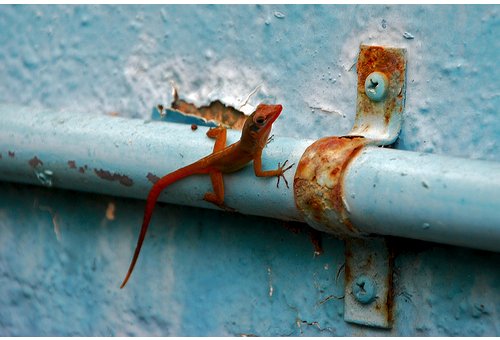
» The picture was taken on Antigua but has no other particular connection to the book. Nice though, I thought. I found it on Flickr; it is © Jeremy Quinn and used under a CC by-nc-sa licence.