Categories
Culture

How Life Imitates Chess by Garry Kasparov

I wouldn’t normally rush to read a chess-themed self-help book, which is more or less what How Life Imitates Chess is. But, you know, it’s Garry Kasparov! The Beast of Baku!

Kasparov seems to have impressed himself on my imagination surprisingly powerfully, considering I’m not much of a chess player. Although I’ve never taken chess seriously, there was a time when I played quite a lot. At school there were a limited number of places to go at lunchtime when the weather was bad; I used to go to the chess room. Even at the peak of my chess-playing powers, I was pretty rubbish, but there wasn’t a great depth of talent at the school, so when they were short of people I would be drafted in to play board eight for the chess team. As far as I can recall, the chess team didn’t win single match in my time at the school, so it wasn’t much of an achievement.
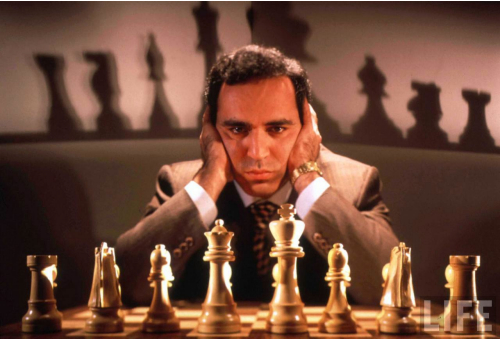
kasparov

At that time Kasparov was the towering figure in chess, and however casual my own chess was, it was hard not to be aware of him. He was the last of the great Soviet chess champions, with all the Cold War mystique that came with that, and he looked the part with the incredible intensity of his gaze and his heavy eyebrows. On top of that there were the matches against a sequence of IBM supercomputers which seemed like such a symbolic moment in the dawning computer age.

And there was the world championship match against the English player Nigel Short, at least some which was broadcast live on Channel 4, hosted by Carol Vorderman of all people. Sadly none of it seems to have made it to YouTube, because I’d be fascinated to see what it looked like. I remember they had a phone vote for the public to suggest the next move, at which point a couple of Grandmasters would explain why the public was an idiot.

So when I was looking for books from the former Soviet republics for the Read The World challenge, it occurred to me that Kasparov might have written an autobiography which I could read as my book for Azerbaijan. Instead I found How Life Imitates Chess, which uses examples from Kasparov’s chess career as well as business and history to illustrate points about, for example, the value of preparation, and analysing your own weaknesses.

As long as he’s talking about chess, I found it really interesting. The psychology of chess, the different approaches different players take, the preparation that goes into a big match at the top level; when he’s talking about chess, he’s engaging and insightful. The self-help aspect I found less convincing.

Partially I suspect that’s because, despite the long history of chess metaphors, chess isn’t actually a very good model for many other human activities. It’s a completely zero-sum game; for one player to win, the other has to lose. Each chess game starts in exactly the same way, with both players having exactly equal resources and position save only the advantage of playing white. There is no unknown information and no element of chance. It is exceptionally well-suited to rigorous analysis, with information about past performances available with an accuracy that makes baseball statistics look vague and wishy-washy.

These qualities are what make it such a fascinating game, but they are also ways in which it is quite unlike, say, running a business. And businessmen are pretty clearly the intended market; it’s aimed at MBA types who want a change from Sun Tzu. That’s made explicit by the subtitle of the US edition (How Life Imitates Chess: Making the Right Moves, from the Board to the Boardroom) but not, interestingly enough, the UK edition (How Life Imitates Chess: Insights into life as a game of strategy).

I also think his heart isn’t really in it. His examples from business and history are very obvious ones and he doesn’t make much attempt to develop them in any detail; his conclusions are plausible enough but often a bit superficial. I don’t think this book was born out of a deep desire to teach people ‘lessons about mastering the strategic and emotional skills to navigate life’s toughest challenges and maximise success no matter how tough the competition’, as the blurb puts it. It was written to make money from Kasparov’s reputation. I gather from the book that he has been working the circuit giving talks to businessmen and the book was presumably born out of that. It feels like it is fundamentally a sideline for him compared to his real passions of writing about chess and campaigning in Russian politics.

But, still, I thought it was well worth reading for the chess bits, which he manages to make interesting and informative while requiring no real chess knowledge in the reader. I would have preferred a straight autobiography, but I still enjoyed the book. I was irritated to realise after I bought it that it was ‘written with Mig Greengard’, because it makes it unclear how much of what you’re getting is Kasparov and how much is the ghostwriter, but I will still be counting it as my book from Azerbaijan for the Read The World challenge.

» The photo is from Life magazine, as hosted by Google.
Categories
Culture

Abyssinian Chronicles by Moses Isegawa

I’ve just finished Abyssinian Chronicles by Moses Isegawa. Which is a bit of a relief, because I found it quite hard work. The good stuff first: it’s a story that traces a couple of generations through the history of modern Uganda, with the arrival of Idi Amin and the collapse of his regime, the sequence of messy guerilla wars, the rise of AIDS and so on. The central character is initially brought up in a village before moving to Kampala, is from a Catholic background and is educated in a rather brutal seminary; his grandmother is a midwife; he ends up leaving Uganda to move to Holland. So there’s lots of good material. And lots of striking incidents and some strong (though not generally very likeable) characters.

Despite which, after reading a hundred pages, I checked to see how long the book was and had a sinking feeling when I saw there were still 400 pages to go.

The problem is the prose style. Quite apart from a tendency to cliché, it seems like Isegawa reacts to similes the way a small child reacts to candy. Everything is like something. These similes are sometimes quite good in themselves — he describes a priest at the seminary as having ‘an ego as large as a cirrhotic liver’ — but I found the overall effect distracting. And it’s part of a generally over-written, shouty kind of tone the book has which I just didn’t get on with; sometimes I’d get into it and be quite absorbed for twenty or thirty pages, and then some turn of phrase would snap me out of it again.

I did wonder whether it was a problem with the translation; but as far as I can tell from the title page, the book was written in English. I guess English must be the author’s second language, which is pretty impressive, but doesn’t alter the fact that I didn’t enjoy his prose.

Here’s an example of the kind of paragraph that would annoy me:

It struck him like a bolt of lightning splitting a tree down middle: Nakibuka! Had the woman not done her best to interest him in her life? Didn’t he, in his heart of hearts, desire her? Had he ever forgotten her sunny disposition, her sense of humor, the confident way she luxuriated in her femininity? The shaky roots of traditional decorum halted him with the warning that it was improper to desire his wife’s relative, but the mushroom of his pent-up desire had found a weak spot in the layers of hypocritical decency and pushed into the turbulent air of truth, risk, personal satisfaction, revenge. His throttled desire and his curbed sex drive could find a second wind, a resurrection or even eternal life in the bosom of the woman who, with her touch, had accessed his past, saved it and redeemed his virility on his wedding night. Sweat cascaded down his back, his heart palpitated and fire built up in his loins.

200 pages of this stuff would have been harmless enough, and I might have said that, despite a few flaws, it was still well worth reading; 500 pages was too much.

But I stuck it out to the end. Partially from stubbornness but mainly because I bought Abyssinian Chronicles as my book from Uganda for the Read The World challenge.

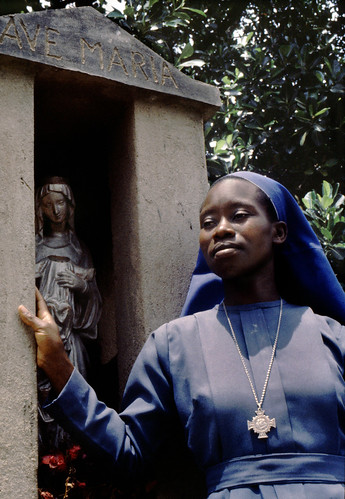
» The photo, ‘Headless‘, is © Dave Blumenkrantz and used under a CC by-nc-nd licence.

Categories
Culture

‘Sickert in Venice’ at DPG

Last time I saw much of Walter Sickert was at the Tate’s exhibition of the Camden Town Group which I briefly commented on here. I didn’t enjoy that show much: lots of dingy grey-brown cityscapes and interiors which, whatever their other qualities, were not exactly full of joy. Still, Venice, city of Canaletto, all Mediterranean light and sparkling water: surely that will be a bit more jolly?

Umm… no. It’s hard to believe, but Sickert’s paintings of Venice are even darker and dingier than his paintings of Camden. He did a bunch of very Whistler-influenced evening and night paintings; but where Whistler managed to make his paintings of the Thames shimmering and luminous, Sickert just makes Venice look dark. His paintings are like walking around a city at night with sunglasses on.

He also did some interiors featuring sickly-looking prostitutes that are rather like the pictures of sickly-looking prostitutes he did in Camden. Only in slightly different clothes.

Interestingly, in the shop they had some postcards and prints of the works in the exhibition that made them look glowing and vibrant, like La Giuseppina against a Map of Venice above, which I’ve taken from the Tate website for a previous exhibition but which is currently in Dulwich. Looks great, doesn’t it? Well, I don’t care what they look like in carefully tweaked reproduction; in the flesh they look gloomy and frankly a bit rubbish.

Categories
Culture

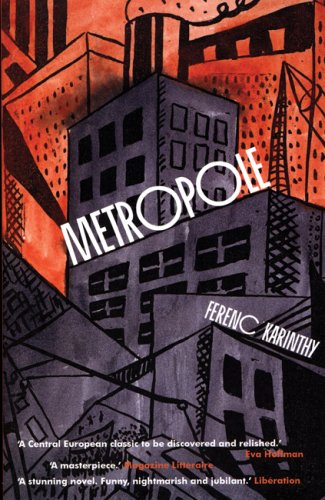
Metropole by Ferenc Karinthy

Metropole, by Ferenc Karinthy, was published in Hungarian in 1970.* This translation, by George Szirtes, was published last year. The blurb on the back from G.O. Châteaureynaud says

With time, Metropole will find its due place in the twentieth-century library, on the same shelf as The Trial and 1984.

which gives you an idea of the general literary area we’re in. It’s the story of Budai, a linguist who gets on the wrong plane and finds himself in a strange city. He gradually realises he is trapped there, not because some person or organisation is holding him against his will, but because despite speaking most major European languages, he cannot make himself understood or decipher any of the language around him.

Which is a nightmarish situation and the book did in fact give me nightmares. Well, not really; I couldn’t sleep properly because of my hay-fever†, and I was drifting in and out of sleep having peculiar Metropole-related dreams about being unable to read a piece of text. Can’t remember what it was.

The scenario — a man trapped in a mysterious world he doesn’t understand — makes Kafka the obvious comparison, but I’d be reluctant to reach too quickly for the word ‘Kafkaesque’ because that to me implies a certain very specific tone and atmosphere. It’s a long time since I read Kafka, but I remember it being much more relentlessly surreal. Metropole is played comparatively straight: it’s set in a very peculiar world but it has an internal consistency to it, and the story is told in a straightforward way.

In that sense I can see the comparison with Orwell, and the sprawling, grey, joyless city is certainly somewhat like the London of 1984, but otherwise I don’t think it quite works. The world of 1984 has to be a real place. A fictional real place, but still real; it’s a vision of the future. It’s not at all clear that the world of Metropole is real in the same way. It’s more like Budai has accidentally wandered into the wrong novel; nothing makes sense to him because him even being there means that something is fundamentally broken.

The other analogy that occurred to me is that it’s like a story from one of those Oliver Sacks books: someone is in a car accident or has a stroke, and they wake up completely unable to process language. The rest of their brain seems to be working fine, but somehow the ability to understand language has gone missing and all they hear is gibberish.

I have to admit that the book didn’t completely grab me, but I suspect that’s more to do with me being in the wrong mood than a problem with the book itself. I can see that it’s inventive and atmospheric and darkly funny, and if I didn’t get completely absorbed by it, well, perhaps I read too much of it while feeling like my head had been stuck in a bucket full of hairy caterpillars.

* OK, one procedural point here: when reading a book in translation, I don’t think it should be difficult to find out when the book was first published in its original language. It should be somewhere on the title page. I shouldn’t need to look up the author on Wikipedia. I suppose it could be strategy: perhaps the people at Telegram Books think I’m less likely to read it if I realise that it is *gasp* 40 years old. Probably not. But it’s annoying either way. The potential confusion is increased by the fact that the only copyright dates listed on the title page prior to the English translation are 1999 and 2005 in France. I would guess there’s some kind of added complication arising from the fact that it was originally published in communist Hungary? I dunno.

† I mean seriously, my eyes were really sore and I couldn’t breathe properly. Thankfully the worst of my hay-fever seems to fairly short-lived; there’s about a week or two when it’s rough enough that it can be quite distressing, then it calms down a bit. I don’t know whether it’s because there’s less of the relevant kind of pollen or because my immune system stops panicking as much.

Categories
Culture

‘Rodchenko & Popova’ at Tate Modern

I went to ‘Rodchenko & Popova: Defining Constructivism’ at Tate Modern today. I’ve seen quite a few exhibitions in the past few years that feature Aleksandr Rodchenko*, so I wasn’t really sure how much I would get out of it, but in the event I enjoyed it. Firstly I didn’t know anything about Liubov Popova, and also they had a couple of rooms of paintings, which I certainly hadn’t seen many of before.

I think they were much better designers than painters, mind you — the paintings look like rather generic examples of early geometrical abstracts, to me — but it was still interesting to see them. And the graphic design work they had on display seemed to be a different selection from what I’d seen previously. So that was all good.

The Tate’s exhibition website doesn’t have much stuff on it — I’ve used most of the pictures in this post — but curiously enough, when I was looking for pictures, Google threw up the Tate’s Immunity from Seizure page which, currently as least, is full of (rather tiny) pictures of work from the exhibition. If you’re curious:

Part 6 of the Tribunals, Courts and Enforcement Act 2007 provides immunity from seizure for cultural objects which are loaned from overseas to temporary public exhibitions in approved museums or galleries in the UK where conditions are met when the object enters the UK.

Or you could check out this page of Rodchenko stuff from Howard Schickler Fine Art in New York, or this from MoMA.

Incidentally, I was interested to note that they’ve started using touchscreen iPods for their multimedia guides. Last time I got an multimedia guide at the Tate, it was on a Windows Mobile-fuelled piece of crap of some kind and it annoyed me so much that I complained about it at some length afterwards. I didn’t try the guide today, so I can’t offer a comparison, but it seems like a move in the right direction.

* There was an exhibition of his photography at the Hayward; at one stage the Tate had a room displaying his photomontages for USSR in Construction; he also featured in the V&A’s Modernism exhibition and the British Library’s exhibition of printed material from the European Avant-Garde.

» both pictures from the Tate website; the top one is Liubov Popova’s Painterly Architectonic, 1918, and the bottom is Aleksandr Rodchenko’s design for an advertisement for the Mossel’ prom (Moscow agricultural industry) cafeteria, 1923.

Categories
Culture

The Year of the Hare by Arto Paasilinna

The Year of the Hare by Arto Paasilinna is my book from Finland for the Read The World challenge. It makes something of a change: it’s short (130 pages!) and rather light. Most of the books I’ve read for this exercise have been rather serious novels about post-colonialism, dictatorship, the collapse of traditional cultures, civil war, the refugee experience and so on. Mainly no doubt because that was the C20th experience for so much of the world’s population, but also perhaps because of a translation bias: it’s the Serious Books which are most likely to find their way into English editions.

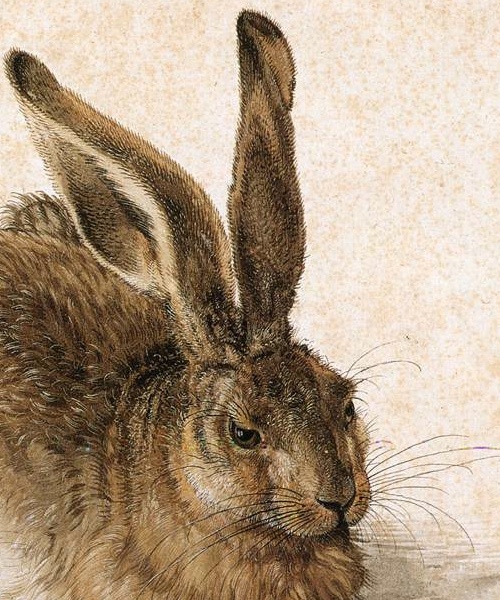
durer_young_hare3

So, although I have a reasonably high tolerance for that kind of thing, it’s still a nice change to read something which is, at least superficially, lighter. The Year of the Hare is the story of Vatanen, a journalist whose car hits a leveret; he finds it, splints its leg, and essentially goes walkabout with the hare for company, leaving his job and his wife to go and work in the Finnish countryside.

The book has an episodic structure as Vatanen meets eccentric characters and gets caught up in mildly farcical adventures. People often come out rather badly, their chaotic and frequently ridiculous intrusions onto Vatanen’s life in contrast to the constant, quiet presence of the hare, and the book is clearly among other things a satire and a book about solitariness and being in Nature. But I don’t want to overburden it with interpretation: I enjoyed it. I recommend it.

» The picture is of course Albrecht Dürer’s A Young Hare, taken from Wikipedia. The most obvious choice imaginable, but it’s such a nice picture.