Categories
Culture

that George Szirtes music thing

George Szirtes has invited examples of “those occasions when I had only to hear a bar of music to know that something had radically changed.”

This will do, for me:

I’m cheating, really, though, because it’s not just that piece of music, though I think it holds up pretty well and it does have a brilliant opening with that sample of Rickie Lee Jones talking about sunsets. It’s standing in for all that late 80s, early 90s bleepy stuff from the ambient to no-nonsense thumping rave music.

I’ve never actually been that keen on clubbing—too loud, too boring—and the rave scene happened without me, but I’ve always loved the aesthetic. Instead of electronic instruments being used as a simple replacement for physical intruments, the music starts embracing the ways in which they are different from physical instruments. The artificiality of the sound becomes part of the point. I still like that sound; I still like rather electronic-y pop music.

Looking back at the early stuff now, part of what appeals is the simplicity of it. Even though it’s obviously been made with electronics rather than bits of wood and catgut, it has a rough-hewn quality that’s sort of charming.

Categories
Culture Other

London 2012 logo reactions

As regular readers probably know, I’m an enthusiastic supporter of the London Olympics. But I’ve always had my own particular private worry about them. Not transport problems or cost overruns; no, what I’ve always had a nagging worry about is the opening ceremony.

There have been two big international sporting events held in the UK in the past 15 years: Euro ’96 and the 2002 Commonwealth Games. From an organisational point of view, both were a great success. But the opening ceremonies were cheesy, incoherent, unimaginative, clichéd. Half-baked. Second-rate. And my worry was that not just the opening ceremony, but the whole style, everything that the world will remember about the London Olympics other than the sport, might end up the same way: naff and a bit amateurish.

DSC03132, originally uploaded by Dean Morris.

There are plenty of people in the UK who know how to put on a show, whether it’s an exhibition, a rock concert, a West End musical or a royal funeral. For that matter, the fabulous opening ceremony for the Athens Olympics was done by a British company. But none of that creativity seems to survive contact with the government. Whether politicians just have bad taste, or it’s the clammy hand of design by committee that ruins everything, I don’t know, but the record doesn’t inspire much optimism. The ultimate example is the Millennium Dome. It was always an event in search of a reason for existing, and the cost of the thing wasn’t exactly going to endear it to anyone, but much of that would have been forgiven if the experience of visiting it had been exciting and stimulating. Or glamorous, or awe-inspiring, or shocking, or moving. Instead, it was overwhelmingly mediocre. I had a pleasant enough day out there with my family, but it was completely unwowful and unmemorable.

I was cautiously optimistic about London 2012, though. The team seemed to be very focussed and professional, the bid logo was certainly the best of the competing cities, and the videos for the bid presentation in Singapore were very polished and even quite witty. And beach volleyball on Horseguards Parade, where the PM will be able to watch it from the windows of 10 Downing Street, is a stroke of genius. So I had a sense of shock and a feeling that all my worst fears had come true when I saw that the new logo is, basically, ugly:

London 2012 logo

Not only is it garish and lopsided, it looks so dated. And not generically old-fashioned, but quite specifically dated. My immediate associations were Max Headroom and the original Channel 4 logo; other people have mentioned Smash Hits, the video for Money For Nothing, MTV, and the titles for Saved By The Bell. In other words, there’s an immediate association with the cheesier end of 80s yoof culture.

Now I have a certain nostalgic fondness for the 80s, and I know the decade is quite trendy at the moment, but it seems a bizarre note to strike for the 2012 Olympics. And what worries me even more than the retina-scarring gaudiness of it is that note of cheesiness. The Olympics is never going to be cutting-edge and hipper-than-thou; it’s too big, too old, and too establishment for that. But it should be possible to do it with a bit of panache.

Well, I’ve been reading some of the commentary on design blogs—there’s a couple [1, 2] among the daily links in the previous post—and although everyone seems to have the same initial reaction of startled revulsion, some people have, after a little thought, offered some defences of the design. There seem to be three basic points:

1) Technically speaking, it’s a very flexible design. It scales well, it works well in black and white and a variety of colour schemes, and it will work not just in print and on screen but on baseball caps, polystyrene cups and just about any other medium. Which wouldn’t make up for any of its other failings, but is worth noting.

2) At least it doesn’t include a picture of Big Ben. More broadly: Olympic logos are generally forgettable, clichéd and bland. This one is surprising, striking, and, presumably, memorable. It has had an immediate impact, and although that initial impact has been negative, it is at least a strong reaction. And people will get used to the design in time. Possibly.

3) Most interestingly: it’s not just a logo. Because it is so visually striking, it sets up a visual signature which will be able to be carried through into all kinds of materials: TV ads, posters, banners, volunteer uniforms and so on. It really is, as the committee stressed, a brand rather than a logo.

These arguments have not quite won me over. ‘At least it’s not bland’ is a bit too much like saying ‘don’t you see? It’s ugly on purpose.’ Which just might be so clever it loops round to stupid again. And while I can see the virtues of a coherent visual style for the Games, the idea of the whole of London being plastered with lurid jaggedy shapes for the next seven years doesn’t fill me with an overwhelming sense of joy.

But at least it’s given me something to think about and a sense that, just possibly, there’s some method to the madness. Perhaps they know what they’re doing, perhaps it’ll all be OK; perhaps we won’t be looking back at the Games in 20 years time with a visceral cringe of embarrassment.

Categories
Culture

Self-Portraits from the Uffizi

The full title of this exhibition at Dulwich Picture Gallery is Artists’ Self-Portraits from the Uffizi. But I don’t think it’s overly pedantic to point out that self-portraits are pretty much always by and of artists. The Uffizi has a collection of 1600 self-portraits, apparently; 50 of them are currently in Dulwich, arranged in roughly chronological order from Filippino Lippi in 1485 to Mimmo Paladino in 2003.

The Uffizi isn’t apparently in any hurry to embrace the internet age, so I can’t illustrate this post with any pictures from the exhibition. Instead, here’s one by Gwen John which is in the Tate:

Self Portrait by Gwen John

I wandered into the exhibition whimsically wondering if I was going to be able to see some kind of common trait in the portraits; some kind of physiognomical identifier of artiness. Well, if this exhibition is to be believed, artists are much more likely to be men, but apart from that they didn’t have much in common physically.

There was a certain kind of expression, though: whether the artists were presenting themselves as glamorous men of substance or bohemians or just unadorned faces, they all tended to share an expression of quizzical detachment.

It would be tempting to see this as indicating a painterly scepticism about portraits; the expression of someone who has seen behind the curtain and knows that a painting is deceptive: contingent, unreliable, manufactured.

In fact, though, it’s probably just the expression of someone examining his own face in the mirror.

Categories
Culture Other

Two Lives by Vikram Seth

Two Lives is a biography of Seth’s great-uncle and aunt. They met in the 30s in Berlin when Shanti Seth was studying dentistry and took lodgings with the (Jewish) Caro family. Henny Caro was one of the daughters of the house and at the time was engaged to someone else; but after the war they eventually got married and lived together in London.

In one way of another their lives and those of their friends touch on many of the key historical moments of the C20th, but most centrally the war and the Holocaust. I’m reluctant to give too many details because I think he intentionally reveals them slowly.

Seth writes well, of course, and I found it an engaging enough book. I still slightly wonder whether it would have been published if it wasn’t written by a famous novelist, though. Not because it’s badly written or not worth reading, but because it seems to lack focus somewhat. He started writing it after the death of Henny, intending really to write a book just about his uncle but found a stash of letters, mainly between Henny and her German friends after the war. So Shanti’s story is based on direct interviews as an old man, while hers is pieced together from old letters, and they don’t quite mesh, somehow. In fact, considering they were married for several decades, there’s an odd feeling that their lives as told in this book don’t overlap that much.

I don’t know. I’m not sure that the whole is more than the sum of the parts. Mind you, those parts are are often very good: interesting, moving, well written.

(this post also appears in my ‘What I’ve been reading‘ section)

Categories
Culture Other

The Utility of Force by Rupert Smith

I’ve just finished The Utility of Force: The Art of War in the Modern World by General Sir Rupert Smith. Rather admirably, he doesn’t actually use those titles on the cover of the book, but his military background is obviously relevant. He joined the military in 1962, and in the last decade of his service he commanded the British Armoured Division in the Gulf War in 1991, was Assistant Chief of the Defence Staff from 92-94, commanded UNPROFOR in Bosnia in 1995, the troops in Northern Ireland from 1996-8, and was NATO Deputy Supreme Allied Commander Europe from 1998-2001. So when he says there’s something fundamentally wrong with the way the military works, his opinion is certainly worth taking seriously.
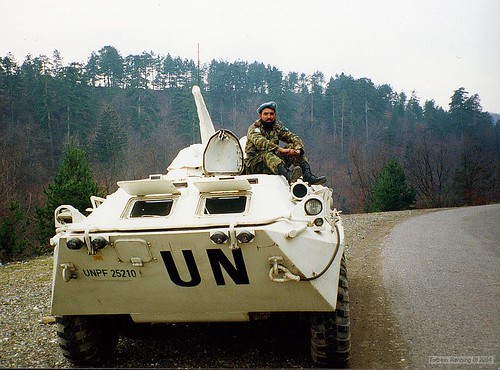
scannet bilde(59)_std, originally uploaded by Torbein.

Years ago, there was a British Army Major on a birding holiday I was on, and at the time I thought how interesting it was to hear him talk about his work, because although the armed forces aren’t exactly secretive, they tend to operate in a kind of parallel world separate from civilian life. Especially since we weren’t involved in any particularly high-profile wars at that point—it must have been just about when Yugoslavia was starting to kick off but before it had pulled in the UN and NATO. Even now, with the Iraq War the biggest political issue of the time, the military aren’t all over the media in quite the way the politicians and pundits are. We tend to get a view of them filtered through all kinds of emotive rhetoric and propaganda, both positive and negative. So the book is interesting just from that point of view, the chance to read a professional soldier’s cool-headed and analytical perspective on the business of using military force.

But the book has a rather more serious purpose than that; it isn’t a memoir, after all. He has a thesis to put forward; basically, that the military—not just the British military, but everyone else’s as well—is set up for doing one kind of job but is called on to do something distinctly different. And that no-one, whether the armed forces, politicians, media or public, has really come to terms with the change yet. So not only is the organisation, training and equipment of the military badly suited to their work, but that everyone around them is having their decisions and judgments distorted by what they think war ought to be like.

The book starts with a historical survey of the development of conventional warfare from Napoleon to the second world war, it terms of changes in tactics, organisation and weaponry, the impact of the railways and so on. War in the form it reached in the two world wars, with the entire industrial capacity of the combatant nations devoted to the war effort, and the military aim of destroying your opponent’s capacity to wage war before he can do the same to you, he refers to as ‘industrial war’.

He also traces the parallel development of guerilla warfare, revolutionary war, terrorism and other kinds of informal warfare over the same period; from Spain in the Napoleonic War, where the word guerilla originated, through the Boer War, the Chinese revolution, WWII resistance movements, Vietnam and so on. He calls these kinds of warfare ‘war amongst the people’.

His contention is that our armed forces are designed to fight an industrial war—against the Soviet Union—and in fact all the conflicts they are involved in are examples of war amongst the people. And not just since the end of the Cold War; for the past 60 years nearly all military engagements have been civil wars, (post) colonial wars, peace-keeping operations and so on; as he points out

the last real tank battle known to the world, one in which the armoured formations of two armies manoeuvred against each other supported by artillery and air forces, one in which the tanks in formation were the deciding force, took place in the 1973 Arab-Israeli War on the Golan Heights and in the Sinai Desert.

Which hasn’t stopped armies buying tanks or even using them; but for the past 35 years, these bits of kit that are supposed to be the technological and military pinnacle of the army’s equipment have not been used to do what they were designed to do. A tank is a fine weapon against another tank, but not very appropriate against a man with an AK-47. The same applies to a modern fighter/bomber; for most contemporary wars it is at the very least hugely over-specified for the job at hand.

IMG_1825-01, originally uploaded by shish0r.

And it’s not just the equipment, but the whole balance of the army. He suggests that we have too many fighting troops as a proportion of our forces, and not enough men trained to gather information. In a situation like Iraq, with non-uniformed enemies fighting in urban conditions among civilians, there’s a limit to how much force you can usefully apply, but you can never have too much information about how best to apply it. Similarly, in an industrial war, liaising and coordinating with the civilian population and civilian organisations is a secondary task and the branches of the armed forces devoted to it are therefore small and unprestigious; in a war among the people it becomes much more complicated and vital to the success of your operations.

If it was just a book about suggested organisational reforms to the army it would still be interesting but it would have less far-reaching implications. Throughout the book the emphasis is less on the business of fighting than the use of force to achieve a goal; the relationship between the military and politics. For me, the take-home message is that war among the people is by its nature political war. I mean obviously all war is political, but in an industrial war, once it starts, the primary objective is a military one and the politics has to serve that aim. If the military is serving a political aim all sorts of things change. For example, ‘winning hearts and minds’ isn’t just a secondary focus that is important because it makes the job of the military easier; it’s the objective that everything else should be working towards. You can’t destroy a guerilla or terrorist ‘army’ by force; you have to create a (political!) climate where they can no longer operate. That means persuading the civilian population that they are better off with you than with the insurgents.

Similarly, both the military and the politicians need to recognise that the military can only achieve military objectives, not political ones. And so because the aims are political, it follows that these wars cannot be ‘won’ by force. Military and politicians need to get out of the mindset of believing that there is the possibility of a military victory that will solve their problem. That doesn’t mean the military has no role, but they have to be subservient to a political aim; they have to be used to help create the conditions for a political solution to be reached. Military victory cannot be an aim in itself.

Anyway, I’ve gone on long enough and I haven’t even touched on all sorts of interesting observations about, for example, dealing with the media, or working within a multinational coalition. I’m not really in a position to assess all his arguments, although they seem persuasive to me, but I found it an immensely interesting book. If anything I’d just say that the historical stuff about Napoleon and Clausewitz and so on in the first half of the book is relatively dry; don’t let it put you off.

n.b. A duplicate of this post appears in my ‘recently read books’ section; I’ve decided that for longer reviews like this it seems silly not to post them on the front page as well. So from now on that’s what I’m going to do.
Categories
Culture Other

Anglo-Saxon names

Teju has a couple of great posts about names and what they mean (1, 2), specifically relating to Yoruba. Which set me thinking about Anglo-Saxon naming.

bit of the Anglo-Saxon chronicle

I have no idea exactly what relationship the Saxons had with their names, and I don’t know what academic work has been done on it—I’m just going on the impression I get from the names themselves—but the names are often easily parseable into combinations of words. Rather than take them from a literary source like Beowulf, here’s a list of names found in a poem which was about fairly contemporary events, The Battle of Maldon. The spellings are adapted somewhat to be closer to modern English pronunciation; i.e. ‘Æscferð’ becomes ‘Ashferth’, ‘Æþeric’ becomes ‘Atherich’.

Offa, Eadrich, Byrhtnoth, Athelred, Wulfstan, Ceola, Maccus, Alfere, Byrhtelm, Wulfmar, Alfnoth, Godrich, Godwin, Godwig, Alfwin, Alfrich, Ealhelm, Leofsunu, Dunnere, Edglaf, Ashferth, Atherich, Sibirht, Gad, Wistan, Thurstan, Wigelm, Oswold, Eadwold, Athelgar.

Now if I say that athel* means ‘noble’ and gar means ‘spear’, it looks an awful lot like ‘Athelgar’ means ‘noble spear’. Here are some other bits of A-S vocab so you can pay along at home:

ash – ash (the type of tree)
byrht – bright
ead – rich, blessed, happy
edg – edge, sword
ferth – soul, spirit, mind
god – good, God
helm – helmet
leof – desirable, pleasant, loved, a friend, a loved one
laf – what is left, remnant
noth – boldness
rich – power or powerful
sunu – son
stan – stone
wulf – wolf

So what happened to all these meaning-full names? Well, the Norman Conquest, basically. Skip forward a couple of centuries and despite English remaining in continuous use, very few of the old English names hung around. A few, mainly associated with saints and kings, are used to this day: Alfred, Edward, Edmund, Harold and Oswald must be the most common, but you occasionally meet a Godwin, Cuthbert or Dunstan.

By the 16th century, about 30% of men were called John, with another 40% called Thomas, William, Richard or Robert. And I believe they were generally named after their godparent, so there wasn’t much room for creativity there. And of the top 50 mens’ names from the 1560s and 1570s on this page, only two, Edward and Edmund, are of English origin rather than French or biblical.

Actually, it’s quite interesting that the Anglo-Saxons didn’t use Bible names; they’d been Christian for several hundred years by the time of the Battle of Maldon.

I doubt if we’re going to have a revival of these names any time soon; most of them sound distinctly harsh to the modern ear. I rather like Ælfric (i.e. Alfrich); apart from the sound of it, there was a man called Ælfric who was a grammarian, translator and hagiographer. According to Bosworth and Toller, ælf is ‘elf, genius, incubus’, so ‘Aelfric’ must be something like ‘elf-power’. Powered by elves? With the power of an elf?

And since ræd means ‘advice, counsel’, Alfred means ‘elf-advised’. That’s the joke in the name Ethelred the Unready, of course. He was Æthelræd Unræd— his name, Æthelræd, means ‘advised by princes’ or ‘noble advice’ and unræd means ‘ill-advised’. So called because it was on his watch that the Danes took over half of England.

*again, strictly speaking that would be æðel. I’m not going to footnote my spelling every time, but similar tweaks apply throughout.