Categories
Culture Nature

Cutting up books

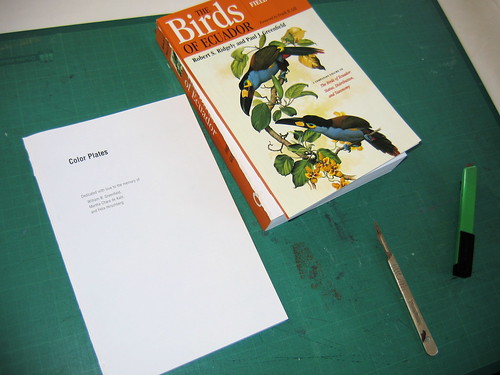
I’m going to the Galapagos and Ecuador on Friday. Or at least, on Friday I’ll only get as far as Quito, but the next day we go on to the Galapagos, and after that, back to mainland Ecuador for a bit. My copy of the ‘field guide’ to the birds of Ecuador was so heavy that I’ve resorted to drastic measures. Especially drastic since those who’ve ever borrowed a book from me could tell you that I’m completely anal about their condition — I like to read them in such a way that afterwards they still look new.

But I cut out the colour plates:
And did an amateurish but hopefully good enough version of re-binding with PVA glue, cardboard and sticky-backed plastic:
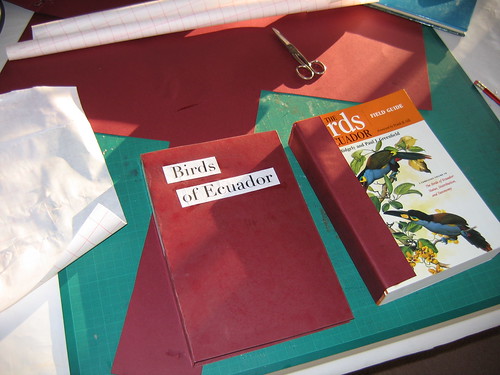
I’ll take both ‘books’ with me, but leave the bigger one in the hotel. I should probably point out that the fact the book is really heavy is no fault of the authors, who seem to have done a brilliant job. There are just too many species; ‘nearly 1600’ in Ecuador, apparently, which puts it in competition with Bolivia and Brazil for country with the most bird species in the world.

And cutting out the plates isn’t an original idea to me, either; it’s standard practice for birders travelling to South America. The region is such a wonderland of biodiversity that even birders aren’t OCD enough about it to risk spinal damage.
Categories
Culture Other

FSotW: Fibre “Quick on the Draw” Drawings

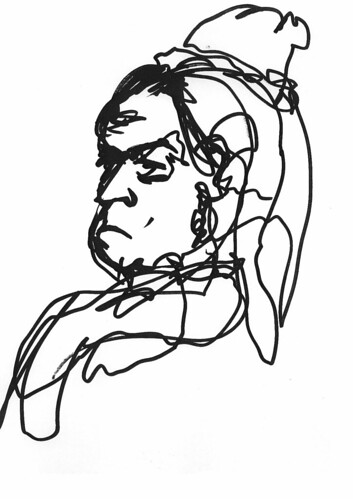
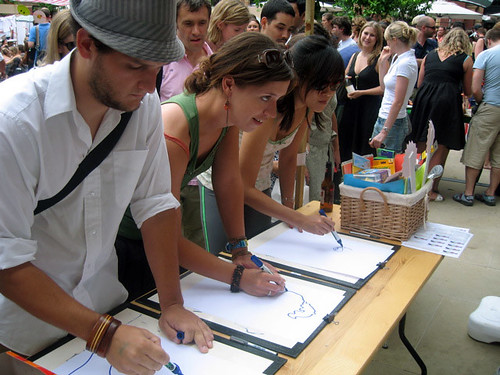
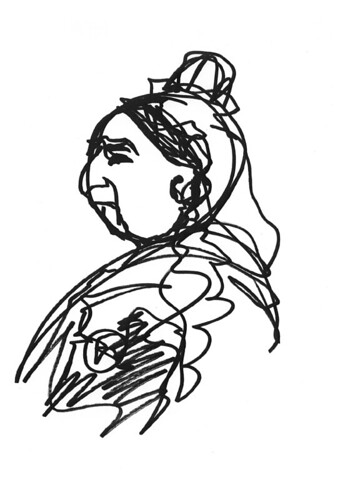
Flickr set of the week is actually two sets; Fibre “Quick on the Draw” Drawings and Fibre “Quick on the Draw”. ‘Quick on the Draw’ was “Fibre’s stall at the 2006 V&A Village Fete. Each artist had one minute to draw a picture of Queen Victoria without taking their pen of the paper.” As usual, you can click on any picture to get to the relevant Flickr page.

Categories
Culture

The Queen

I went to see The Queen last night, which is about the Queen and Tony Blair in the week after Diana’s death. I enjoyed it more than I was expecting.

I couldn’t help thinking that a film about one of the biggest and most relentlessly commented on news stories of the past ten years was unlikely to offer much of a surprise. And it didn’t, really. The details have obviously just been made up, and who knows how close they are to what happened, but the presentation isn’t a particularly radical one. But it was well written, looked great (not least because so much of the action took place either in the Scottish Highlands or royal palaces) and had some amusing moments, mainly to do with the bubble of anachronistic weirdness that surrounds the Queen.

And most of all, I thought Helen Mirren as her Maj and Michael Sheen as Blair both did a good job of presenting them as human and likeable while treading the fine line between acting and doing an impression. There are lots of films that require actors to play famous people, of course, but it must be unusual to play someone quite so familiar who is still alive and still in the news all the time. Sheen was the more like of the two, and captured the newly elected Blair (rather different to the current model), but as a result occasionally strayed close to caricature. I never quite felt with Mirren that I was watching the Queen; there’s not much of a physical resemblance and she avoided doing that strangulatingly posh voice the Queen has. But it worked as a performance anyway. Of course most of the supporting parts are pretty famous too — Philip, Charles, the Queen Mother, Cherie, Alastair Campbell — and so the likeness or, more often, unlikeness of their performances was often a touch distracting. Diana only appeared in archive film and the young princes barely appeared and didn’t have speaking parts. That’s probably a good decision: keep the focus on the Queen and Blair.

At one point in the film, the Queen is watching that awful, coy, manipulative Diana interview with Martin Bashir. Every time I see it it makes my skin crawl, despite the fact that I can’t stand Prince Charles and I think Diana was completely shafted by the system. Who knows what the situation would be like today if she hadn’t died; what she’d be up to, and how well the Royal family would be coping. Even without Diana as a constant presence offstage, I think Charles will find his mother a hard act to follow. There’s so little support for abolishing the monarchy that it feels inevitable that they’ll be around for ever. But perhaps all it would take would be one disastrous incumbent to change the mood; Charles just might have the potential to be that person.

Categories
Culture Nature

Modigliani at the RA

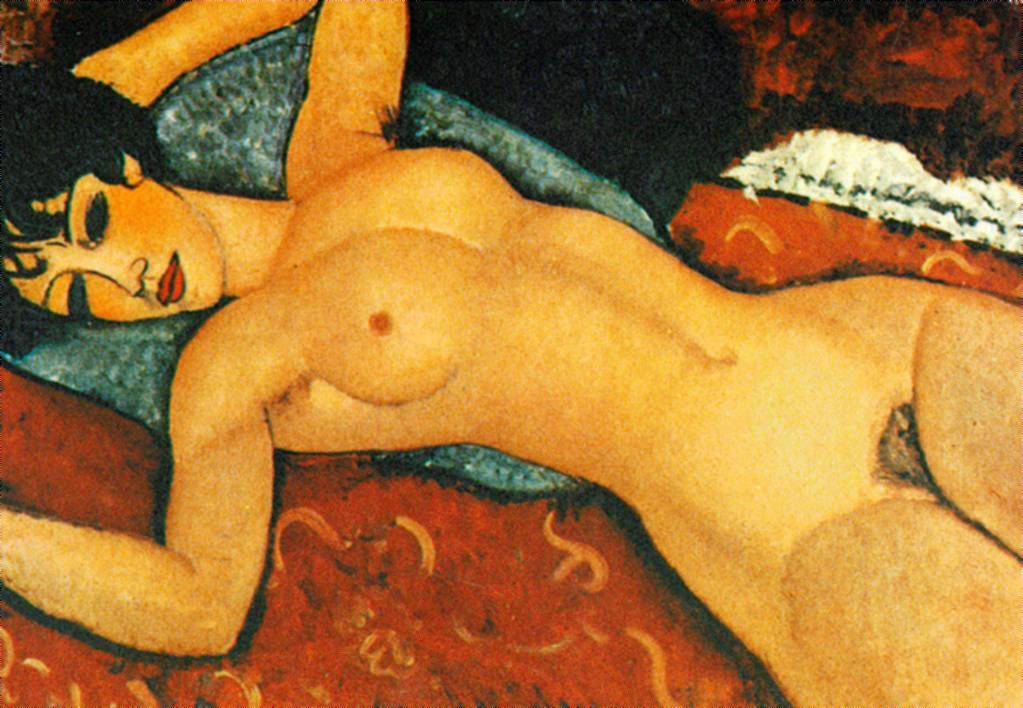
I went to see Modigliani and his models at the Royal Academy today. In a sense, there was nothing very surprising about the exhibition since Amedeo Modigliani only really seems to have painted rather stylised portaits and very pink nudes, including this one of Joan Collins from 1917:

It (she?) looked pinker in real life.

The stylised portraiture is intriguing, because although the basic characteristics were fairly consistent — long neck, rounded shoulders, elongated face — and the paintings all have the Modigliani look about them, the overall effect varied considerably. Some came across as caricature, including this one:

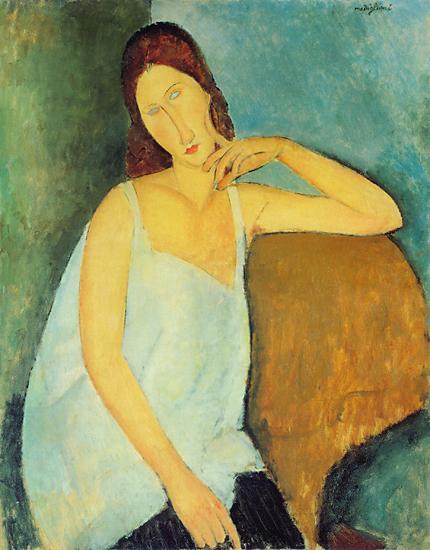
Others have a rather impersonal quality that suggests that the particular model is almost irrelevant, that the subject is just a generic woman. This portrait of his lover/common law wife, Jeanne Hébuterne, seems to me to tend to fall into that category, although not as much as some of his other pictures of her:

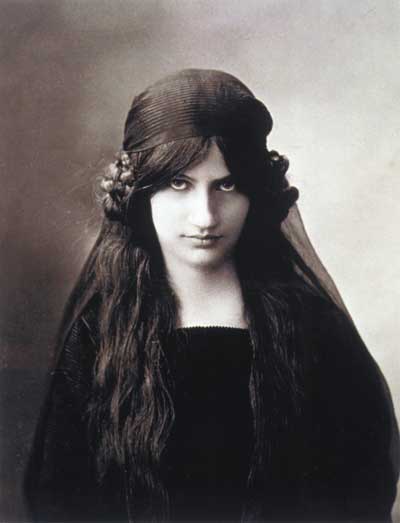
To get a sense of how stylised the portraits are, this is a photo of Jeanne Hébuterne:

Many of the portraits did manage to look like portraits — like they showed a real personality rather than a caricature or a blank —but I didn’t note down any titles in the exhibition and haven’t managed to track down good pictures on the web to use in this post. Which is a bit unfair on Amedeo, but them’s the breaks. I did enjoy the exhibition; the best of the paintings have a real presence to them, and they’re never less than likeable.

The most intriguing of his stylisations is perhaps the blank eyes. Some of his portraits have irises, but most have blank eyes. I can only guess that he chose to leave the eyes blank because otherwise they were too distracting. In that sense they unbalance a portrait.

In Green Park (the nearest tube station) I was amused to see that someone had scratched out the eyes on a movie poster in what I would like to believe was a reference to Modigliani, but was probably just because they were bored. I didn’t have a camera, but here’s a reconstruction:

And finally, a bonus picutre. When googling Modigliani, I discovered Cyclommatus modigliani:

I assume the beetle is named after some other Modigliani — an entomological relative — but you never know, perhaps it was named by an art-loving beetlist.

Categories
Culture Other

David Tennant on ‘Who Do You Think You Are?’

Who Do You Think You Are? is a BBC series where they trace the family history of celebrities. There was a particularly good episode tonight with David Tennant (Doctor Who, among other acting credits). Good both because he’s an articulate, personable man and because they had some good material to work with; one branch of the family were cotters on Mull who were forced to move to Glasgow by the Clearances, and another branch were deeply involved with Protestant sectarianism in Ulster.

Two points spring to mind. One is that the appeal of the program is very much what I was saying about biography: sometimes history seems more vivid when you narrow the focus. You don’t really learn anything new about the Clearances by seeing David Tennant on the site of the town where his ancestors lived and where now there are only some stone walls standing amid the bracken, but it does help you understand the individual human cost.

The other point is that every time I see film of the west coast and islands of Scotland, it looks unutterably beautiful. If there’s a more photogenic place on earth, I don’t know where it is. I really should get up there some time, to see the phalaropes and corncrakes and sea eagles as well as the scenery.

Categories
Culture Other

Biography

I do enjoy reading biographies. Not just to learn more about people I have a special interest in, but as a more entertaining way of reading about history.

There can be something a bit stifling about the careful thoroughness of the conscientious historian trying to lay out all the strands of a complicated subject. The joy of a biography is that it just picks out one strand. The subject’s life offers a route through a period. And even though it’s often a rather erratic and contingent route, it forms a natural narrative.

And because these narratives are immune to certain kinds of criticism, they can be full of the kinds of unexpected twists, bizarre coincidences, heavy-handed irony and acts of heroism or villainy that might seem vulgar in mere fiction. I mean who could make up a character like T. E. Lawrence? Or Emma Hamilton?