Categories
Culture Me

Mutant poetry

Ever since I read Mutants, I’ve been mulling over the idea of writing a group of poems around the idea of mutants and mutation.

The human (and indeed animal) stories – poor old Charles Byrne, freak-shows, the Elephant Man, court dwarves, superheroes and so on – are interesting source material; the science is somewhat interesting and provides extra source material by its connection to natural selection, ontogeny, Chernobyl, teratogens; the general idea of mutation has all sorts of metaphorical possibilties; and the word is attention-grabbing.

One possibility would be a set of ‘mutant sonnets’. The baseline of an established form would allow the formal mutation of the poems to be made apparent. Alternatively, the language could be ‘mutated’ in other ways. And the theme doesn’t have to extend to formal/linguistic considerations at all.

Something to consider. Perhaps a trip to the Hunterian is in order.
Categories
Culture Nature Other

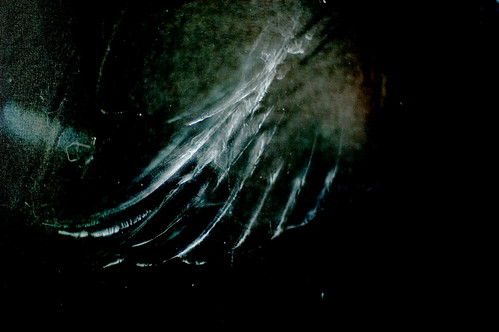
Birdstrike wing

A photo my brother took of the mark left by a bird hitting his window. You can see the whole bird in this one.


Birdstrike wing

Originally uploaded by rutherfordfamily.

Categories
Culture

Mask of the Week

From the British Museum site, which is a goldmine of fabulous images, the death mask of Oliver Cromwell:

The BM’s blurb seems worth quoting in full.

When a famous person died, a death mask was often taken as a permanent and precise record of the way they looked. An initial cast provided a mould from which subsequent plaster or wax death masks could be taken. Death masks were widely distributed through private and public collections and were also used as models for posthumous portraits, whether painted or sculpted. This example was originally owned by Sir Hans Sloane (1660-1753) whose collection contributed to the founding of the British Museum in 1753.

It was important that a death mask was made as soon as possible after death so that the character of the deceased was captured before the features started to fall. The death mask of Oliver Cromwell (1599-1658) was taken after the embalmment of his body and it shows the cloth bound around his head to cover the cincture. The face has a beardlet and moustache, but Cromwell’s famous wart has either been pared off or has disappeared due to the action of the embalming fluid. Several casts of Cromwell’s death masks exist. Although the identification of this example has been questioned, it certainly entered the Museum as a representation of Cromwell. Cromwell was initially buried in Westminster Abbey but his body was exhumed after the Restoration and hung on Tyburn gallows and his head was displayed on a pole. Apparently, his head was later sold many times until it came into the possession of the Wilkinson family in the nineteenth century. It was finally buried in a Cambridge college in the 1960s.

Categories
Culture

‘The Sorceror’s Apprentice’ by Tahir Shah

I’ve just finished The Sorceror’s Apprentice by Tahir Shah. It’s the (apparently) true story of his journey to India to learn the secrets of magicianing. It feels a tad embellished to me, but it makes an entertaining read nonetheless. Or because.

Categories
Culture Other

Adult film posters (and some other stuff)

Adult movie posters, via we make money not art, who got it from Camp Heatwole.

edit: more linkworthiness. Dazzle painting, via gravestmor. It’s worth looking at the pictures and clicking on the links in the dazzle article.

further edit: Bangladeshi rickshaw art, via Metafilter.

and still more: Crop Art, also via Camp Heatwole.

Categories
Culture

Mask of the Week

Busó costumes:

Busó is apparently a festival to mark the start of spring in Mohács, a town in Hungary.

“According to the oral tradition, the Busó who crossed the river on boats chased the Turkish away from the area of Mohács in 1687. This has never been proven but possible since it is well known that the Turkish are very suspicious and the frightening Busós looked like the devil especially when the Turkish saw an army of them. According to traditions, the Turkish fled in panic when they saw the horrible army.”